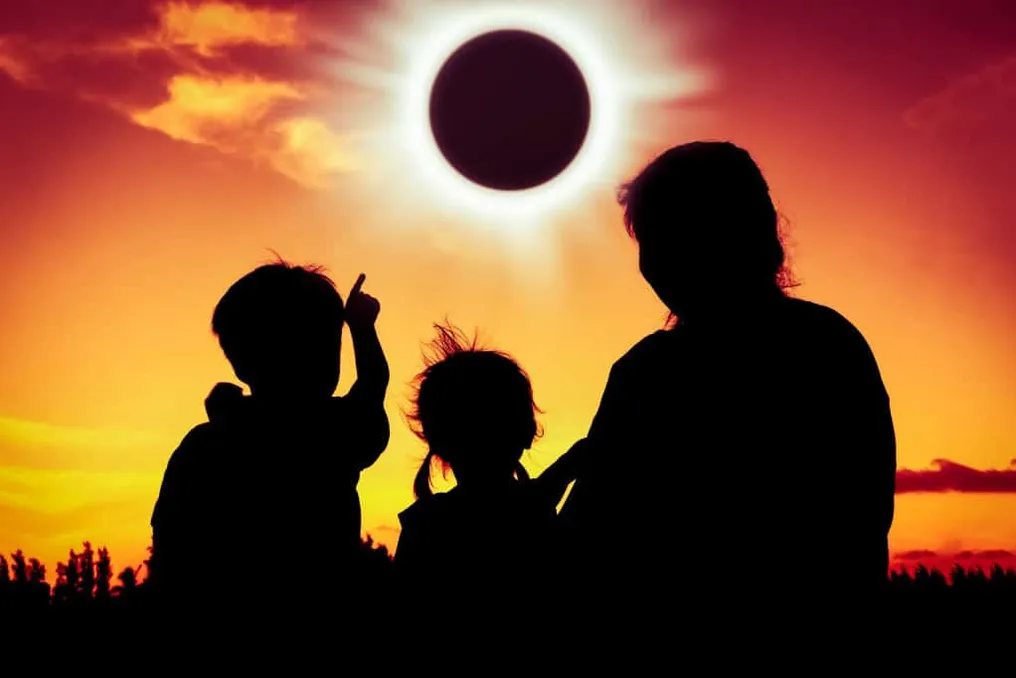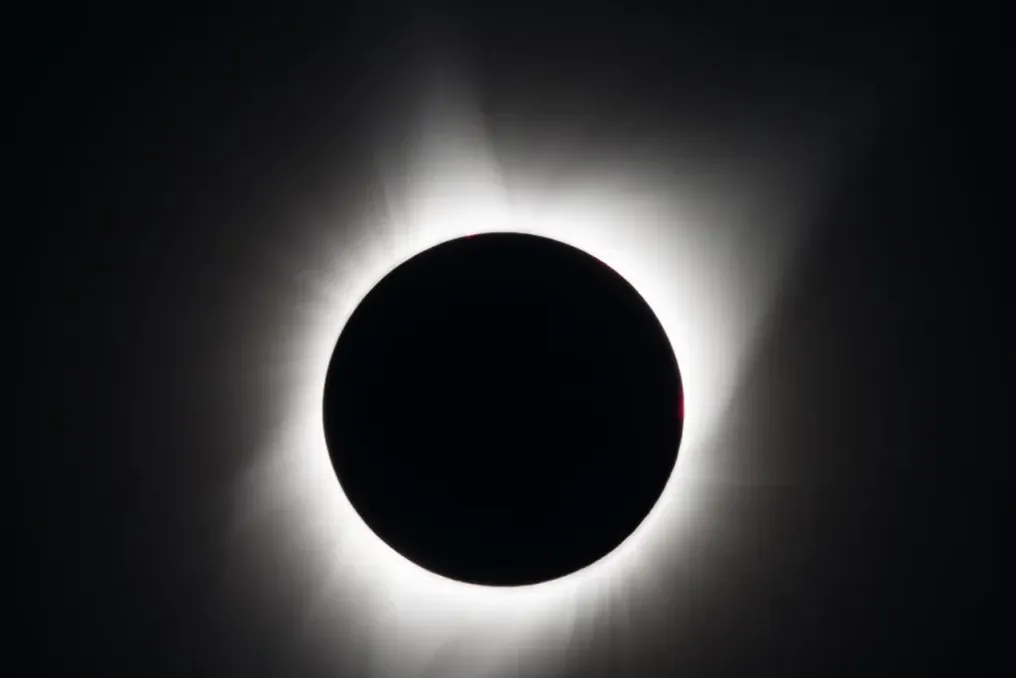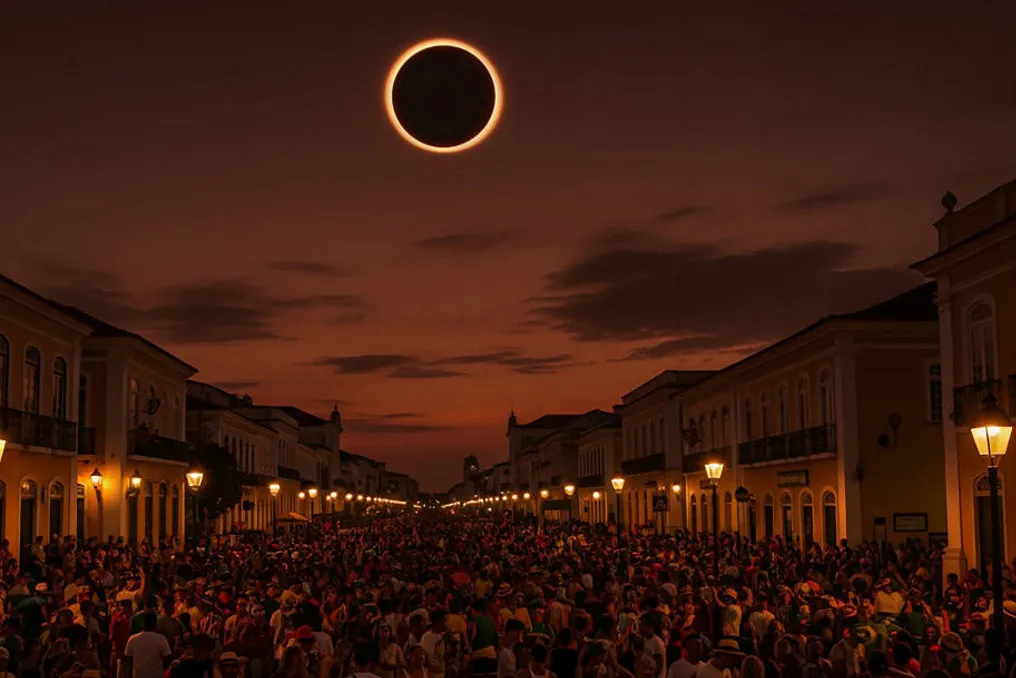
During Science Week, various astronomical and geophysical phenomena were reported, including a total solar eclipse observed in parts of Europe, such as mainland Spain, where such an event had not been seen since 1905.
Total solar eclipses are considered rare phenomena; NASA estimates that a region of Earth might wait between 375 and 400 years for a total eclipse, although this interval is not fixed. The occurrence depends on the size of the umbra, the Moon's darkest shadow, which generally measures between 100 and 200 kilometers in width, forming a narrow path of totality.
The distribution of these paths follows the Saros Cycle, which repeats in cycles of approximately 18 years, 11 days, and eight hours. This dynamic explains the variation in time between eclipses in different locations, such as Carbondale, in the United States, which saw eclipses in 2017 and 2024, and London, in England, which waited 837 years between 878 and 1715.
The next total solar eclipse will occur on August 2, 2027, covering parts of Spain, North Africa, the Middle East, and the Indian Ocean, including Morocco, Algeria, Tunisia, Libya, Egypt, Saudi Arabia, Yemen, Somalia, and Gibraltar. In Brazil, however, the event will be minimal, with only a small area of Rio Grande do Norte registering a partial eclipse between 5:12 and 5:38 AM Brasília time, covering less than 1% of the solar disk.
The last time Brazil witnessed a total solar eclipse was on November 3, 1994, and the next opportunity is scheduled only for August 12, 2045, when the path of totality should pass through the North and Northeast, reaching cities such as Belém, São Luís, João Pessoa, and Recife.
Additionally, there are other upcoming events: an annular eclipse, known as the 'Ring of Fire,' can be seen in part of Brazil on February 6, 2027, and a partial solar eclipse will occur on August 2, 2027.
Regarding eclipse types, the difference lies in the distance of the Moon: in a partial eclipse, only a fraction is covered; in an annular eclipse, the Moon is farther away and leaves a visible luminous ring; and in a total eclipse, it completely hides the Sun for those in the umbra, revealing the solar corona. There is also the hybrid eclipse, which varies between annular and total depending on the point of observation.
The change in eclipse dynamics is caused by the Moon's distance from the Earth. Due to the elliptical orbit, the distance varies between about 356 thousand kilometers at perigee and more than 406 thousand kilometers at apogee. Measurements confirm that the satellite is moving away by an average of 3.8 centimeters annually, a result of gravitational interaction and tidal forces.
Other topics addressed include climate forecasts, where NOAA raised the probability of a very strong El Niño between October and December 2026 to 95%, and the discovery of a 'black hole star' by MIT astronomers, observed by the James Webb.
The Perseid meteor shower, visible annually between mid-July and the end of August due to debris from comet 109P/Swift-Tuttle, peaked between the night of Wednesday (12th) and the morning of Thursday (13th). Thanks to the new moon phase, visibility was favored, being observable in Brazil, albeit on a smaller scale.
Finally, the South Atlantic Magnetic Anomaly, an area of lower intensity of the Earth's magnetic field over part of South America and the South Atlantic Ocean, is a focus of scientific interest due to its impacts on space exploration and its proximity to Brazilian territory.