The entire country celebrated the occasion of the 80th anniversary of independence. The Prime Minister addressed the nation's youth from the Red Fort, outlining the concept of a developed India. However, concurrently, young people and children are demonstrating their demands, asserting their rights through their own methods. The persistence of Generation Alpha and their loud slogans send a new signal about the strength of democracy, forcing the state system to realize that the voice of children can no longer be ignored.
When ministers came themselves to listen to students
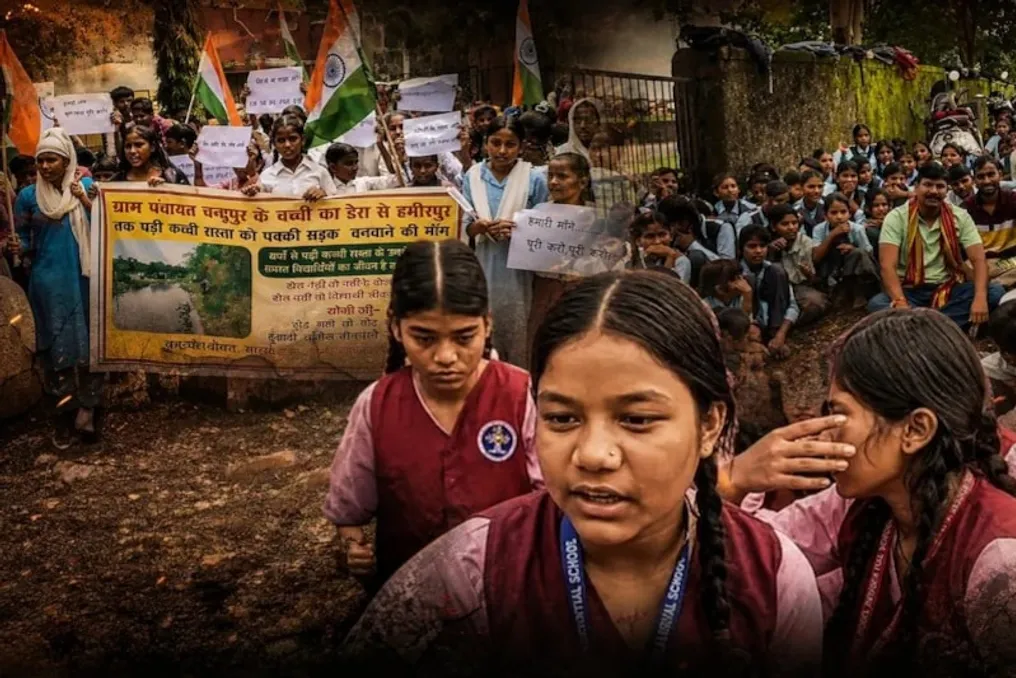
In Lucknow, Uttar Pradesh, Gen-Alpha students took to the streets to demand their rights. Students from Jai Prakash Narayan Sarvodaya School, located in the Mohan Road area and under the Department of Social Welfare, blocked the road. They protested against serious issues such as poor nutrition in hostels, constant detection of insects in food, lack of medical treatment for illnesses, and teacher shortages. When the school administration failed to respond to these complaints, the students took to the streets.
Given the seriousness of the situation, the UP Social Welfare Minister, Asim Arun, immediately arrived at the protest. He stated that he wanted to hear their grievances. As soon as the minister appeared on site, the students cleared the road and were able to openly present their problems. This proves that today's children understand both their constitutional rights and their responsibilities well.
The administrative apparatus woke up when it was locked in a room in Kannauj
Another unique scene emerged from Kannauj, also in Uttar Pradesh. Instead of taking to the streets to solve problems, students from Jawahar Navodaya Vidyalaya decided to lock themselves in one room. To conceal their identities, they covered their faces and locked themselves in a classroom to prompt action from the administration. Upon receiving information, the District Magistrate (DM) of Kannauj, Ashutosh Mohan, arrived at the scene and listened to the students' complaints. These children had read about protests in civics textbooks, and today they are advocating for their rights in a democratic manner for the first time.
Questions asked directly to officials in Alwar
Female students from the Government Higher Secondary School in the village of Jodhavas, located in Tanagaji block of Alwar district, Rajasthan, presented a new model of behavior to the officials. The school had only five teachers over four years and lacked a sports ground. Concerned by this, the female students filed complaints with the SDM and Collector but received no response. The students stood before the officials and asked direct questions. They asked if they would teach children in such conditions if they were their own children? Following this protest, the administration reacted immediately: seven new teachers were appointed, and steps were taken to resolve the children's issues.
Students took to the streets in Madhya Pradesh to reduce bus fares
In Vidisha, Madhya Pradesh, dozens of female students began loudly chanting slogans at the Seronj bus stand, holding school bags and uniforms, demanding a reduction in bus fares. They actively protested against the increase in travel charges. After the students' protest, the administration was forced to concede and take action according to their demands.
A similar situation occurred in Ujjain, Madhya Pradesh. More than 700 girls from Sarfa Kanya Higher Secondary School staged a sit-in protest near the Collector's office, protesting the merger of the school into a secondary institution. The girls argued that the new school was too far away, making it difficult for them to commute. Nevertheless, the Director of Education visited the site and listened to their complaints.
These scenes coming from different states across the country prove that despite all government efforts, the basic infrastructure of education remains weak in many places. Take, for example, the case of Mohanlalganj in Uttar Pradesh, where there is a huge disparity between two schools in the same area. In one school, classes are conducted using a digital LED projector, while in another school, there is no water even in the toilet.
This is why today's Generation Alpha children, instead of silently enduring, ask questions directly to officials and ministers regarding their education and learning conditions. This firmly confirms that every child in India fully understands their democratic rights and responsibilities.