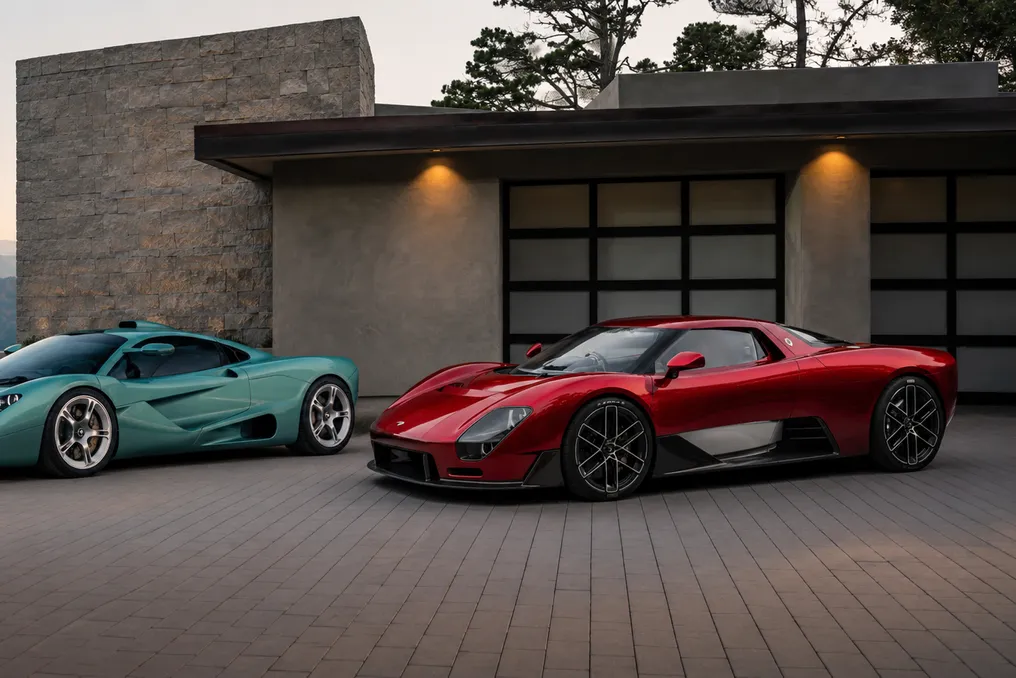
Annually in August, a coastal area of California transforms into the global automotive epicenter during the Monterey Car Week. This event is not a single gathering, but rather a set of parallel activities held in the southern part of Monterey Bay, with traditions established since 2014.
The week usually begins with the Rolex Monterey Motorsports Reunion, followed by The Quail, and concludes with the Concours d’Elegance Pebble Beach. All of this is complemented by auctions from the largest global houses, private gatherings, and smaller events promoted by automakers and sponsors.
However, the 2026 edition presents a notably larger volume of significant new features, which raises questions about the current direction of the industry. There is a trend observed of daily releases of electric and electronic vehicles, which tend to turn the driver more into a passenger, standardizing cars and obscuring the intrinsic value of these machines.
In the past, automobiles evoked feelings through the sound of the engine or the absence of it, the interior and exterior design, and the essential function they served in daily life. Today, this machine has become so common that we have lost the perception of the power it offers—the ability to travel longer and faster than the human body allows.
This trivialization can be seen as an inevitable way to democratize access to this power without causing urban chaos, especially in a context where basic mobility is neglected. However, human nature demands contrasts; pleasure depends on suffering, and emotion requires boredom. Without these opposites, everything loses meaning, just as life loses meaning without death.
The automobile reflects this by gradually eliminating effort, noise, vibration, and the need for active driver participation. It is precisely in this scenario of perfect, silent, and predictable cars that original mechanical vehicles become highly desirable again, transforming into a luxury niche accessible to those seeking to escape the anesthesia of modern models.
While until the mid-last decade a supercar needed to surpass its predecessor in terms of modernity and capability—such as the Bugatti Chiron versus the Veyron—today technical limits have been reached. It has been discovered that fulfillment lies not in the peak of speed, but in small daily experiences.
Therefore, new supercars no longer need to be extreme hypercars. They are designed to provide satisfaction in every start and drive, even on simple trips. Automakers are thus using current technology to revive characteristics of past eras, reinterpreting old concepts without the technical restrictions of the time.
This explains the strong presence of historical references in this year's launches: not just visual inspirations, but entire cars conceived around mechanical designs and solutions from decades ago. After all, truly perfect machines require human imperfection, such as the need for manual gear shifting or maintaining control by the driver.
Gordon Murray S1
The first vehicle on this list perfectly encapsulates this philosophy. Last year, Gordon Murray presented the S1 LM in Monterey, an extreme project from the newly created Gordon Murray Special Vehicles. This model was a reinterpretation of the formula Murray has followed since returning to production under his name: low weight, naturally aspirated engine, manual gearbox, and total focus on driver interaction.
The S1 LM was made to celebrate the 30th anniversary of the McLaren F1 GTR's victory at the 1995 24 Hours of Le Mans. With only 957 kg, a 4.3-liter Cosworth V12 producing 720 hp, competition aerodynamics, and limited production to five units, one example sold for US$ 20.6 million, a record for a new car at auction. A year later, Murray returned to The Quail with the S1.
The S1 maintains the basic architecture of the S1 LM, including width, track width, and suspension concept, but eliminates the large aerodynamic appendages, increases the ride height by 10 mm, and adjusts the calibration for road use. Furthermore, the entire bodywork has been redesigned, and part of the aerodynamic work has migrated to active elements integrated into the design, focusing on mechanical grip rather than aerodynamic load.
Without the fixed wing and prominent splitter of the LM, its proportions resemble more of a street supercar. While the S1 LM referenced the McLaren F1 GTR, the S1 evokes the original 1992 street F1, with solutions such as low-slung wheels and auxiliary headlights inspired by a Monaco prototype.
Above the three occupants, there is a specific 4.2-liter, naturally aspirated Cosworth V12 producing 680 hp. The technical highlight is the redline at 12,100 rpm, achieved with lightweight silicon carbide pistons, titanium valves and connecting rods, and dry sump lubrication. The adaptation for long distances allowed 80% of the torque to be available from 2,500 rpm.
The only available gearbox is a six-speed manual, with sixth gear being standard with an elongated ratio for touring, and the mechanism features cables with a more direct path for greater lever precision. Despite incorporating comfort items such as sound insulation, better seats, leather trim, and audio system, the obsession with weight control kept the S1 below 1,000 kg.
Steering features adjustable assistance for different levels of road use, and the suspension was recalibrated to prioritize mechanical grip on real pavement, not just on circuits. In terms of performance, the S1 does not seek speed or electric power records, relying on its 680 hp to move less than a ton.
The creation of Special Vehicles by GMA is justified by the need to operate outside the standard formula of regular models, allowing for smaller and unique projects, often originating from orders or Murray's ideas. Only 64 examples will be produced, all customized, and all units are already reserved.
McLaren MCL 6GT
If the S1 refers to the McLaren F1, McLaren itself revisits what existed before the F1 with the new MCL 6GT. In 1969, Bruce McLaren envisioned transforming a race car into a street vehicle, using the Can-Am M6A as a base, adapting it with a closed body, windshield, and doors for off-track circulation. This prototype, called the M6GT, became Bruce's personal car, used on public roads.
Although there were plans for a small series of the M6GT in collaboration with suppliers, Bruce died in 1970 before this plan could be realized. McLaren would not launch its own street car for over twenty years later, with the F1. Now, 56 years after the founder's death, the company has resumed this initial project.
The MCL 6GT is not an exact replica of the original M6GT. Its connection lies in the proposal to bring elements of a racing car to the street without compromising daily practicality. There are direct visual references to Bruce's car, such as the red paint, the headlights, the taillights, the dihedral doors, and certain body details near the side air intakes.
At the launch, McLaren displayed the new MCL 6GT alongside the original M6GT and also showed engineering drawings from 1968 referring to the production version that never came to paper. This signaled the intention of continuity between Bruce McLaren's interrupted project and the vehicle the company plans to make available starting in 2028. This continuity is also evident in the center console gearbox, as the MCL 6GT will be the first McLaren with this feature.