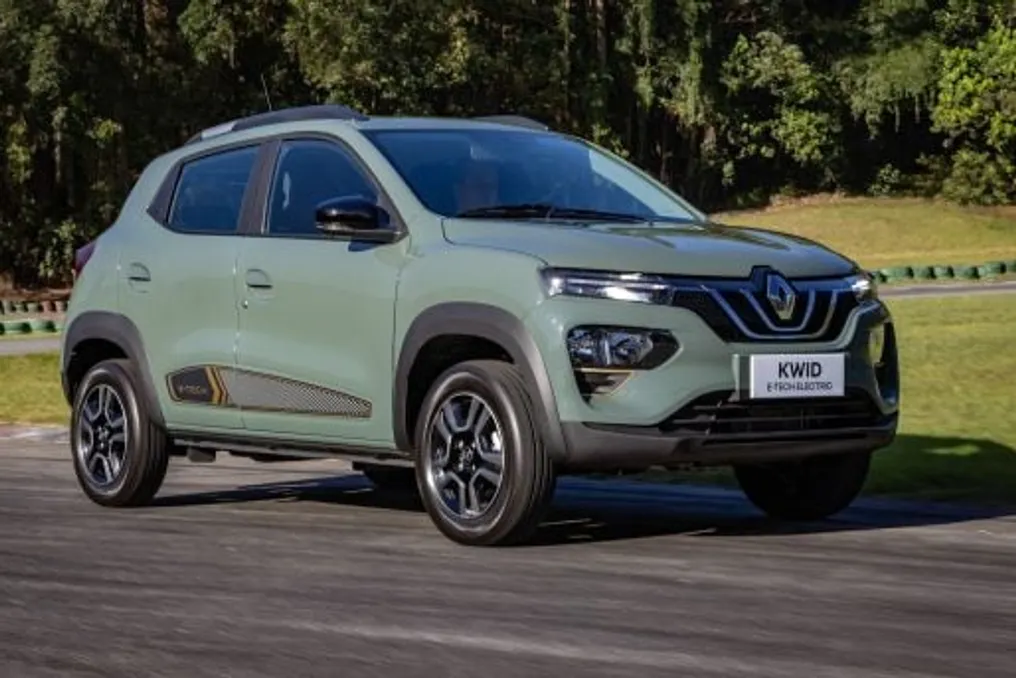
The Renault Kwid E-Tech established itself as a competitive electric vehicle in the Brazilian market, being one of the first fully battery-powered models to fall below R$ 100 thousand. Although it was one of the most affordable electric cars in Brazil, its time on the market was relatively short.
This subcompact was introduced in Brazil in September 2022, imported from China. At the time, it held the title of the cheapest electric car in the country, with an initial price of R$ 142,990. Its launch coincided with the brand's vehicle subscription service, Renault On Demand, which already included this small electric car.
Visually, the Kwid E-Tech presented distinctions compared to the Kwid flex, notably in the front grille and wheels, which had four holes versus the three on the flex model.
Model Updates and Changes
In October 2025, Renault presented the renewed version, named the 2026 line of the Kwid E-Tech. This update brought several driving assistance features and an aesthetic redesign inspired by the European Dacia Spring. The design incorporated more rectilinear lines on the front, a dark grille with raised bars, and the new logo of the French brand. The headlights were also redesigned, and the LED daytime running lights adopted the characteristic 'Y' shape.
At the rear, the vehicle received a black horizontal strip over the tailgate, which integrates with the LED taillights, which also received new internal sections. Internally, an electronic instrument panel, a multimedia center with a raised screen on the dashboard, and a joystick-style gear lever, similar to the one used in the Kardian, were added. However, these modifications were brief, as the car stopped being imported in May 2026.
Performance and Technical Specifications
Despite weighing 977 kg, the electric motor, which generates 65 hp and 11.5 kgfm, allows the Kwid E-Tech to navigate the city with some agility. Initial accelerations are instantaneous, typical of electric vehicles. Reaching 50 km/h is fast, taking 4.1 seconds, according to manufacturer data. However, subsequent acceleration is slow, requiring 14.6 seconds to reach 100 km/h, reinforcing its focus on urban use.
The propulsion system uses lithium-ion batteries with a capacity of 26.8 kWh. According to the PBEV/Inmetro cycle, a full charge allows for 185 km. Regarding charging time, Renault states that using common 220V grounded domestic outlets, the process takes 9 hours. Using Wallbox units, charging from 20% to 80% is completed in 3 hours, and with DC chargers, this same percentage interval requires 45 minutes.
Adaptation and Driving Dynamics
A notable aspect of the Kwid E-Tech is that it does not have an architecture specifically designed for electrification; it is a car originally conceived for an internal combustion engine that was adapted to receive the electric powertrain. This adaptation directly impacts the vehicle's dynamics. The batteries located under the rear seat affect the center of gravity. Like the Kwid flex, the electric version shows instability on roads above 90 km/h and is sensitive to crosswinds.
In curves, the inherent fragility of the subcompact manifests, as the body exhibits higher torsion than expected for a vehicle with only 2.43 meters of wheelbase. The car measures 3.70 meters and is homologated for four occupants. The driving position is considered inadequate, potentially causing ceiling contact for drivers taller than 1.75 meters and impairing visibility. In the rear seat, leg and knee space is restricted, and a raised tunnel remains in the floor, a characteristic inherited from the combustion engine vehicle design. The trunk offers a capacity of 290 liters.
Additional Features and Market Comparisons
The Kwid E-Tech presents unusual features in electric cars, such as a lever-operated handbrake and a physical key to start the engine, unlike most competitors that use electronic parking brakes and button start. The electric power steering is very light, and the turning radius of 9.60 meters, combined with its reduced dimensions, facilitates the maneuverability of the Renault Kwid E-Tech.
Acoustic comfort is provided by the absence of vibration from the three-cylinder flex engine, although wind noise can penetrate the cabin. The finish, despite improving in the 2022 update, remains an area for improvement. The suspension has a firm calibration, even when compared to the combustion Kwids. Conversely, the hatchback does not exhibit excessively soft behavior when passing speed bumps and potholes, something common among many Chinese rivals.
Initially, with a price of R$ 142,990, it was more accessible than the JAC E-JS1 (R$ 164,900). It lost the title of the cheapest electric car after the launch of the Caoa Chery iCar for R$ 139,990, although the Renault was better equipped. Later, BYD launched the Dolphin for R$ 149,800, initiating an intense price war. Caoa Chery and JAC reduced their prices to less than R$ 120 thousand, while Renault maintained its stable price.
When there were rumors about the launch of the Dolphin Mini in 2024 with a price below R$ 100 thousand, Renault reacted by lowering the price of the Kwid E-Tech to R$ 99,990. The BYD rival, meanwhile, was launched for R$ 115,800. Currently, the Renault Kwid E-Tech Techno 2025/26, still under warranty, can be found for R$ 89,565 at KBB Brasil store and R$ 80,608 privately (August 2026 data).
Safety and Sales
This latest version of the Kwid E-Tech is equipped with a robust suite of driving assistance, including ACC, autonomous emergency braking, blind spot monitoring, fatigue alert, license plate recognition, and lane assist. These are rare or non-existent features in combustion compact hatchbacks and even in entry-level Chinese electric vehicles. In terms of passive safety, it features six airbags, front and rear parking sensors, and a reverse camera. The interior is complemented by a 7-inch electronic instrument cluster, a 10-inch multimedia system, digital air conditioning, and an electric trio.
Despite its excellent cost-benefit ratio and having been the cheapest electric car in the country, the Renault Kwid E-Tech did not achieve great sales success. Its best performance occurred in 2025, with over 1,600 registrations. Over the nearly four-year period, the car registered a total of 3,870 units sold. The vehicle offered three years of warranty, and the batteries had eight years or 120,000 km coverage. At its debut, the manufacturer promised maintenance services at half the cost of maintaining the combustion Kwid.
Owner reports on forums and the Reclame Aqui website indicate that the most frequent complaints about the Renault Kwid electric relate to specific vehicle issues.