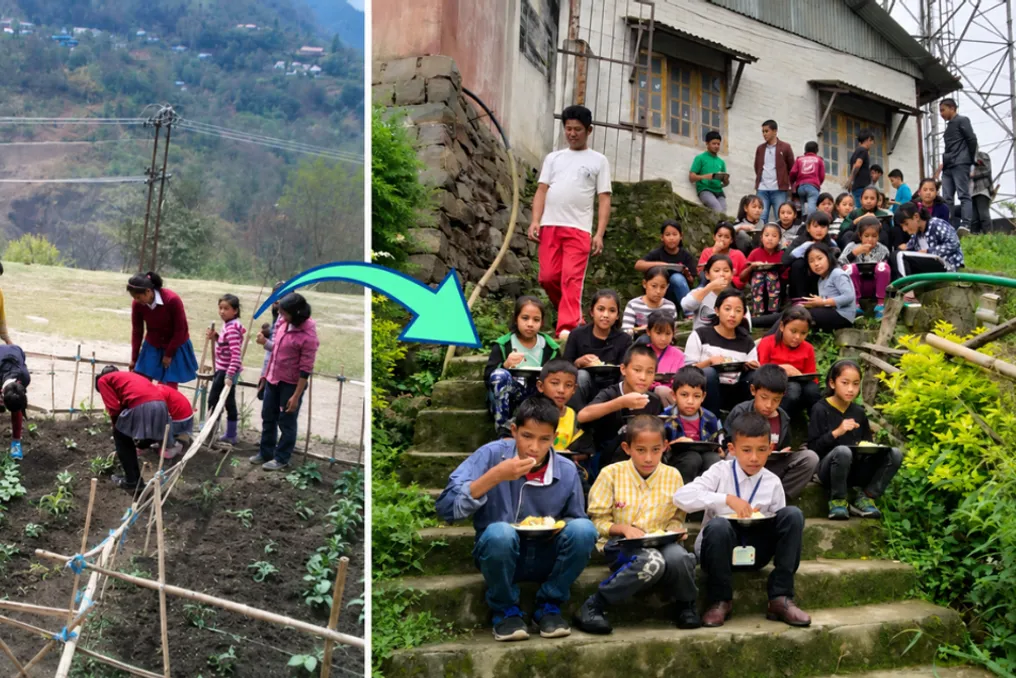
At K Khel Middle School in Visvema, Nagaland state, lunch begins right in the school garden. About sixty students at this school grow vegetables that are then taken from the ground directly onto their plates. Children participate in all stages: they help clear the land, plant seeds, water the beds, remove weeds, and make organic fertilizer. This garden has been part of their educational process for over ten years and is now included in their daily meals.
While school lunches often become subjects of negative criticism, this school's example raises a broader question: what should nutritious school food look like, and how can we ensure every child receives it?
Garden Next to the Classroom
Recent videos have brought attention back to this issue. A viral video appeared in the Sitapur district of Uttar Pradesh, allegedly showing children being served thin potato curry with burnt rotis. After these videos went viral on social media, the principal was suspended, the cook was fired, and a police report was registered. Action was also initiated against a senior education official for supervisory shortcomings.
Last year, another video from a government school in Odisha showed children being served boiled rice, thin curry, and a boiled egg as part of the school meal program. Such incidents highlight the need to strengthen oversight of the program designed to ensure children do not go hungry while studying.
In Visvema, a village of about 7,500 people in the Kohima district of Nagaland, one government school has linked eating to the surrounding land for years. This village is known for its pottery and mountainous landscape, and terraced farming has long been part of the local agricultural experience. In K Khel Middle School, agriculture has also become part of the children's education.
The school started a small garden in 2011, initially with the goal of encouraging gardening as a hobby and extracurricular activity. It later began using vacant plots around the school to grow vegetables for student lunches. Today, students in grades 1 through 8 grow beans, cabbage, pumpkin, squash, pomegranate, and lemons, as well as tubers and herbs. Corn and Naga-dal are the main crops, while mustard is grown in a small plot as a seasoning. The harvest is used in the children's meals.
Head teacher Kenaisenu Witsu states that the idea was based on teaching children practical agricultural skills. In an interview with The Better India in 2020, Witsu said: 'It all started in 2011. We decided to teach children organic farming to instill in them skills and knowledge in agriculture.' She added that this activity also helps children understand the value of labor and appreciate the environment. The first plot was a wasteland. Under the guidance of teachers, students cleared and leveled it, removed weeds, and prepared green manure using organic waste collected from their homes. Organic farming continues to be part of the school's Environmental Club. Students study cultivation alongside environmental conservation, and intercropping helps maintain soil health, improve water retention, and increase yield.
What Should School Food Provide?
The school meal program, now known as PM POSHAN (Pradhan Mantri Poshan Shakti Nirman), provides one hot cooked meal per day to children in grades 1 through 8 in government and government-aided schools. For children in grades 1 through 5, each meal must contain 450 calories and 12 grams of protein, as well as 100 grams of grains, 20 grams of pulses, 50 grams of vegetables, and 5 grams of oil or fat per child. For students in grades 6–8, the requirements increase to 700 calories and 20 grams of protein, with 150 grams of grains and prescribed amounts of other components. These nutritional standards form the basis of the school meal program. And the kitchen garden can add something special: the opportunity for children to understand how food is grown and what goes into its preparation.
From Garden to Plate
At K Khel Middle School, this learning happens through direct experience. Students observe how seeds turn into vegetables, learn how soil and seasons affect growth, prepare fertilizer from organic waste, and understand the effort required to grow food. The kitchen garden will look different in each school, depending on available land, climate, and resources. Visvema offers a simple idea that could spread much wider: nutrition education can begin long before lunchtime. For these sixty-plus students, it starts with a small patch of land next to the classroom, a few seeds, and the experience of watching what they grew eventually end up on their plates.