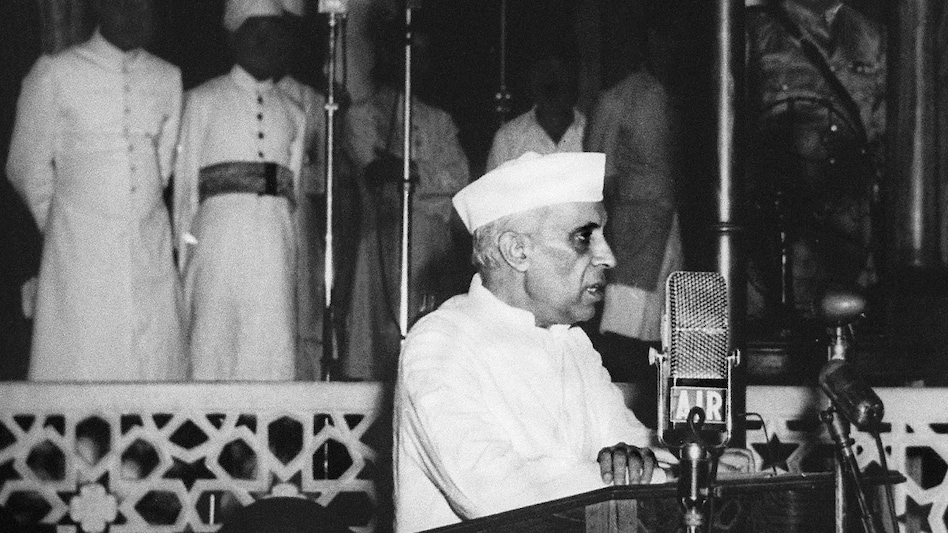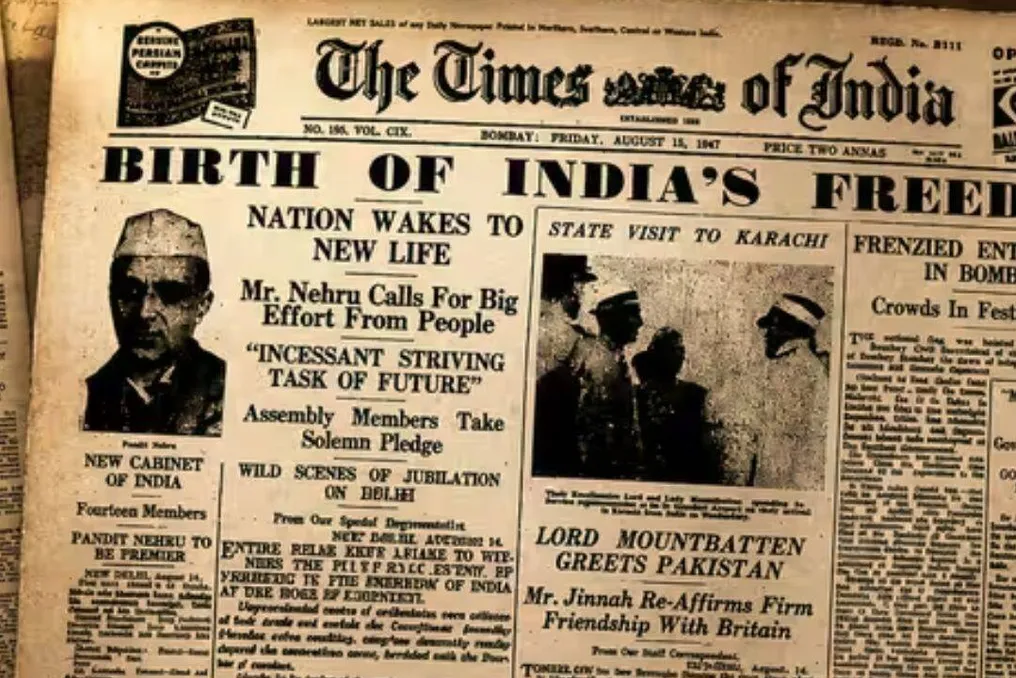
At the stroke of midnight, while the world slept, India awoke to life and freedom. This historic moment marked the transition from the old to the new, the end of one era, and the gaining of a voice for the long-suppressed soul of the nation. In this solemn hour, a promise was made to dedicate oneself to serving India and its people, as well as the broader cause of humanity.
These words were spoken by the first Prime Minister of Independent India, Jawaharlal Nehru. The change of date from August 14 to August 15, 1947, officially brought an end to nearly two centuries of British dominion, and India became a sovereign state.
However, midnight was not the culmination of the entire process. The first hours of freedom brought elation, ceremonies, and celebration, but also immense responsibility for governing the new country. The government had to begin functioning, the state machinery required inheritance and reorganization, and millions of people were involved in the upheavals caused by Partition.
The new nation celebrated its freedom with flags, crowds, prayers, and speeches. Nevertheless, alongside the festivities, refugees were moving, communal violence was spreading, and India's final borders remained undefined.
The story of India's liberation began long before midnight. On the evening of August 14, members of the Constituent Assembly gathered in New Delhi for a historic session that was set to be the moment of power transfer. The assembly, which had been working on India's constitutional future, was preparing to become the central political institution of the sovereign state.
Just before midnight, the realization hung in the air that the date was about to change. Then Nehru spoke. His speech, later known as the 'Tryst with Destiny,' transformed the formal transfer of power into a moment of national mythology. He spoke of emerging 'from the old into the new,' of the end of an era, and how the 'soul of the nation' finds expression after a long period of oppression.
This was only the beginning. In his message to the nation, published on August 15, the Prime Minister described India as 'awakened, alive, free, and independent,' but immediately addressed the duties that accompanied freedom. It was necessary to fight poverty, ignorance, and disease; it was necessary to build democratic and social institutions; and political freedom had to transform into opportunities for the common people.
This distinction is critically important for understanding the first day of India as an independent country. The midnight ceremony was not just a celebration of Britain's departure; it was the first public act of a government that suddenly found itself needing to govern.
Even before the midnight ceremony, Nehru announced a cabinet that would take over governance from August 15. According to the announcement, Nehru would oversee foreign affairs and relations with the Commonwealth in addition to his duties as Prime Minister. Vallabhbhai Patel took charge of internal affairs, information, and broadcasting, as well as states. Rajendra Prasad was responsible for food and agriculture. Maulana Abul Kalam Azad received education. Baldev Singh handled defense. B. R. Ambedkar took jurisprudence. R. K. Shanmukham Chetty managed finance, and Rajkumari Amrit Kaur received healthcare, among other portfolios.
Why did India gain independence on August 15, 1947? The choice of August 15 was not in India's original independence schedule. The British government had initially planned the transfer of power for June 1948, but Lord Louis Mountbatten, the last Viceroy of British India, moved this date forward by almost a year.
One reason, as he explained later, was the need to prevent further unrest, protests, and bloodshed amid the deteriorating political and communal situation. But the date also held personal significance for Mountbatten. August 15 was the second anniversary of Japan's surrender to the Allied powers in 1945, marking the end of World War II. As Supreme Allied Commander of Southeast Command, Mountbatten accepted the Japanese surrender in Singapore.
Years later, in his book 'Tryst with Destiny,' Mountbatten was quoted explaining that the date 'came completely unexpectedly.' He said he wanted to demonstrate his control over the transfer of power, and when asked about the date, he settled on August 15 due to its connection with the Japanese surrender.
However, a problem arose: astrologers consulted at the time deemed August 15 inauspicious. According to the Hindu calendar, the new day traditionally began with sunrise, making the daytime of August 15 unsuitable for such a momentous event. The decision was unusual but symbolic: the Constituent Assembly would meet at midnight between August 14 and 15, allowing India to enter the new era at the exact moment the date changed in the Western calendar. This is why India's independence was declared not at dawn on August 15, but at the moment the clock struck midnight.
As dawn approached on August 15, the mood in Delhi shifted from a solemn ceremony to a public festival. Streets and public spaces filled with crowds, flags appeared everywhere, and people who had lived their whole lives under British rule suddenly found themselves in a country that belonged to them politically.
The Tricolour, officially adopted by the Constituent Assembly only a few weeks earlier, became the most visible symbol of this transformation. However, there was no established script for Independence Day. There was no long-standing tradition of the Prime Minister appearing at the Red Fort every August 15, nor was there a customary sequence of ceremonies for officials.
India was inventing its Independence Day, celebrating it for the first time. The ceremony that Indians now instinctively associate with August 15—the hoisting of the national flag by the Prime Minister at the Red Fort—did not take place on that day in 1947.
The Red Fort, now synonymous with the celebration of Indian Independence Day, was not the site of the first flag-hoisting ceremony of the country. One of the earliest known hoistings of the Tricolour in independent India took place in Madras, now Chennai, at Fort St George at 5:30 AM on August 15, 1947, just a few hours after India officially gained independence. A six-meter flag made of pure silk, used for the ceremony, is kept in the Fort St George Museum and remains one of the surviving flags from that historic day, serving as a tangible link to the dawn of freedom when the Tricolour was raised across the country for the first time.
Later that morning, Nehru hoisted the national flag in Princess Park near the India Gate, not at the Red Fort. Historical records kept in Nehru's Archives note that the official Independence Day ceremony took place there.
The ceremony at the Red Fort took place the following day. Nehru first hoisted the Tricolour there on August 16, 1947. This ceremony eventually became the defining ritual of August 15, transforming the Mughal-era monument into the permanent backdrop for annual Indian Independence Day celebrations.
There was another striking contrast in the first hours of India's freedom: Lord Louis Mountbatten, the last Viceroy of British India, did not leave the British Raj. Instead, he became the first Governor-General of independent India. The Indian Independence Act provided for the creation of two new Dominions—India and Pakistan, with Mountbatten continuing in Independent India in his new constitutional role.
His presence reflected the complex nature of the transfer of power. Independence did not mean that every British structure, official, or administrative setup vanished at midnight. Political power passed from the British Crown, but the mechanism by which the subcontinent was governed had to be repurposed practically overnight.
Railways had to keep running, communication had to be maintained, food supplies had to be managed, finances had to be administered, armed forces had to be commanded, courts had to function, and cities had to be patrolled, all while the same administrative system was being divided between India and Pakistan. Freedom, in other words, came with a long list of tasks.
While Delhi prepared to celebrate independence with flags, speeches, and crowds, Mahatma Gandhi decided to spend August 15, 1947, away from the capital, in Calcutta, which was suffering from violence. Although his name was mentioned in the Constituent Assembly, and crowds outside chanted 'Mahatma Gandhi ki Jai,' Gandhi himself was in Beliaghata, trying to prevent hostility between Hindus and Muslims.
On August 14, Gandhi visited a crowded prayer meeting and announced that he would observe a 24-hour fast, prayer, and spinning on August 15. The Gandhi Heritage Portal records that he spent Independence Day on a prolonged fast, receiving a constant stream of visitors. Gandhi left Delhi about two weeks prior. After spending four days in Kashmir, he traveled to Calcutta, where communal tension remained dangerously high.
Historian Ramachandra Guha writes in 'India After Gandhi' that Gandhi arrived in Calcutta on August 13 and settled in Beliaghata, in the Hyder Ali Mansion, surrounded by a deeply divided neighborhood. Gandhi deliberately chose to live in a house belonging to a Muslim in a predominantly Hindu area, in an attempt to demonstrate that reconciliation was still possible. The building, now known as Gandhi Bhavan, became closely associated with one of the most unusual episodes surrounding the attainment of independence. Gandhi lived there from August 13 to September 7, even while the rest of the country celebrated the end of British rule. His presence in Beliaghata was later linked to what came to be called the 'Calcutta miracle,' after communal violence subsided.
For millions of people, there was no clear division between August 15 and Partition. The creation of India and Pakistan triggered one of the largest mass migrations in modern history, as Hindus, Muslims, and Sikhs who had lived for generations in the same towns and villages suddenly faced the prospect of displacement. Punjab became one of the worst centers of violence. Lahore, a large city in West Punjab with a significant Hindu and Sikh population and extensive property among these communities, found itself at the epicenter of the turmoil. As communal tensions escalated, many began leaving it towards Delhi and East Punjab, abandoning homes, businesses, and property.
Across Punjab and Bengal, the drawing of new borders turned ordinary issues of houses, farms, shops, and neighborhoods into matters of survival. Refugee trains became symbols of the upheaval, some journeys ending in massacre, while roads were filled with families carrying everything they could save. Thus, the first day of freedom became the beginning of a traumatic migration that changed the subcontinent for generations to come.
The dramatic events of August 15 can sometimes overshadow the legal process that made the transfer of power possible. The Indian Independence Act was presented in the British House of Commons on July 4, 1947, in a very modest procedure. A report in the newspaper 'Times of India' the next day noted that the actual reading took only a few moments when Prime Minister Clement Attlee stood up and bowed while the Secretary read the name of the Act.
Behind this brief parliamentary ritual lay legislation that was supposed to end British rule over the subcontinent of nearly 400 million people and create two independent Dominions—India and Pakistan—effective August 15. The Act...
{