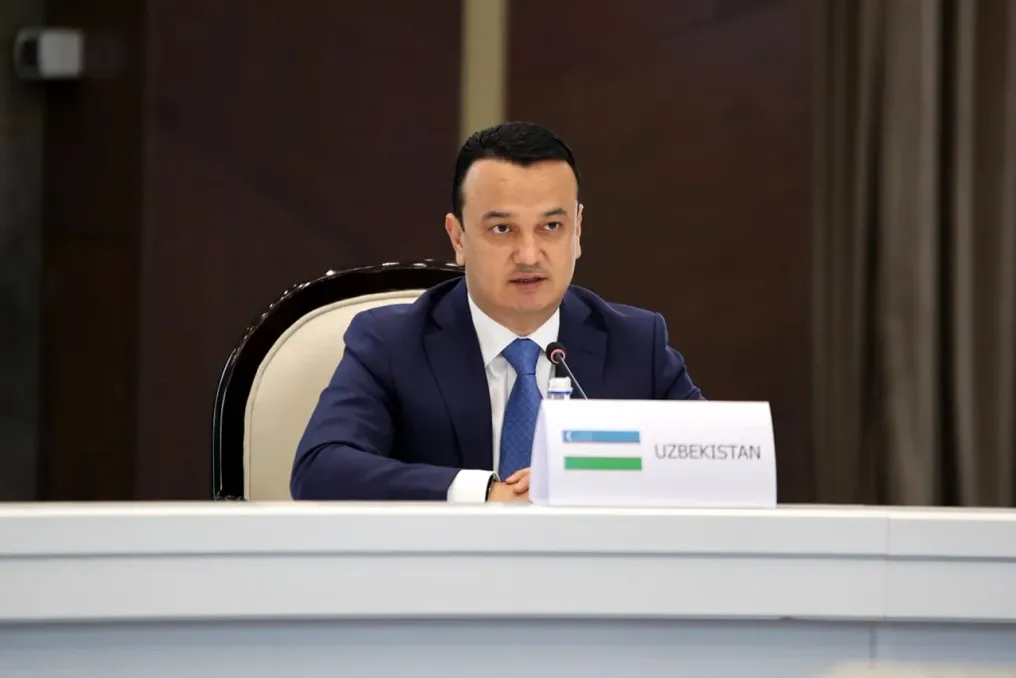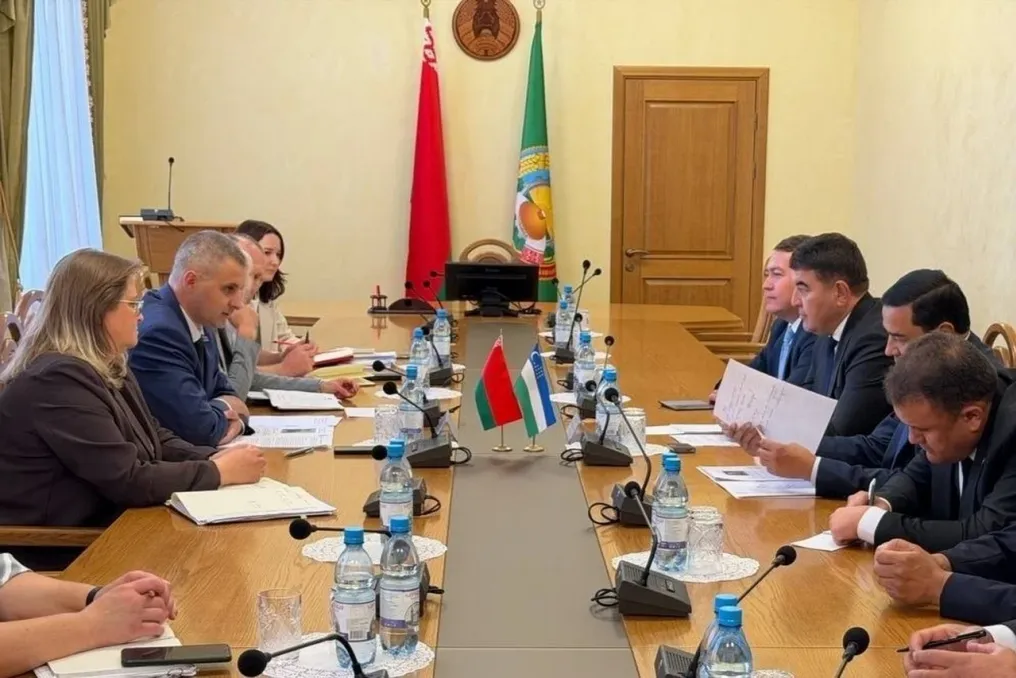
A delegation from the Namangan Region, led by Hokim Shavkatjon Abdurazzakov, held negotiations with representatives of Belarusian ministries, departments, and major industrial associations during their visit to Belarus.
A delegation from the Namangan Region, led by Hokim Shavkatjon Abdurazzakov, held negotiations with representatives of Belarusian ministries, departments, and major industrial associations during their visit to Belarus.
One of the central areas of discussion was cooperation in the light industry sector. During the meeting with representatives of the Bellegprom concern, the parties considered the possibility of implementing joint investment projects, introducing modern technologies, and increasing the export of light industry products from the Namangan Region to the Belarusian market, as reported by the press service of the Namangan Regional Hokimiyat.
The Bellegprom concern unites enterprises from the textile, sewing, knitwear, leather, and footwear industries, comprising over 60 organizations involved in the production and sale of light industry goods.
Separate talks took place with representatives of the Ministry of Agriculture and Food of Belarus, as well as with the Belpishcheprom concern. The main focus of these discussions was on creating and further developing bilateral interaction.
The visit of the Namangan Region delegation to Belarus is ongoing.
The Minister of Investment, Industry, and Trade of Uzbekistan, Laziz Kudratlov, reported in an interview with Uzbekistan 24 on the results of President Shavkat Mirziyoyev's state visit to Kyrgyzstan. During the visit, both countries agreed to increase interaction in several key sectors.
The agreements cover areas such as agriculture, mineral extraction, energy, construction material production, and transport. The parties have agreed on a number of joint projects to be implemented in Kyrgyzstan.
These projects include the creation of a livestock breeding cluster, as well as initiatives for growing rice and potatoes, alongside the development of building material production. Uzbek enterprises are already involved in the production of aluminum profiles, polymer products, and dry building mixes.
Mineral extraction will become a new area of cooperation. Kudratlov noted that the ministries and specialized companies of Uzbekistan plan to conduct geological surveys in Kyrgyzstan, utilizing accumulated experience.
Priority areas of cooperation also include the energy sector, participation in the Kambarat hydro-power plant project, and the development of small energy facilities. Furthermore, progress is being made in the construction of the China-Kyrgyzstan-Uzbekistan railway, which is proceeding ahead of schedule.
The countries also reached an agreement to create more favorable conditions for cargo transit, processing, and customs clearance. Following the Uzbek-Kyrgyz business forum, numerous documents were signed and agreements on investment projects and trade contracts worth over 1.5 billion US dollars were concluded.
Laziz Kudratlov emphasized the positive dynamics of bilateral trade. He stated that the volume of trade between the two states increased by 45% since the beginning of 2026, reaching 624.6 million US dollars. In 2025, bilateral trade amounted to 1.2 billion US dollars, which is 37% more than in 2024 ($874.7 million).
The Minister added that the parties have already identified additional categories of goods, assortments, as well as exporters and importers that will contribute to further trade expansion. According to Kudratlov, the state visit of the President of Uzbekistan to Kyrgyzstan marks an important stage in the development of bilateral relations. At the conclusion of the meetings, the heads of state signed the Treaty on Alliance between Uzbekistan and Kyrgyzstan. Cooperation in the fields of energy, trade, and logistics was also discussed.