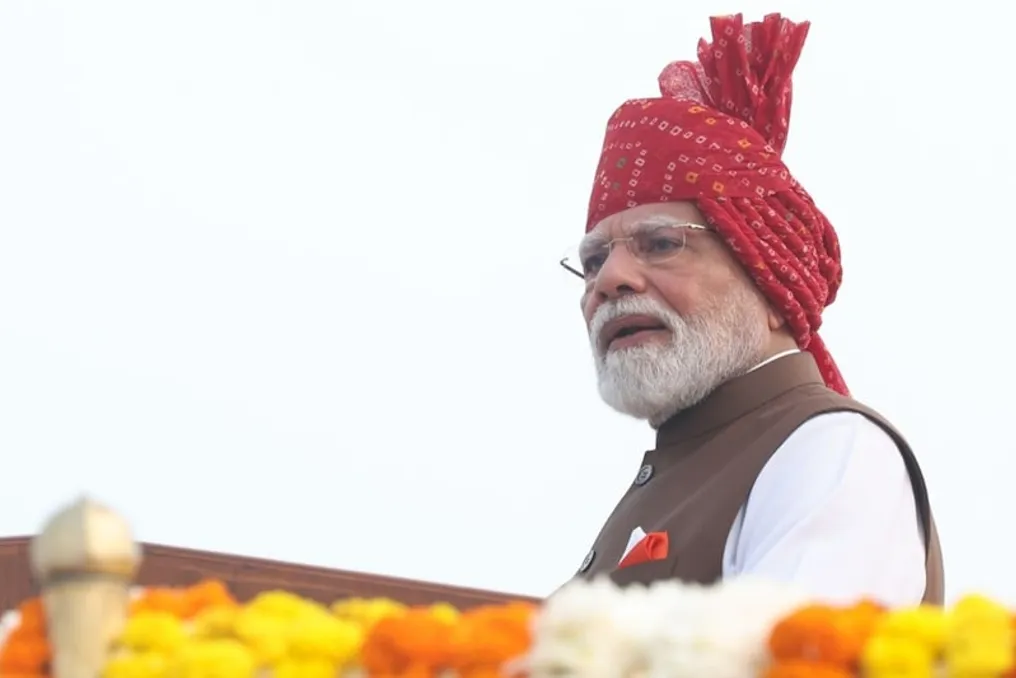
Prime Minister Narendra Modi addressed the Red Fort, sending a clear signal to countries that view India merely as a large market for the world. He emphasized that India is no longer willing to yield to external pressure.
In his speech, Modi made it clear that while India was previously the largest global market, its current goal is to capture global markets. To achieve this, he stated that it is necessary to shed negative thinking and focus on its own interests to reduce dependence on foreign factors.
On one hand, Modi responded to the actions of the United States. In recent months, the US has focused exclusively on its own interests, influencing the global economy while ignoring globalization. An example of this was the arbitrary imposition of tariffs and threats of imposing a 100 percent fine on countries trading with Russia, which demonstrates a lack of concern for the global economy on the part of the US.
US policy towards India was also based on pressure. However, India is now ready to defend its interests, and Modi voiced his intentions to the entire world. He noted that currently, no one is talking about globalization; everyone is preoccupied with themselves, and India must also think about itself.
As part of these changes, he announced that India will undergo a series of major reforms in the near future. It is necessary to accomplish in seven years what was not achieved in seventy years. He called for enhancing self-capabilities and independently securing its interests, so the movement for a self-reliant India is advancing with firm determination.
All Indians are involved in areas such as 'Make in India', 'Swadeshi', and 'Vocal for Local'. Modi stated that India no longer depends on one or two countries. Since 2014, India has been signing Free Trade Agreements (FTAs) with about 40 countries, and now the country's MSMEs should take advantage of this opportunity.
He stressed that India must enter the global markets. Modi said: 'We must go global so that all Indian products reach global markets. Whether it is our textiles, our engineering products, or medicines, we must not miss opportunities. But we must surpass global standards by striving to create better than what we receive from the world.'
Modi added that to compete with the world, the country has begun the 'Reform Express' movement and will move towards the next level of reforms in the near future. Therefore, the government, society, industry, producers, and farmers will have to reform their traditional systems, change their mindset, and adjust their goals.
In this regard, Modi proclaimed the slogan 'Saptadhara' from the Red Fort, which must be implemented in practice over the next five to seven years. This will give the country strength, and the Indian system must evolve in line with the goals of 2047. One cannot rely on past policies; one must shape policies according to future dreams.
He particularly highlighted the need to develop the manufacturing sector, increase production volumes, and create both small components and large products. In the global market, India must be known for its reliability and quality. Its mantra should be 'Quality, quality, quality', as there can be no compromises on quality, and this will become its global brand value.
Modi insisted that India must become self-sufficient in defense in any situation. He noted that India and the world have learned this lesson, and there is no way out without it. The goal should be to become a global supplier by developing next-generation defense technologies.
India's economy is strong, and in the coming years, the government will focus on the green and blue economy, which will also lead to the creation of green jobs. India must succeed in green hydrogen, renewable energy, energy storage, green mobility, and green manufacturing on a global scale.
Furthermore, agriculture remains the backbone of the economy. Therefore, the country needs to advance in food processing. Global markets have opened up for the country's farmers through FTAs, providing them with a very large market, and India must enter it.