As part of the celebration of the twentieth anniversary of the Artscape Women's Humanity Festival, an event is taking place that pays tribute to the courage and resilience inspired by the historic Women's March of 1956. This festival brings together various communities to promote the principles of inclusivity and gender equality.
In 1956, Rahima Musa, Lillian Ngoyi, Sophie Williams-de Bruyn, and Helen Joseph led a procession of 20,000 women to the headquarters of the Apartheid government in Pretoria, at the Union Buildings, on August 9. They carried petitions with over 100,000 signatures, protesting against injustice. The women stood in complete silence for thirty minutes, after which they began chanting 'Wathint' Abafazi Wathint'imbokodo' ('If you beat a woman, you beat a rock').
It is the bravery, resilience, defiance, and collective action of diverse women in the face of Apartheid's brutality—the condemnation of injustice, particularly draconian 'dompas'—that forms the basis of this year and previous Artscape Women’s Humanity Festival.
The XX edition of the Artscape Women’s Humanity Festival, organized jointly with Woman Zone, was meticulously prepared by various community stakeholders. It gathers women, people with disabilities, the LGBTQ+ community, performers, NGOs, civil society, interfaith groups, youth, community leaders, ward councillors, media personalities, gender activists, academic circles, and activists to use art as a platform for action and reflection 70 years after the landmark Women's March.
The Artscape Women’s Humanity Festival expands upon the scope of decisive action from 1956. Over the past two decades, the festival has become a channel giving voice to previously excluded groups. The program runs for a full month and includes book presentations, documentary screenings, theatrical performances, dance, songs, 'walk for humanity' actions, exhibitions, workshops, signature collection against gender violence and exclusion, art openings, public discussions challenging silence, celebrating resilience, and advocating for an equal society. All of this is inspired by ordinary women who took a brave stand in 1956.
During her address at a recent seminar for Commonwealth Parliamentary Association (CWP) African regional parliamentarians on gender awareness, held at the Western Cape Legislature in Cape Town, the speaker focused on how Artscape uses art and public engagement to dismantle harmful stereotypes and shape inclusive narratives. During the annual 'Walk for Humanity' on Sunday, despite the rain, the walk was led by people with disabilities and LGBTQ+ community members alongside participants from the 'Bonteheuwel Walking ladies'. Young interfaith leaders offered blessings, and spiritual dancers performed alongside popular Cape Town artist Jimmy Nevis, who performed his song against gender violence 'Prey', in which he prays that no one will ever be a victim of this scourge. Also on stage was the renowned diva from Mitchells Plain, Salome—a survivor of gender-based violence and former drug addict—alongside Michael September, chairman of Lief en Leed for people with disabilities in Mamre. Both shared the importance of having a platform to express common needs for acceptance, resources, and real change within a larger collective movement.
The CWP seminar also highlighted a serious issue in the legal system: the country possesses one of the world's most progressive constitutions, yet women with disabilities remain among the most politically marginalized due to the insufficient implementation of best laws. A similar situation exists regarding gender-based violence and the lack of inclusion of all people, which was noted by diverse panel participants during a discussion at the Artscape Women’s Humanity Festival, moderated by radio host Lester Kiviet. Panel participants included Professor Gertrude Foster-Vickomb, former Artscape board member (1994) and former Commissioner of the Gender Equality Commission; Bonnie Curry-Gamwo, NPA lawyer and specialist in Thuthuzela Care Centres; a representative from the anti-gender violence activist organization Women for Change; Pastor Craven Engel, CEO of The First Community Resource Centre; disability activist Notukela Makhosiso; and author and LGBTQ+ activist Dianne du Toit Alberze. In discussing the steps being taken and needed to address the issues of marginalized communities, the panelists unanimously called for proper accountability and enforcement from the authorities.
The XX Artscape Women’s Humanity Festival gathers communities to commemorate the historic Women's March of 1956, presenting art, performances, and discussions that advocate for gender equality and social justice.
The Walk for Humanity, inspired by these icons, took place on Women's Day in Cape Town, starting at the Cape Town City Centre and ending at the Artscape building. The goal was to showcase the actions of women by uniting diverse communities, people with disabilities, the LGBTQ+ community, NGOs, civil society, interfaith communities, youth, and artists who collectively contemplated how they could become catalysts for change in their communities, society, art, workplaces, and families. This walk was unique because it was led by people with disabilities and LGBTQ+ community members. Participants observed a minute of silence, after which they removed their masks and collectively declared 'Stop the Silence' in partnership with Women for Change. This powerful act symbolizes a unified stance against gender-based violence, discrimination, and the silencing of marginalized groups.
Acclaimed South African singer, performer, and gender activist Jimmy Nevis presented his powerful new anthem 'Prey', which is a moving tribute to the resilience, hope, and strength found in unity. The event concluded with a spontaneous performance by the iconic singer Salome and blessings from young representatives of the Cape Town interfaith initiative, marking hope, unity, and our shared humanity, inspiring collective action for long-term change.
Thus, the Artscape Walk for Humanity once again declares the necessity to stop stereotyping, end prejudice, gender-based violence, promote humanism, and remember: every human life matters. It is a continuous action against gender-based violence, injustice, discrimination, and stereotyping, as well as a constant push for opportunities and resources for people with disabilities, women, and youth, for inclusivity, unity, justice, and peace. It is an open call for the government to actively ensure, adequately fund, strengthen, and expand existing legal frameworks to protect and include our marginalized citizens. The Artscape Women’s Humanity Festival serves as an effective model of how a state institution uses its mandate to bring together diverse communities that collectively celebrate strength, achievements, courage, self-expression, and artistic mastery, providing a safe space where everyone belongs and every life matters.
Thanks to sales like the annual ABFAB Drag show, Divalicious Dames, and the Bottelnek Breek Bek book launch, the Artscape Women's Humanity Festival has established itself as a space that embraces all gender expressions, fighting stereotypes against LGBTQ+ individuals who still face discrimination in daily life. In May of this year, LGBTQ+ activists and rights organizations were shocked by the acquittal of a man in a case of alleged 'corrective rape' of a minor lesbian who was raped in Atteridgeville on January 1, 2020. This verdict reignited debates about the challenges faced by LGBTQ+ survivors seeking justice in South Africa, especially in cases involving hate-based violence allegations. The mentioned performances, and especially ABFAB Drag, have become one of the main attractions of the annual Artscape Women’s Humanity Festival, confirming Artscape's commitment to being a place for everyone.
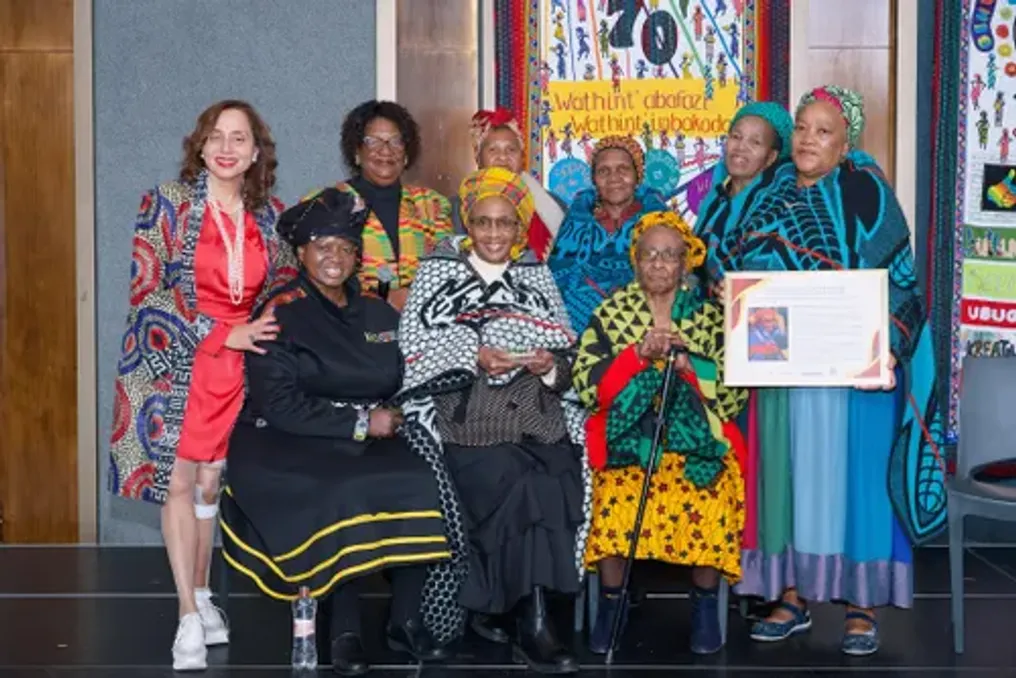
This year, we were honored to honor Dr. (Mrs.) Mildred Ramakaba-Lesia (93 years old), a veteran activist from Lange/Gugulethu, who played a vital role in mobilizing Cape Town women for the Women's March in 1956, as well as in numerous other campaigns, by presenting her with the Humanitarian Award. Mrs. Ramakaba-Lesia's account of how she and other women acted against Apartheid injustice, which led to her detention in Pollsmoor prison and numerous house arrests, and her gratitude for the recognition in the presence of her daughters, underscores the significance of the Artscape Women’s Humanity Festival as a medium where the sacrifices made by strong women are recognized as motivation for the younger generation to continue telling the heroic stories of our strong women through songs, dances, writings, and other artistic expressions.
Inspired by the heroes of 1956, community volunteers from all walks of life joined forces to create two beautifully crafted textile pieces, EVERYWOMAN, which were displayed at this year's Artscape Women’s Humanity Festival. These works aim to immortalize the historic Women's March and mark the 55th anniversary of the Artscape building. Every stitch tells a story of courage, resistance, defiance, resilience, and hope: it is a wonderful gift from the community to the state institution, proving that Artscape truly is a place for all. These tapestries will hang in the Artscape building for many years. We thank Woman Zone—one of our affiliated organizations based in the Artscape building—for collaborating with us for the last 13 years, making the Artscape Women’s Humanity Festival meaningful and memorable. I believe that Artscape is also the only state theatre where a women's organization highlights the issues and achievements of women, conducts book presentations and documentaries by female authors and filmmakers, and creates impressive handmade items, expanding the influence of the heroes of 1956.
This year, we were also fortunate to celebrate the courage of young postgraduate student and film director Nomandla Vilakazi. Inspired by her mixed heritage, including Khoi ancestry, she created the documentary 'Bones'. This poignant film explores the repatriation of the remains of Sarah 'Sartjie' Bartman from the Museum of Man in Paris, France, to South Africa in May 2002, after they had been in Paris for nearly two centuries. Her repatriation to South Africa was prompted by the famous poem by the late Diana Ferrus, 'I’ve come to take you home', which calls for her return. Sarah Bartman was finally buried in Hankey in the Eastern Cape on August 9, 2002—Women's Day—to be commemorated alongside our 1956 heroes. Nomandla's documentary prompts deep reflection on the deeply rooted history of gender-based violence, objectification, and abuse suffered by indigenous women during colonization. It also highlights the loss of cultural heritage and the urgent need for repatriation and restoration.