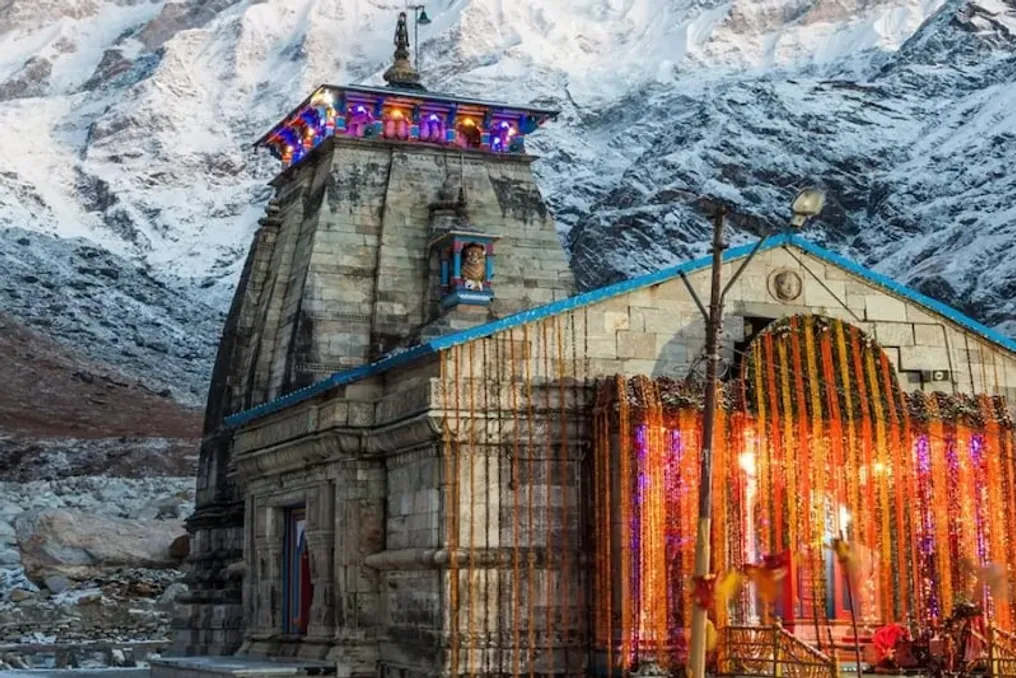
For most people, Kedarnath is simply a picturesque pilgrimage site, visited for photographs. However, this temple, located deep in the Himalayas, is not only a center of faith but also the greatest mystery at the intersection of history and science. It is a place where human understanding ends and miracles begin. One must wonder: how were such massive stones transported to an altitude of over 11,755 feet above sea level without cranes, cars, cement, or modern technology? Which master carved this grandiose structure? And most importantly, how has this temple withstood the destructive power of nature?
Situated in the lap of the Himalayas, at an altitude of about 11,755 feet above sea level, amidst snow, rocks, and silence, Kedarnath is no ordinary temple. It bears witness to times when humans lacked modern technology but possessed building knowledge that still amazes people. Every stone of the Kedarnath temple seems to ask a question, and the answer is not easy to find. Millions of people arrive here every year—some with the hope of having their wishes granted, others seeking peace of mind, and a third waiting for changes in their lives after visiting this place.
However, few know that the temple before which they bow is not only a symbol of faith. It is also an amazing example of harmony between ancient Indian architectural traditions and the nature of the Himalayas. So, what is the history of this temple? Let's find out.
Why is the form of Shiva's back worshipped in Kedarnath?
The history of the Kedarnath temple begins with a striking mystery: the image of the god Shiva worshipped there. Usually, lingams are depicted in oval or cylindrical shapes, but in Kedarnath, the worship of Lord Shiva takes place in a special form called the form of Shiva's back. This is supported by a mythological legend directly related to the Pandavas after the Mahabharata war.
It is said that even after winning the Mahabharata war, the Pandavas could not find peace. The weight of killing their own relatives, teachers, and brothers weighed heavily on their souls. When they asked Lord Krishna how to rid themselves of this sin, they were advised to turn to Lord Shiva. This is where the Pandavas' journey begins, leading them from the plains to the difficult heights of the Himalayas. But Lord Shiva did not want to be with them. According to belief, to avoid the Pandavas, he took the form of Nandi, the bull, and hid in the cattle herd. Nevertheless, Bhima recognized him. Bhima assumed his enormous form and spread his legs on both sides of the Kedar pair so that no one could pass through them. Then Bhima realized that it was not an ordinary bull, but Lord Shiva himself. When Bhima tried to grab him, Lord Shiva began to sink into the ground. Bhima managed to hold onto his rear end. According to tradition, this very image of Lord Shiva later became revered in Kedarnath. It is said that Lord Shiva was pleased with the devotion of the Pandavas, granted them a vision, and blessed them with freedom from sins. This is why the belief in worshipping Lord Shiva in the form of the back exists in Kedarnath. This legend is also connected to the Panch Kedar tradition, which includes Kedarnath, Tungnath, Rudranath, Madhyameshwara, and Kalpeshwar, with Kedarnath holding a special significance among them.
Who built the Kedarnath temple?
The question arises: was the Kedarnath temple built during the time the Pandavas arrived? There is no single definitive historical answer to this question. The history of Kedarnath is linked both to religious beliefs and to history.
According to one tradition, the temple was erected by the Pandavas. Another religious tradition is associated with the form of Narayana of Lord Vishnu. According to belief, Rishi Narayana performed severe ascetic worship in this region. Pleased by his asceticism, Lord Shiva granted him the blessing to reside here in the form of Jyotirlinga. After this, the name Adi Shankaracharya appears in history. There is a belief that in the 8th century, Adi Shankaracharya played an important role in organizing and structuring the main holy sites of India. He is also linked to the revival of Kedarnath. Today, the tomb of Adi Shankaracharya is located behind the Kedarnath temple. Although historians disagree on the construction of the Kedarnath temple, some historical sources link the construction or expansion of the temple to subsequent rulers. Therefore, it is more accurate to consider that the Kedarnath temple is not the heritage of a single period, but a religious and architectural heritage that has evolved over centuries.
How was the temple built from such large stones without cement?
Now let us move to the question where faith meets science. The Kedarnath temple is built from giant stones. Looking at its structure, the first question arises: how were such heavy stones transported to such a height and such a sturdy building constructed? Many methods were used in ancient Indian architecture to firmly join stones together. In the structure of the Kedarnath temple, large stones were also arranged in such a way...