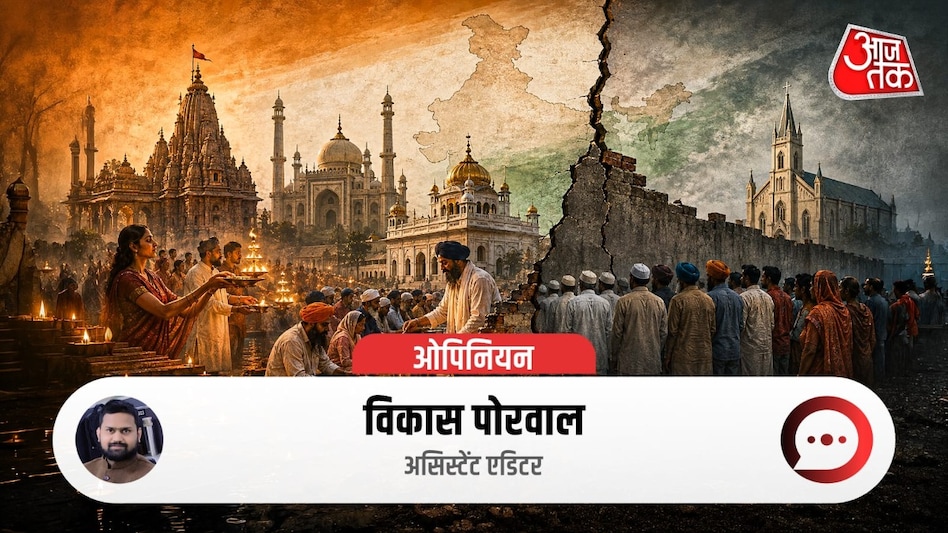
When India gained independence in 1947, it was not merely the liberation of one nation, but the birth of a new state—Pakistan. The partition between India and Pakistan was based on religion. Although Pakistan openly declared its Islamic identity, India faced a fundamental question: what should be the basis of this divided territory besides religion?
Over the past eight decades, this question has periodically arisen in complex or convoluted forms, but it has never been fully resolved. Independent India adopted its well-known synonymous name Hindustan, yet it never made it the basis of its religious identity. Despite the separation of Pakistan, India remained a country that preserved numerous diverse philosophical doctrines, beliefs, sects, and confessions.
These diverse beliefs enriched India religiously and filled it with diversity, upholding the spirit of 'Vasudhaiva Kutumbakam' (the world is one family). Therefore, when assessing the status of religion in India on its 80th anniversary, one cannot reduce it merely to the question of whether the country has become religious or secular. The main question is whether the current form of religion in India will become a cultural and spiritual force uniting Indian society, or if it will turn into a politico-social barrier through which dialogue will constantly be hindered.
Looking back 80 years, the people who drafted the Constitution of India, despite the obvious religious background of the partition, did not declare India a state of any single religion. Articles 25 to 28 of the Constitution provided citizens with rights related to religious freedom. Article 25 guarantees freedom of religion, as well as the freedom to profess, practice, and propagate the religion accompanying conscience.
Time has passed over these twenty-five years of religious freedom, and in 1976, the word 'secular' was added to the Preamble of the Constitution. Nevertheless, the foundations of the constitutional order concerning the impartiality of the state and the equality of citizens based on religion existed previously. When mentioning the term 'secular,' it is important to note that Indian secularism differs greatly from the models of many Western countries. Here, a complete wall was not built between the state and religion.
The state enacts laws related to religious institutions, participates in the management of religious trusts and institutions, and respects the personal laws of different communities. Thus, India chose the path of establishing equal citizenship in a polyreligious society, instead of pushing religion outside public life. This was the dignity of India. Despite this feature, there are certain 'crises' regarding religion in India.
Essentially, religion is not tied to any cult or ritual. It is not limited to belief in God and celebrating associated festivals and rites. Nevertheless, religion is often defined through family, festivals, traditions, marriage, birth, and funeral rites, diet, music, architecture, holy places, and folk art.
The biggest crisis related to religion over these 80 years is that we have failed to grasp that religion is another name for karma. The Gita also explains Dharma as Karma. In the Vedas and Upanishads, Dharma is interpreted as the 'human message.' It is described in seven, ten, and sometimes fourteen types, but the core essence of religion is to do good deeds, show compassion, empathy, and avoid violence.
Furthermore, religion is named for fulfilling various duties. The duty of a father differs from the duty of a son; the duties of a teacher and a king are different, as are the duties of a merchant, worker, student, and guest.
The paradox and the biggest crisis is that by claiming religiosity, we have failed to recognize this as a society. This is why former Prime Minister Atal Bihari Vajpayee said in one of his speeches that 'no one can be an atheist, because who would live separate from religion, together with injustice?' He added that people can belong to different sects, but they cannot live outside of religion.'
Therefore, today Ganga Aarti, covering the Durga sarcophagus, Langar in Gurdwara Sahib, Christmas decorations, or a fair during Shivaratri in a remote village—these are not just religious acts, but part of our confessional beliefs and cultural life. For this reason, religious identities in India sometimes appear clearly divided, but in practice, traditions continue to interact. Bhakti and Sufi traditions have created a common world in language, music, and folk life that is difficult to confine within the boundaries of a single religion.
Nevertheless, religion often becomes a source of crisis for the social sphere by becoming linked to politics. The link between religion and politics in independent India has never been completely broken. Events such as the Shahbano case, the Ram Janmabhoomi movement, the 1992 demolition, Ghodhra and Gujarat, and subsequently the consecration in Ayodhya show that religion has repeatedly returned to the center of Indian politics.
Despite all these differing views, the main question remains the same: can the majority of society demonstrate the equality of every citizen in the eyes of the state while publicly declaring its religious and civilizational identity? This is the most important question of Indian democracy.