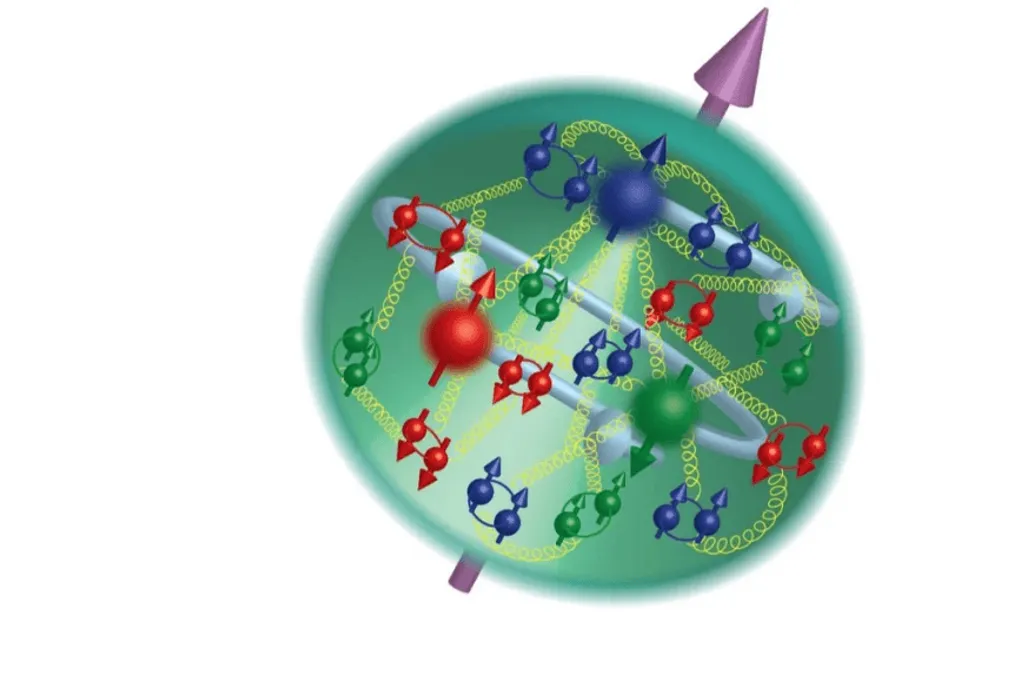
Physicists have discovered some of the most compelling experimental evidence to date suggesting that the fundamental property of protons and neutrons may not be associated with the three quarks they are composed of, as previously thought. Instead, the so-called baryon number might be transferred through a structure in the shape of a Y, known as a baryonic connection, which is formed by gluons.
This finding, published in the journal Science, provides new data for an idea proposed back in the 1970s and potentially helps resolve one of the fundamental problems in particle physics: what ensures the stability of matter and how it acquired the properties that allowed the Universe to exist in its current form.
The baryon number is used to distinguish matter from antimatter and is related to the apparent stability of the proton. The proton is the lightest baryon—a class of subatomic particles made of quarks—and no instances of proton decay have ever been recorded.
The traditional explanation posits that the baryon number is carried by the three valence quarks forming baryons such as protons and neutrons. However, the new research presents evidence that casts doubt on this model and supports the interpretation that the baryon number is associated with the baryonic connection.
The proposed structure has a Y-shape and consists of a gluon field—particles responsible for the strong interaction that binds quarks. The hypothesis arose about 50 years ago, but for decades, physicists could not find an experimental way to adequately distinguish between these two possibilities.
As the researchers explain, the three ends of the baryonic connection are connected to the valence quarks. Therefore, in most physical processes, it is difficult to determine whether the baryon number is carried by the connection itself or by the quarks. The researchers wrote in the article published in Science: 'For this reason, neither scenario has been unambiguously tested experimentally.'
The researchers observed that baryons travel a greater distance in the dense and extremely energetic region created by the collision than electric charge. According to the authors, this behavior indicates that the baryon number is transferred by the connection, which does not slow down as much as the electron-charged valence quarks.
The team also analyzed photo-nuclear collisions in which photons interact with gold nuclei moving at relativistic speeds. When gold nuclei, which carry a positive charge, are accelerated to speeds close to the speed of light, they generate an electromagnetic field that can be considered a source of virtual, or 'almost real', photons. These photons can then interact with the gold nuclei, providing a cleaner way to observe the transfer of the baryon number. Since the photon reaching the collision has a baryon number of zero, any net baryon number found in the resulting fragments must be associated with the gold nucleus.
The results were also consistent with Regge theory, which incorporates the baryonic connection more adequately than simulations based solely on valence quarks. According to the researchers, these results, combined with data previously obtained by STAR in gold nucleus collisions at various energies, weaken the valence quark model.
Despite the strength of the evidence, the results do not fully answer the question. In a perspective published alongside the study in Science, physicist Wenliang Li from the University of Mississippi (USA) emphasizes that the new measurements suggest that gluons may contribute to the transfer of the baryon number, but they do not constitute a direct and strictly controlled measurement of the mechanism responsible for this phenomenon.
Nevertheless, this discovery could be significant. With further research, understanding how quarks and gluons transfer the baryon number could help physicists study how the strong interaction organizes stable matter and why there is a predominance of matter over antimatter in the Universe. As the researchers note: 'Determining whether quarks or the gluon field transfers the baryon number could contribute to understanding how the strong interaction between subatomic particles organizes stable matter and what causes the imbalance between matter and antimatter in the Universe.'
The research must continue with new particle collision experiments. Among these is a future electron-ion collider to be built at the Brookhaven National Laboratory. The researchers themselves emphasize that further investigation into existing and alternative theories is necessary. To be considered viable, they must simultaneously explain all observed phenomena. At present, the authors assert, 'only the baryonic connection structure remains qualitatively consistent' with the available results.