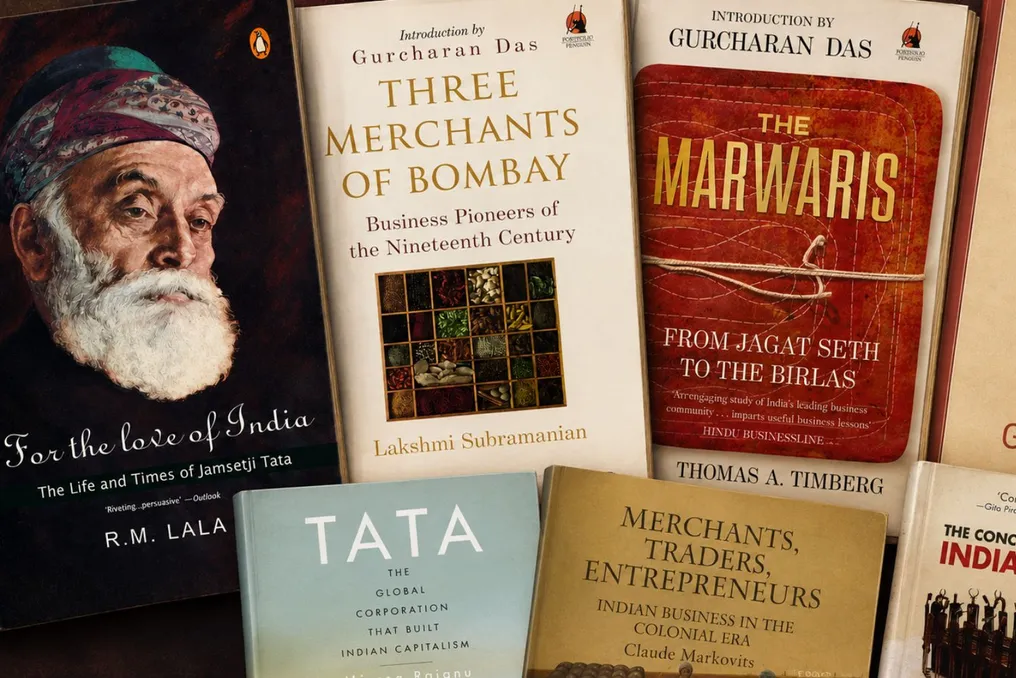
Before India gained independence in 1947, a group of outstanding entrepreneurs laid the foundation for the country's industrial and commercial future. Working under colonial rule, these visionary individuals established enterprises in sectors such as textiles, steel production, shipping, aviation, and mechanical engineering.
Their achievements were significant not only from a commercial standpoint; they represented acts of nation-building that contributed to job creation, infrastructure development, and strengthening faith in Indian entrepreneurship. Studying the lives of these pioneers offers valuable insights into leadership, innovation, resilience, and the challenges of doing business in difficult conditions.
Among these business leaders, including Jamsetji Tata, G.D. Birla, and Valchannd Hirachand, played a crucial role in India's industrial development before independence.
R.M. Lala's book, «For the Love of India: The Life and Times of Jamsetji Tata», is an indispensable starting point for anyone interested in India's early industrial pioneers. It details the life of Jamsetji Nusserwanji Tata, who dreamed of an India possessing its own industrial power, scientific institutions, and modern infrastructure.
Lala portrays Tata as a businessman who understood the necessity of long-term planning for a successful enterprise. His interest in steel, energy, scientific research, and education demonstrated an unusually broad vision for his time. Furthermore, the book illuminates the obstacles faced when attempting to build large-scale Indian industries under colonial control.
The book's particular appeal lies in how it connects Tata's personal aspirations with his broader vision for the country. For readers seeking a compelling portrait of one of the most influential pre-independence entrepreneurs, this book offers both historical context and deep biography.
Lakshmi Subramanian's book, «Three Merchants of Bombay: Business Pioneers of the Nineteenth Century», moves away from more famous stories of industrialization and focuses on the commercial world of 19th-century Bombay. The merchants featured in this book operated in a world shaped by expanding global trade, colonial institutions, and changing financial models.
Their success depended on the ability to understand markets, build trust, and operate within commercial networks. Subramanian does not depict entrepreneurs as isolated heroes but highlights the importance of family ties, social networks, partnerships, and access to information. These factors were often as crucial as capital. For those interested in Indian entrepreneurship, it provides insight into the roots of India's business empires.
Thomas A. Timberg's work, «The Marwaris: From Jagat Seth to the Birlas», explores the history of one of India's most influential business communities. Instead of focusing on a single entrepreneur, the book traces the evolution of Marwari commercial networks and their subsequent transition from trade to large-scale industry.
This history is particularly valuable because it demonstrates the close link between the growth of Indian business, migration, social connections, and systems of trust. Marwari traders settled in different parts of the country and created networks that allowed them to conduct business over long distances. Timberg also tracks the transformation of these trading traditions, where figures like the Birlas became prominent industrialists. For readers interested in entrepreneurship, this shows how trust, networks, and finance contributed to business growth.
Gita Piramal's book, «Business Legends», compiles the stories of several major Indian entrepreneurs and business families, making it especially useful for those who wish to compare different approaches to building a business. The book examines individuals who played a vital role in shaping Indian entrepreneurship and analyzes the qualities, decisions, and circumstances that led to their success. Its strength lies in placing the business leaders within the broader context of the Indian economy, rather than presenting their achievements as isolated stories.
For those studying India before 1947, «Business Legends» demonstrates how entrepreneurs from diverse backgrounds and with different strategies built enduring enterprises. It offers a wider view of the many paths that defined the history of Indian business.
Mircha Rayanu's «Tata: The Global Corporation That Built Indian Capitalism» offers a deeper analytical review of the Tata enterprise and its place in the development of Indian capitalism. Rayanu does not reduce Tata's history merely to the biography of Jamsetji Tata, but studies how the group evolved into an institution with a distinct approach to corporate organization, management, and social responsibility.
The historical perspective is particularly useful when studying the period before independence. The Tata enterprise developed during colonial rule and was forced to build relationships with British authorities, global markets, and emerging Indian economic interests. The book shows how a business house can transform into a sustainable institution through strong management, corporate structures, and social responsibility, making it valuable reading.
Claude Marcowicz's «Merchants, Traders, Entrepreneurs: Indian Business in the Colonial Era» provides a broader historical framework for understanding Indian business before 1947. Instead of concentrating solely on famous industrialists, the book explores the wider network of traders, merchants, and entrepreneurs involved in India's economic life during the colonial period.
The work examines the interconnections between Indian business communities, colonial institutions, and broader international markets. This broad perspective is important because it challenges the notion that Indian capitalism arose solely due to a few well-known industrial families. Entrepreneurs operated through diverse commercial systems, including merchants, financiers, traders, and family businesses.
Divindra Tripathi's «The Oxford History of Indian Business» is an excellent choice for readers who want to move beyond individual biographies and understand the broader evolution of Indian entrepreneurship. Tripathi analyzes the development of Indian business across different periods, among various communities, and in different sectors. The book provides context for the emergence of merchant groups, industrial entrepreneurs, and large business houses, situating their growth within India's changing economic and political environment.
This makes the book particularly valuable when studying the decades leading up to independence. Instead of presenting business history as a collection of individual success stories, Tripathi places entrepreneurs within the context of larger transformations in trade, industry, finance, and economic policy. The book helps readers understand how various business communities shaped Indian capitalism and the rise of figures like Jamsetji Tata and the Birlas.
The history of India's business pioneers before 1947 is more than just a collection of tales about wealthy industrialists. It is a story of experimentation, adaptation, and institutional creation under difficult circumstances. These seven books reveal different facets of this history. «For the Love of India» brings to life the exceptional vision of Jamsetji Tata. Collectively, these books show that the history of Indian business began not with independence; foundations were laid through trading communities, industrial experiments, family enterprises, and ambitious institutions long before 1947. For those wishing to understand how Indian entrepreneurship developed, these books offer more than just business lessons; they reveal how entrepreneurs acted in a changing society and how their decisions helped shape the economic foundations of modern India.