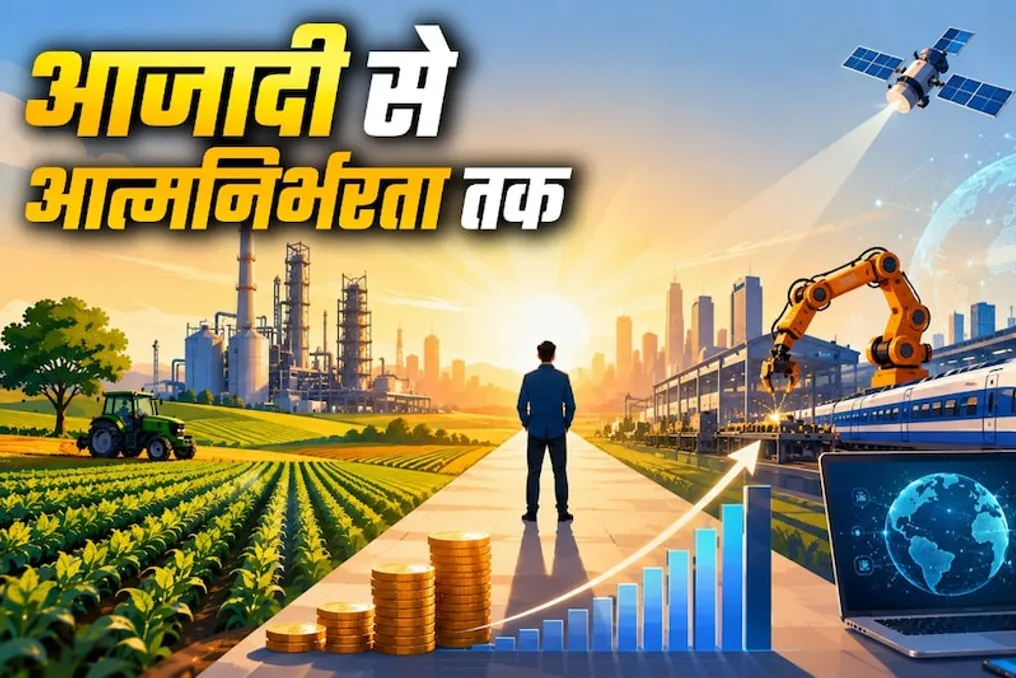
The beginning of India's independence was marked by golden hopes, yet the financial situation of the population remained difficult. Today, India has transformed into the world's second-largest economy and is actively moving towards the goal of $5 trillion. Since gaining independence, the country has undergone a journey of significant economic growth.
In 1947, for the average Indian, the concept of the economy was not about large GDP figures but about ensuring food supply and covering monthly expenses. The main problem for an ordinary family back then was securing two meals a day and paying for children's education.
However, over the last eight decades, the economic landscape of the country has changed radically. Today, as all Indians dream of India becoming a $5 trillion economy, this change is felt everywhere. The construction of capital homes, the development of road networks, access to electricity and gas cylinders, and improvements in healthcare and education systems testify to economic progress in every village.
Immediately after gaining independence, the country faced numerous difficulties. It was necessary to give the devastated economy the right direction. British rule had left India in a state of famine, poverty, and resource scarcity, with almost all needs depending on imports from other countries.
Economic Condition of India During Independence
The two-hundred-year period of British rule completely undermined India's traditional industry, crafts, and agricultural system. If in 1700 India's share of the global GDP was about 27%, by the time of independence it had shrunk to only about 3%. More than 80% of the population lived in extreme poverty, and the literacy rate was only 12%.
In 1947, agriculture was the backbone of the Indian economy, accounting for over 50% of the country's GDP, and more than 70% of the population depended on farming. Nevertheless, at that time, the country faced a food crisis. Technology and irrigation systems were extremely limited, forcing India to import grain from the USA to feed its population.
Besides a few sectors such as the cotton industry and jute, there was an acute shortage of heavy industry and modern infrastructure in the country.
How Has India Changed?
In the 1960s, the Green Revolution allowed India to transition from being a grain importer to achieving food self-sufficiency. Over the past eight decades, thanks to the rapid growth of the industrial and service sectors, the share of agriculture in the GDP has decreased to approximately 15-18%. However, today, about 45% of the population still finds employment in agriculture. With the production of over 330 million tons of grain, agriculture remains the main pillar of India's food security and economic stability.
After gaining independence, India chose a mixed economy, and the foundations for institutions like the Bhakra-Nangal dam, IIT, IIM, AIIMS, and steel plants in Bhilai and Bokaro were laid. Then, in the 1960s, the Green Revolution made India completely self-sufficient in terms of grain.
Economic Reforms through LPG
Until 1990, the pace of economic development averaged around 3.5% due to strict regulation and the licensing system. After this, India adopted LPG reforms. This happened because in 1991, the country faced a currency crisis. As a historical economic transformation, India decided to implement LPG—Liberalization, Privatization, and Globalization—which is still considered a turning point in the Indian economy.
As a result, the licensing system was abolished, foreign companies began arriving in India, and the private sector received an impetus for development. It was during this period that India's IT and service sectors gained worldwide recognition, what we now call the IT revolution.
Since 2014, the digital revolution has given new strength to the economy. Major investments have been made in digital public infrastructure. Thanks to the integration of UPI, Jan Dhan schemes, and Aadhaar, India has shown the world an example of financial inclusion and digital payments.
The 'Make in India' initiative has directed a new vector for the development of infrastructure and manufacturing sectors. The 'Make in India' and PLI programs have helped India become a global hub for the production of electronics, automobiles, and semiconductors, and investments are now actively being made in solar and wind energy.
These Data Are Proof
Some statistical data serve as proof that India itself has changed its economic landscape. If in 1947 India was economically weak, today it is not just a developing country but a decisive force on the global economic stage.
From an economic perspective, the size of the Indian economy (GDP) in 1947 was about 2.7 lakh crore rupees, while now it has reached approximately $4 trillion. If foreign exchange reserves were zero during the period of independence, they now exceed $600 billion. Back then, India was among the poorest countries in the world, but today it is the fifth-largest economy in the world. India has also achieved success in education: if the literacy rate was only 12% in 1947, it now exceeds 77%. Thus, every Indian is a participant in this economic progress and should be proud of their national identity.