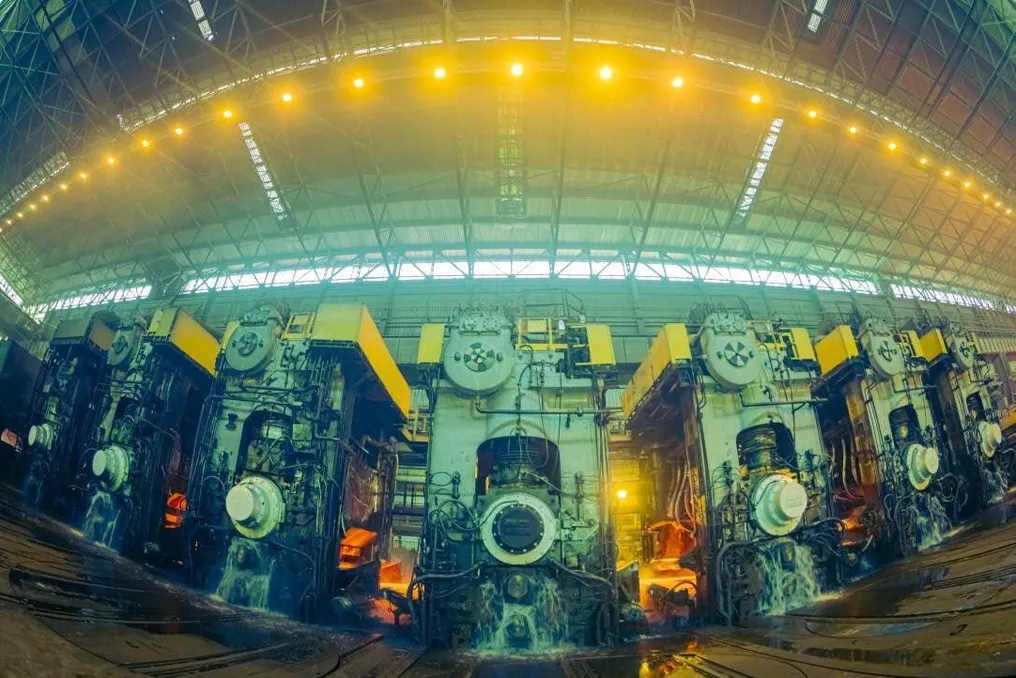
Mobarakeh Steel has moved away from the traditional view of waste, shifting towards material cycle management. This approach involves returning scrap metal to the production process, transforming slag into infrastructure elements, and converting by-products from operational costs into sources of economic and environmental advantage.
According to reports, even before Isfahan woke up, the roads were already busy. Transport moves along the city's fourth ring road, whose asphalt contains fillers derived from a source few would associate with road construction—it is metallurgical production slag. Material that once signified the end of an industrial cycle has now become part of urban infrastructure.
This simple picture raises an important question: if material leaving a furnace can re-enter the economic life, can it still be called 'waste'? This question is relevant not only to Isfahan but to the entire global steel industry. This sector requires huge volumes of raw materials and energy for production while simultaneously striving to reduce its environmental impact.
Under such conditions, value is determined not only by the steel leaving the production line but also by the materials at intermediate and final stages of the process. Here, the circular economy transforms from a mere ecological concept into a new operational logic of production: material should not be considered finished as long as it retains the potential to create value. Mobarakeh Steel has implemented this logic directly within its plant.
A factory with three hundred different outputs
In the steel complex, the term 'waste' is too general to describe complex materials. Mobarakeh Steel has identified about 300 types of operational and non-operational waste streams, each possessing unique characteristics, composition, processing methods, and areas of application.
This diversity shows that the circular economy cannot begin at the scrap sales stage; first and foremost, it is necessary to know exactly what materials exist. Therefore, the priority task has been the creation of a comprehensive Waste Atlas for Mobarakeh Steel—a basic reference guide for identifying, classifying, and documenting technical knowledge related to these materials.
The significance of this atlas lies not only in data recording. In an industry where a significant portion of knowledge is formed by employee experience, documentation prevents the loss of organizational memory and ensures structured decision-making for future generations. However, the most important result is the change in perspective on the material itself. Once a waste stream is identified, its properties are defined, a processing path is outlined, and potential applications are revealed, it ceases to be an unknown residual product. It becomes secondary raw material—material for which a future can be determined.
From material identification to mapping its journey
However, knowledge without data is insufficient. In a large industrial complex with such material diversity, waste streams must be fully visible and traceable—from scrap intake to processing, consumption, sales, and inventory management.
To achieve this goal, Mobarakeh Steel is developing a Waste Processing Dashboard, an integrated system designed to unify these material flows into a single standardized platform. The project has reached approximately 60% completion and is scheduled for launch this year.
At first glance, this system is a management tool; however, internally, it creates a bridge between material data and strategic decisions. When data is centralized, it becomes clear which materials are consumed the most, which processes require optimization, what product has recyclable value, and what output can find new buyers in the industrial supply chain. In the next phase, this data infrastructure can pave the way for predictive analytics and the use of technologies such as artificial intelligence for more accurate waste identification and sorting. Thus, the circular economy is built not just by returning materials, but by the ability to track and see the material throughout its entire lifecycle.
Scrap: the past without waste
Scrap metal is perhaps the best-known form of material recovery in the steel industry. Steel used in vehicles, buildings, or industrial equipment does not necessarily leave the economic cycle upon the product's end of life. It can be collected, sorted, melted, and turned into raw material for secondary production.
In this cycle, the past becomes input for the future. For Mobarakeh Steel, returning scrap to the production process is part of continuous efforts to reduce waste and use resources more efficiently. Nevertheless, the importance of this practice extends beyond the plant. The more the industry can recover materials from the life cycles of previous products, the less it depends on mining and transporting virgin natural resources—this has both economic and environmental significance in a world facing growing pressure on energy and natural resources. From this perspective, scrap is not iron whose life cycle has ended; it is iron that has simply moved from one industrial life to another.
Slag: a loop around the city
While scrap represents the return of material to the plant, slag demonstrates the return of material outward, into society. After being formed during the steel smelting process, slag can be used in civil construction after appropriate treatment.
One of the clearest examples is Isfahan, where treated slag from Mobarakeh Steel was incorporated into the asphalt production for the city's fourth ring road. In another initiative, this material was also incorporated into railway infrastructure, where the use of Mobarakeh Steel slag in the development of railway stations specifically and physically connected the steel and transport industries for the first time.
Material that was once at the very last stage of the steel smelting process can now support the infrastructure that facilitates the large-scale movement of goods, materials, and people. From city ring road asphalt to railway tracks, a unified logic emerges: what is considered the end of a process in one industry can become the beginning of a process in another. Here, slag ceases to be an unwanted product; it transforms into a material performing a new function in another part of the economy. This transition defines the boundary between basic waste management and true material cycle management.
One factory, multiple industries
When treated slag leaves the plant and is used in civil construction projects, something more significant than just consuming a by-product occurs: two previously separate economic supply cycles become interconnected. Steel production provides an output; road construction requires materials; technology, standards, and processing eliminate the gap between them.
When technical specifications are met, these connections reduce dependence on primary raw materials and lessen the burden on natural ecosystems. This same logic can link various industries on a broader scale—from road and civil construction to cement production and other sectors capable of utilizing steel by-products. Here, the circular economy stops being a local cycle within the factory; it becomes an interconnected network uniting different industries.
High-value economic cycle
No cycle can exist without sustainable economic value. Mobarakeh Steel's performance indicators for 2025 demonstrate that this circular approach goes beyond environmental preservation and affects financial metrics. The implementation of 11 improvement projects over the year generated a total positive financial effect of 13.5 trillion IRR (13.5 Hemmat). This set of measures included revenue generation and cost reduction, with the sale of by-products and the commercialization of waste serving as key drivers of value creation.
Here, the circular economy evolves from a purely ecological obligation into a strategic economic decision. Material that previously had to be managed as an expense item can now be sold. By-products can find viable commercial markets. Waste reduction lowers operating costs, and process optimization allows for greater value extraction from existing resources without the need for capacity expansion. This shift represents one of the most important transformations in the steel industry: industrial growth no longer requires increased resource consumption—it means using what we already have in a smarter way.
Will the future of steel be determined solely by iron ore? Global competitiveness in the steel industry in the coming years will depend not only on production capacity. Access to scrap, the ability to recycle by-products, resource efficiency, data management, cost reduction, and the creation of markets for secondary materials will become the main pillar of industrial strength.
In such an environment, the maximum competitive advantage belongs to plants capable of extending the lifespan of materials—materials that are mined once, used once, and returned to the cycle again. Mobarakeh Steel is actively testing this circular logic on an industrial scale while promoting waste identification, intelligent waste tracking, scrap recycling, and slag processing. This path is far from complete—in fact, it should have no end.
The road returns to the furnace
We can return to that initial scene: a morning in Isfahan. The fourth ring road is bustling with traffic. Under the tires is material that once emerged from the heat of the industrial furnace.
However, the journey of this material did not end there. This time, instead of returning to the furnace, it returned to the city. Meanwhile, on the other side of the cycle, metallic scrap returns from the city back to the furnace. Two separate paths, governed by a single continuous logic: the material remains in motion. Its form changes, its application shifts, but its value does not end.
Perhaps this is the true future of the steel industry: not a factory that consumes resources and discards them, but an enterprise that finds a secondary purpose for every material wherever possible. In such a world, 'waste' is no longer a material name—it is simply the name of the moment when we have not yet discovered the next destination for that material.