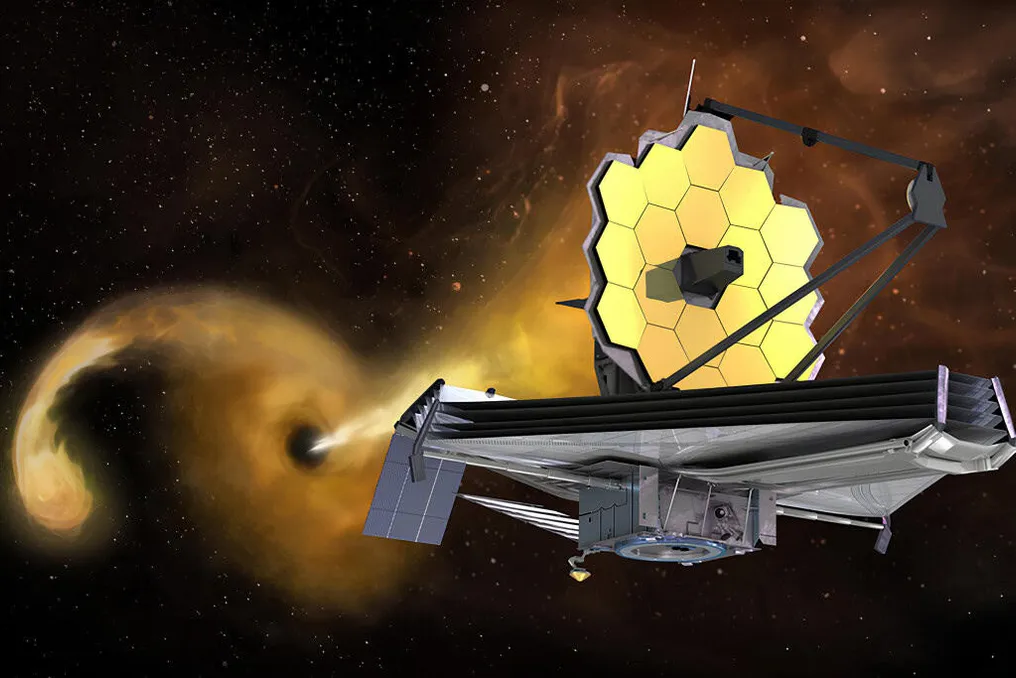
Astronomers from the Massachusetts Institute of Technology (MIT) have identified an extremely bright and reddish object in the early Universe that may represent a new type of astrophysical body—a so-called 'star with a black hole.'
The object, observed using the James Webb Space Telescope, appears like a giant star but emits energy comparable to that of a black hole. This discovery may also help explain the mysterious 'small red dots' found in images of the distant Universe.
This object, named MoM-BH*-1, was observed during observations of an era when the Universe was only a few hundred million years old. Its estimated size is comparable to the size of the Solar System.
Its brightness is particularly noteworthy: the object generates approximately 100 billion times more energy than any known star. Researchers believe that nuclear fusion, the energy source of stars, cannot account for such intensity.
There is a hypothesis suggesting the presence of a black hole with a mass of about 100 thousand solar masses at its center, surrounded by a very dense layer of hydrogen. It is hypothesized that this central black hole is enveloped by an extensive gas shell that resembles a star the size of the Solar System.
The team discovered this object during the Mirage or Miracle (MoM) survey, which aimed to find some of the earliest galaxies. The red dot stood out both in color and brightness.
An initial explanation might have involved dust. However, the light provided another clue—a sharp break known as the 'Balmer break,' which is characteristic of dense gas absorbing photons. In this case, the signal intensity was unusual, ruling out ordinary stars as the source.
Furthermore, the light contained almost no signs of metals or elements other than hydrogen and helium. Modeling showed that an extremely dense layer of hydrogen could cause this effect without the need for dust. Although the gas layer explained the object's appearance, it did not explain its outstanding brightness. To get closer to an answer, astronomers included a black hole undergoing matter accretion in their simulations.
This hybrid variant—a combination of a black hole and a massive gas envelope—proved to be the best fit for the Webb data. This structure would have the following composition: