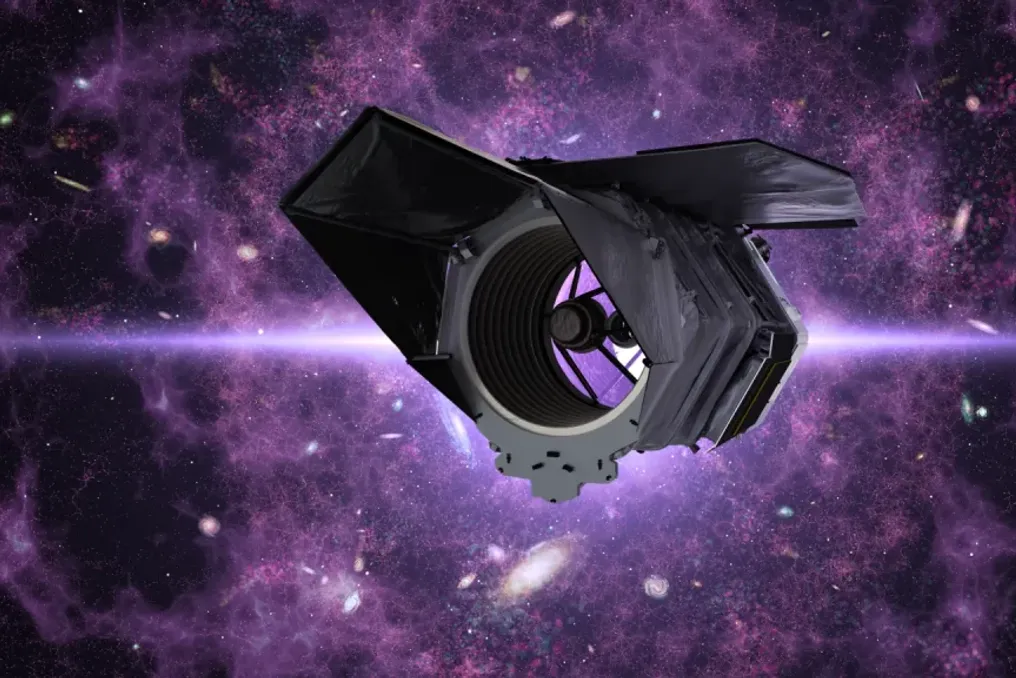
NASA is about to launch the Nancy Grace Roman Space Telescope, which will carry a 300-megapixel supercamera into space. This equipment has the capacity to map vast expanses of the sky in high definition, marking a significant shift in the scale of astronomical investigations.
Scheduled for launch on August 30, the observatory is expected to collect an unprecedented volume of data and images related to galaxies, stars, and planets located outside the Solar System. The expectation is that this will increase knowledge about the evolution of the Universe and pave the way for future research in the search for Earth-like worlds.
The telescope's name honors astronomer Nancy Grace Roman (1925–2018), recognized as one of the central figures in the conception of NASA's space telescope program. She was the agency's first chief of astronomy and dedicated herself to persuading authorities and scientists about the relevance of installing observatories outside the Earth's atmosphere.
This effort paved the way for missions like Hubble, which was launched in 1990. For her contributions, Roman earned the nickname 'Mother of Hubble.' Years later, her name was chosen to name this new telescope, which has an ambitious, albeit distinct, proposal.
The development of this observatory involved collaboration from the Goddard Space Flight Center, the Jet Propulsion Laboratory (JPL), and the Space Telescope Science Institute (STScI).
In recent weeks, the equipment structure underwent a series of rigorous tests to ensure its resistance to the harsh space environment. The telescope was exposed to strong mechanical vibrations, noise tests simulating the intense sound of a rocket during takeoff, and thermal vacuum chambers, which verified its durability against extreme temperature variations.
After being approved in all safety phases, the telescope will be sent into space aboard the powerful SpaceX Falcon Heavy rocket, departing from the Kennedy Space Center in Florida.
According to NASA's planning, after launch, Roman will head to the second Lagrange point, known as L2. This area is located about 1.5 million kilometers from the planet, representing almost four times the average distance between the Earth and the Moon.
This location provides a crucial advantage for an observatory of this size. By aligning the Sun and Earth in the same direction relative to the telescope, a large shield can block most of the heat and light radiation from these celestial bodies. This helps maintain the instruments under ideal operating conditions and minimizes interference during observations. L2 is also used by the James Webb Space Telescope, which operates in the same region.
Roman's main technological advancement lies in the Wide Field Instrument (WFI), a colossal camera with a resolution of 300 megapixels. The distinction from Hubble can be simplified: while Hubble is notable for recording extremely fine details in relatively small areas of the sky, Roman will offer a much broader perspective.
Each image captured by Roman can cover an area approximately one hundred times larger than that observed by Hubble with comparable resolution. Furthermore, its survey speed will be much higher, enabling it to map the sky up to a thousand times faster in certain observations. In five years of operation, the mission will analyze a much larger area than Hubble covered over decades. The telescope will be capable of recording supernova explosions at the moment they occur, as well as documenting neutron star collisions and capturing fast radio bursts (FRBs), providing vital data on the most violent events in the cosmos.
Details on exoplanet studies
Roman will also play a relevant role in the study of exoplanets, which are worlds orbiting stars other than the Sun. One of the technologies employed will be the coronagraph, an instrument designed to obscure part of a star's light, facilitating the visualization of much less luminous objects near it.
The operational principle is analogous to placing a barrier in front of an extremely intense light source. Since a star can be millions of times brighter than an adjacent planet, its brilliance usually obscures the object. Participating in the Space View program, astrobiologist Raíssa Estrela, a researcher at JPL, detailed how this technology works. She explained that the coronagraph serves to block the light of the host star, allowing the observation of light reflected by the orbiting planets. According to her, with this type of observatory, it will be possible to image the planetary system itself.
Raíssa emphasized that this is the great differential of the equipment. She stated that it will move away from indirect measurement, as currently done with James Webb, to allow direct imaging of the planets.
Another method to be used is gravitational microlensing. In this scenario, the gravitational attraction of a star or any massive body curves the surrounding spacetime, deflecting the path of light coming from a more distant source, acting as a natural lens. Researcher Leandro de Almeida, from the Astrophysics Division of the National Institute for Space Research (INPE), clarified the physical phenomenon during his participation in Space View. He described that light travels in a straight line in curved spacetime; when passing an object of large mass, the beam is deflected and changes course. The observer perceives this as the star being in a different position, which is called an image.
By analyzing these modifications in light, scientists can identify objects that would otherwise be extremely difficult to detect. Raíssa stressed that Roman was not designed to directly identify signs of life on small, rocky, Earth-like planets. Its focus will be more directed towards populations of exoplanets, including larger worlds, as well as the general structure and evolution of the Universe.
However, the technology developed for this mission will be fundamental for the future. As the specialist pointed out, the use of the coronagraph and Roman's population data will serve as preparation for the next decades of exploration. She mentioned that we do not yet have the technology to detect molecules in atmospheres like Earth's, a 'Terra 2.0', but the mission is creating the scenario for a space telescope capable of such science to exist in a few years.
The researcher reinforced that the mission will pave the way for the search for habitable planets. Although Roman studies other planets, its focus will be more on gas giants. The technology will not reach the level of characterizing planets like Earth, but it will bring the necessary knowledge about the direct imaging of exoplanets, which will be used by the Habitable Worlds Observatory for smaller planets. Thus, it constitutes the first step on this journey toward characterizing Earth-type planets.
Therefore, Roman transcends the function of merely being a giant space camera. By integrating a wide field of view, high resolution, advanced observation methods, and processing of large volumes of data, the mission has the potential to revolutionize the way scientists study the cosmos. More than generating remarkable images, the new telescope will help answer fundamental questions about the transformation of the Universe over time, the number of worlds beyond the Solar System, and the potential advancement of humanity in the search for environments similar to ours.