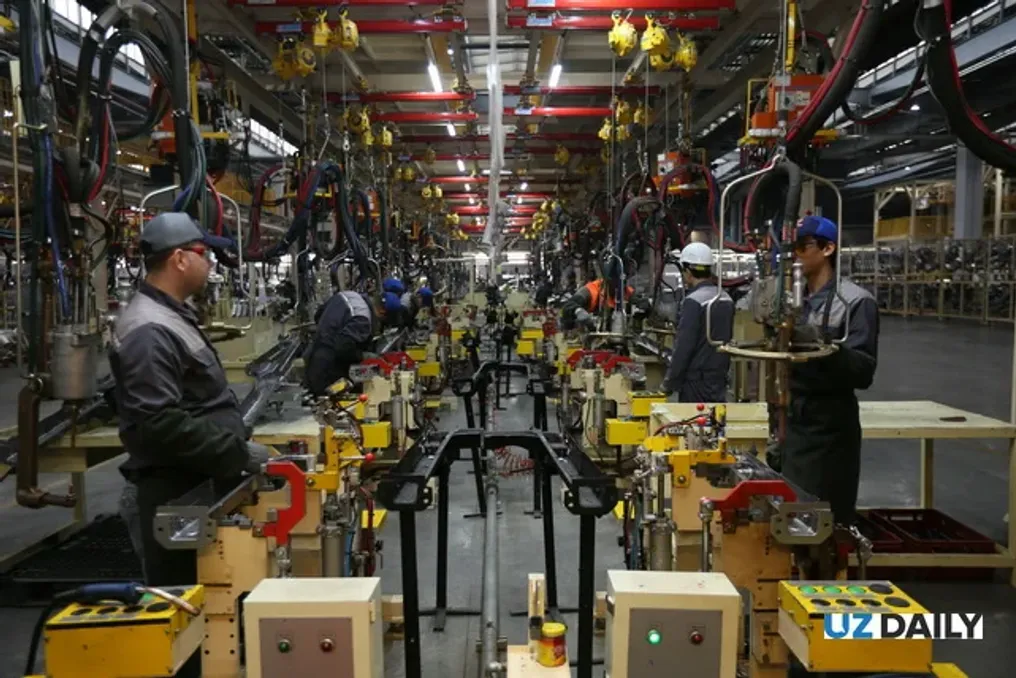
Inspections have begun in South Korea regarding the working conditions of Uzbek citizens employed in the shipbuilding industry. The checks were initiated following complaints about agreements that stipulate a fine of two thousand dollars for each month of work with another employer without prior written permission from the Uzbek side.
These workers arrived in South Korea on an E-9 visa as part of a special program designed for employment in shipbuilding. Before leaving Uzbekistan, they signed relevant contracts with the Agency for External Labor Migration. According to these documents, the worker is prohibited from changing jobs independently; such a transition requires written approval from the Agency's representative office in South Korea. Violation of this clause entails a fine of $2000 for every month worked for another employer. Furthermore, sanctions are provided for refusing to comply with the employer's legal requirements and for illegal stay in the country.
The situation raised particular concern among Uzbek workers at shipbuilding sites in Ulsan. Workers reported that after being dismissed or laid off, it was difficult for them to find new employment due to the threat of fines.
The situation gained greater public attention after the tragic death of a 26-year-old citizen of Uzbekistan at the HD Hyundai Heavy Industries shipyard in Ulsan. According to the South Korean publication Pressian, the incident occurred on July 18 due to a production accident. The deceased's colleagues stated that he had previously suffered from injuries, was worried about continuing work at the shipyard, and intended to change companies but faced difficulties when changing employers.
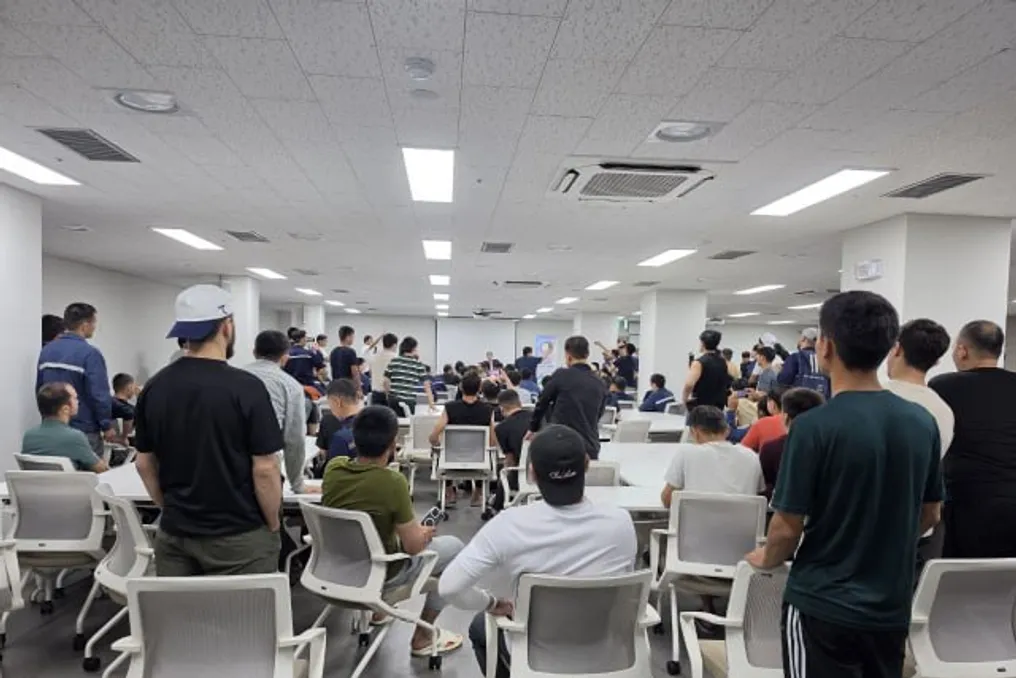
Two days after the tragedy, Nurmatjon Komilov, head of the Korean representative office of the Agency for External Labor Migration, held a meeting with over one hundred Uzbek workers. These employees demanded a review of the terms of the existing agreements and shared stories where, they claimed, fines were applied even after they had left the subcontractor facilities.
The Agency explained that changing employers is permissible under certain circumstances. Specifically, this is possible during temporary suspension or downtime of the enterprise, as well as when there are confirmed medical indications. The agency added that such agreements are also linked to the problem of illegal stay of Uzbek citizens in South Korea.
South Korean authorities showed interest in this issue. The country's Ministry of Employment and Labor, together with the Embassy of Uzbekistan, has started inspecting the working conditions of Uzbek migrants. The South Korean Ministry of Employment and Labor emphasized the need to study this issue from the perspective of international law. Additionally, the South Korean Ministry of Gender Equality and Family reported the possibility of signs of human trafficking in such conditions.
HD Hyundai Heavy Industries stated that it did not participate in signing agreements with workers or establishing penalty clauses. The company also denied that its consent was a necessary condition for the worker to be released from these obligations.
Earlier, a large-scale fraud scheme was uncovered in Tashkent related to promises of employment in South Korea. Two suspects demanded $55,000 from a man, promising to arrange his job and obtain a residence permit through their supposedly influential acquaintances.
According to data from the Federal Statistical Office of Germany (Destatis), employment in the German automotive sector reached its lowest level since 2005 in the first half of 2026. By the end of June, the sector employed 691,500 workers, which is 42,300 fewer people, or 5.8%, compared to the previous year.
The decline in employment in the automotive sphere was the most significant among Germany's large industrial sectors with over 200,000 employees. Nevertheless, the automotive industry remained the second-largest employer in the country in the manufacturing sector. The leading position was held by vehicle production, which employed 905,900 people by the end of the first half of the year.
According to the Central Bank of the Republic of Uzbekistan, based on information from the Migration Agency, approximately 1.4 million citizens of Uzbekistan are working in almost 40 countries worldwide. The structure of labor migration is gradually shifting away from traditional destinations towards Europe and East Asia.
In companies producing vehicles and engines, employment fell by 6.1% year-on-year, totaling 429,200 employees. In the production of components and accessories for cars, employment decreased by 7.6%, reaching 219,500 people. Meanwhile, in the segment of bodywork, body repairs, and trailers, employment increased by 10%, rising to 42,800 workers.
The drop in employment affected not only the automotive industry. Overall, Germany's manufacturing sector employed 5.29 million people by the end of the first half of the year. This figure decreased by 144,100 people, which is 2.7% year-on-year.
A reduction in personnel numbers was also noted in other major industries. The number of workers in metal goods production decreased by 3.8%, and in the production of ferrous and non-ferrous metals—by 3.7%. In the chemical industry, the decrease was 3.6%, and in electrical equipment production—3.4%.
In mechanical engineering, the largest industrial sector in terms of employment in Germany, the number of workers decreased by 2.7% compared to the previous year. More moderate rates of employment decline were recorded in the production of plastics, the food industry, and in the production of computers, electronic, and optical products.
Bharatiya Mazdoor Sangh (BMS) has initiated a call for demonstrations, rallies, and dharnas in all its units across the country on August 17.
The reason for this call is a number of unresolved issues concerning labor relations. These issues include increasing the minimum pension, reviewing the wage limits for EPF and ESI, restoring the Old Pension Scheme, and making amendments to the provisions of the new labor codes.
The agency's data indicates that the largest number of labor migrants are concentrated in Russia—834,200 people, followed by Kazakhstan with 84,400, Turkey with 72,100, and South Korea with 46,400. A total of 258,000 Uzbek citizens are employed in European countries, and another 97,700 are in other states.
Among the migrants, women account for 398,900 people, which is 28.6% of the total, while youth number 402,100 people, or 28.9%. The share of CIS countries in the migration structure has decreased to 29%, while the share of the European region has increased to 42%, and the share of East Asia has risen to 26%.
The Central Bank notes that trends in the workforce can have varied impacts on economic growth in different regions: in Central Asia, this demographic factor can increase annual economic growth by about 1 percentage point, whereas in Northern Europe, it may reduce growth by nearly 0.7 percentage points. The regulator believes this creates favorable economic conditions for expanding labor corridors from Central Asia to Europe and other countries with aging workforces.
One of the key economic factors influencing migration decisions remains the difference in wages between destination and origin countries. According to the International Labour Organization (ILO), the highest average wage levels were recorded in Luxembourg at $9,307 in Purchasing Power Parity (PPP) terms, followed by Belgium ($8,297), the Netherlands ($7,234), the United States ($6,273), and Finland ($6,253). Next are Ireland ($5,441), Slovakia ($5,291), Canada ($4,571), Sweden ($4,538), and Switzerland ($4,466).
The ILO report indicates that despite significant uncertainty in economic and trade policies in 2025, the global labor market proved more resilient than expected. The global unemployment rate remains around 4.9%, and the broader job deficit indicator, covering people who are not working but want and are able to work, is projected at 408 million people in 2026.
Youth unemployment in 2025 stood at 12.4%, and the proportion of young people who are neither in education, employment, nor training (NEET) reached 20%, encompassing 257 million young people. The ILO forecasts that the NEET rate among youth will reach 20.2% by 2027, and 27.7% among young women, with a potential rise to 34% among women in low- and middle-income countries.
According to the latest available ILO data for 2022, 167.7 million labor migrants participated in the international labor market, with 68.4% of them employed in high-income countries. By sector, migrant employment was distributed as follows: 68.4% in services, 24.3% in industry, and 7.4% in agriculture.
The Central Bank emphasizes that by 2030, population aging and the shrinking working-age population in European countries will become one of the key structural problems of the labor market, with the labor shortage in the region estimated at 7.5–10.5 million people. Demand for labor is expected to grow in mechanical engineering, high-tech manufacturing, infrastructure construction, transport and logistics, agriculture, medicine, information technology, tourism, and services.
According to forecasts from the Institute for Employment Research of the German Federal Employment Agency, if the country does not attract at least 400,000 skilled migrants annually, it will negatively affect GDP growth. Healthcare and social security have been named as a separate area of demand. According to the forecast by the Scientific Institute of the German Association of Private Health Insurance (WIP), the need for care in the country will reach 5.7 million people by 2030, requiring up to 500,000 additional workers in healthcare and care. In the UK, according to Skills England, about 90,000 additional care workers will be needed. In Japan, the labor shortage in care, agriculture, and construction is estimated at 6–7 million people, while in South Korea, in shipbuilding, metalworking, electronics, and industry, it is 1.2–1.5 million people.
Growing demand for workers is also forecasted in the green energy sector. A study by the German Chamber of Commerce (DIHK) shows that Germany will face a shortage of about 300,000 specialists in installing solar panels and wind turbines, as well as technicians, mechanics, and environmental engineers, due to renewable energy projects. The Central Bank notes that Northern European countries are becoming centers of clean technologies, where demand for workers in green metallurgy, wind energy, and information technology is also growing.
Increased demand for labor is also expected in the Gulf countries as part of national development programs, including efforts to diversify the economy away from oil dependence. According to the ILO, Saudi Arabia may require 1.5 to 2 million additional workers, and the United Arab Emirates—1 million, primarily in construction, healthcare, hospitality, tourism, aviation, and logistics.
Based on these trends, the Central Bank concludes that alongside traditional labor migration, it is becoming increasingly important for Uzbekistan to develop the linguistic, professional, and digital skills of its youth, as well as prepare for remote service exports. The regulator believes that when further organizing external labor migration, demographic and structural changes in the global labor market, as well as new geographical and professional areas with high labor demand, must be taken into account.