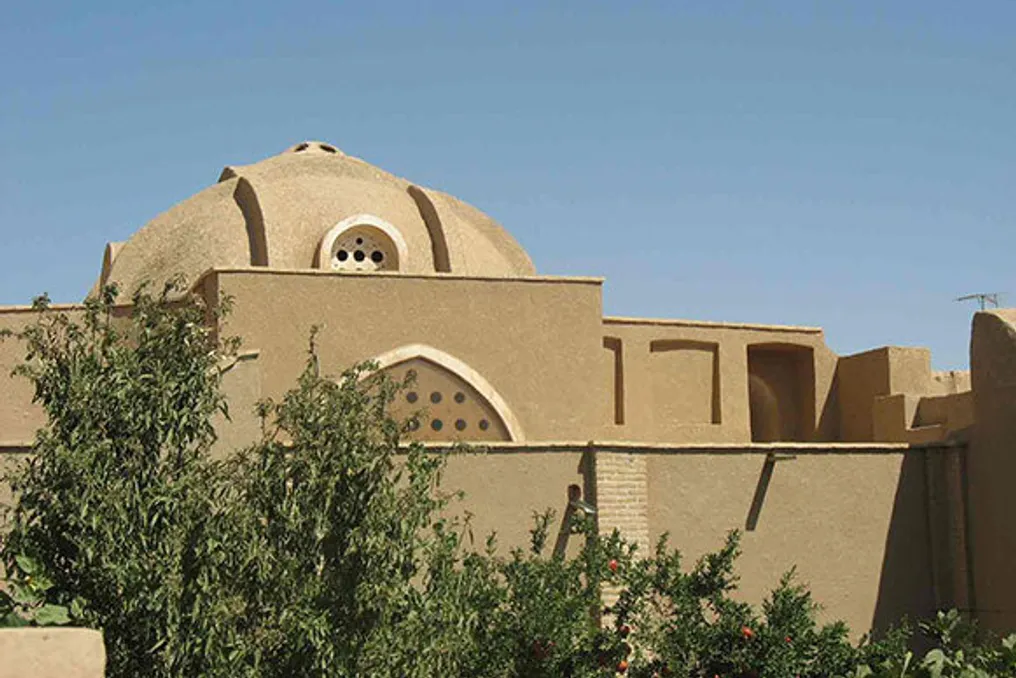
Local officials plan to transform the historical house of the philosopher Mulla Sadra, located in Kahak, Kom province, into a central hub for developing astronomical and philosophical tourism. This initiative is being implemented as part of an agreement aimed at promoting the city's cultural attractions and strengthening its tourism economy.
Behnam Ahmadi-Farsani, Director General of the Department of Cultural Heritage, Tourism, and Crafts of Kom Province, announced this plan on Wednesday following the signing of a memorandum of understanding between the provincial department, the Kahak district administration, and the municipality of Kahak.
According to data from the Provincial Department of Cultural Heritage, this agreement aims to promote the popularity of Mulla Sadra's house and develop the value chain of religious, literary, and philosophical tourism in the city.
In accordance with the terms of the agreement, the historical building and associated structures will be more actively used for cultural and artistic events, as well as for astronomy-related tourism. Ahmadi-Farsani stated that astronomical instruments are installed in the centuries-old house, and the site will be provided to a science-oriented company to conduct astronomy and philosophy events.
Furthermore, the official representative noted that this program will also strive to integrate tourism, crafts, and cultural events. The creation of a craft fair in the historical house and the organization of philosophical tours dedicated to Mulla Sadra and his intellectual heritage are planned. These events will be included in the tourism calendar of Kom province, which was approved by the department's technical council.
Ahmadi-Farsani emphasized that the goal is to present the opportunities of Kahak to pilgrims and tourists, adding that the province hopes to better promote Kahak's potential in culture, tourism, and crafts.
Located in Kahak, about thirty kilometers from the capital of Kom province, the house is associated with Sadr al-Din Muhammad Shirazi, better known as Mulla Sadra, who lived in Kahak during his withdrawal from public life. Sources describing the monument identify it as a Safavid-era building constructed from adobe bricks, clay mortar, and wood. Its plan has a cruciform configuration with a central domed space and surrounding rooms.
This house is a national heritage site of Iran, registered under number 1821. Its architectural features include a domed roof and simple plastering, while historical descriptions indicate the use of unrefined clay bricks, clay mortar, and wooden structural elements.
The proposed tourism program aims to give the historical site a modern educational and cultural function while preserving its status as a monument associated with one of Iran's most influential philosophers.
Mulla Sadra was born in Shiraz around 1571–1572 and died in Basra around 1635–1640, although scientific sources disagree on the exact year of his death. According to the Stanford Encyclopedia of Philosophy, his dates are approximately 1571–1636, and he is described as one of the most significant Islamic philosophers after Avicenna. He developed al-Hikma al-Muta'aliyah, often translated as 'Transcendent Theosophy' or 'Transcendent Wisdom'—a philosophical approach combining elements of Islamic philosophy, theology, and mysticism. His works were based on earlier traditions, including Avicennan philosophy, Illuminism, and Islamic mystical thought.