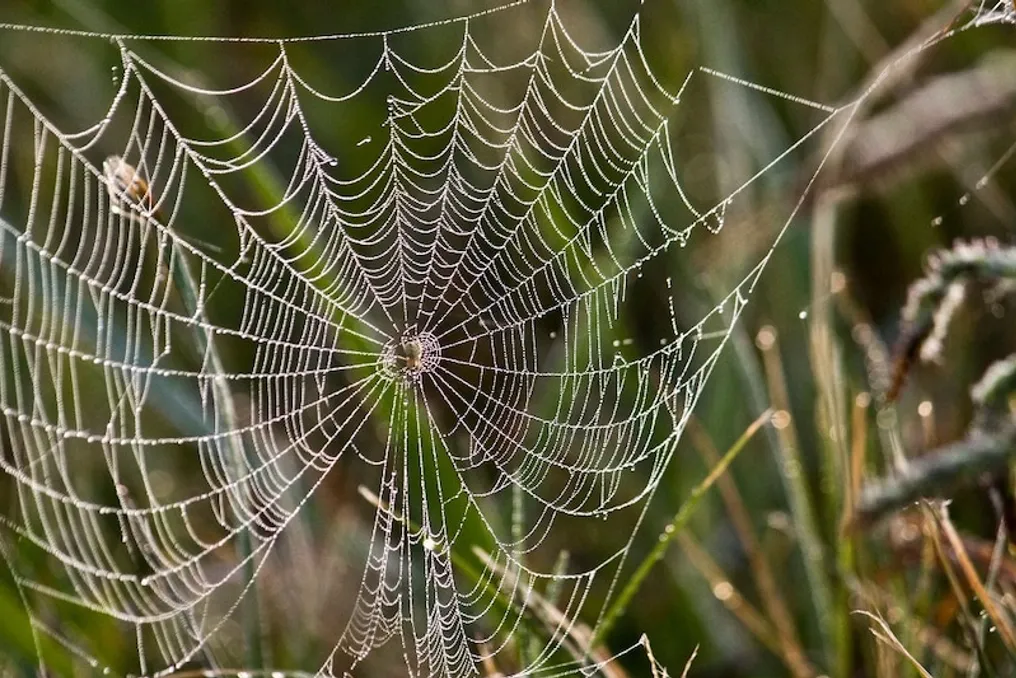
When looking at a spider web, one usually imagines a very thin and easily torn thread. However, it might seem hard to believe that this fiber can rival various steel wires in strength. Scientists have managed to understand the secret behind this feature of spider silk, which makes it both strong and elastic.
The strength of the material is measured using the tensile strength limit, which simply shows how much an object can stretch before breaking. This indicator, known as tensile strength, reflects the pulling force that can be applied to an object before its destruction, and it is measured in Pascals (MPa), which corresponds to a force of 1 Newton per square meter.
The tensile strength of spider silk is about 1200 megapascals (MPa). When compared to ordinary structural steel alloy, which has a strength of about 400 MPa, it is clear that the web can withstand significantly more pressure than many types of steel under tension. Nevertheless, it cannot be compared to all types of steel; some high-strength alloys reach 760 MPa, and specially manufactured steel wires can exceed 2200 MPa. Therefore, it is more accurate to state that spider silk is one of the strongest natural materials relative to its weight.
The special feature of the silk lies not only in its strength but also in its much greater elasticity compared to steel. Before breaking, spider silk can stretch almost twice its original length. This means that the thread does not break instantly when stretched, but can stretch significantly while withstanding considerable stress.
But the question arises: how does such a thin thread achieve such strength? In a new study, scientists tried to answer this question by studying the atomic structure of the spider fiber. Researchers from King's College London and the University of San Diego studied the structure of the fibers at a microscopic level.
According to scientists, the spider fiber consists mainly of proteins, which are long chains of amino acids. Some specific amino acids connect to each other like small 'glue points'. These bonds, which form and break again and again, help assemble the protein into a single structure. It is this organization that gives the silk a structure allowing it to withstand weight under tension.
Scientists note that this mutual attraction is maintained during the fiber formation process, gradually creating an extremely complex nanostructure. This structure provides spider silk with its exceptional strength and flexibility.
When a spider spins a web, the silk is not initially a solid thread. The proteins forming the fibers are in a viscous liquid called 'silk dope' inside the spider's gland. When the spider releases this liquid from its body and begins weaving the web, this material gradually transforms into a solid and very strong fiber. For a long time, it was known that proteins formed small liquid clusters before silk formation, but the full picture of how these clusters organize and transform into a strong fiber was unclear. The new research helped to understand this process at the atomic level.
Spider fiber is considered one of the most unique materials in nature and is of great importance to the spider, as it uses it to create a web, support its body, and move. Its properties are often compared to strong materials such as steel and Kevlar. Its strength relative to its weight, as well as its impact toughness, is particularly impressive. This is why scientists have been trying for decades to create artificial fibers similar to spider silk.
Today, scientists aim not just to imitate the web. Their goal is to understand how nature creates such strong and durable materials. This could help in the future to create light yet strong protective clothing, lightweight and sturdy aircraft parts, biodegradable medical implants, and fibers for soft robotics.
The main feature of the web is not that it is stronger than any steel, but that it is extremely strong and elastic for a very low weight.