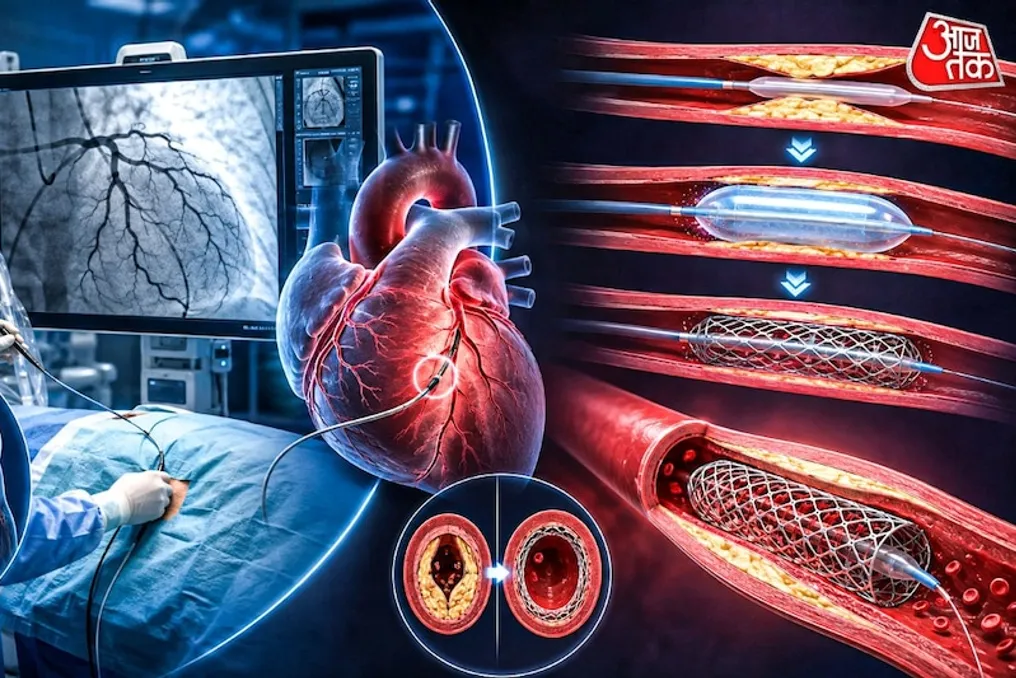
In recent years, there has been an increase in heart diseases and heart attack cases. When treating heart conditions, patients often encounter two medical terms: angiography and angioplasty. Many mistakenly consider them synonyms, but there is a significant difference between them. In this article, the doctor explains what angiography is and how it differs from angioplasty.
Coronary angiography is an examination that uses X-rays and contrast dye to check the blood flow quality in the heart's arteries. This procedure is designed to detect narrowing or blockage of the heart's vessels. Simply put, angiography is performed to find blockages in the heart and determine the degree of these blockages.
Dr. Ajit Kumar from the cardiology department of Rajiv Gandhi Hospital explains that if a person seeks hospital care with symptoms such as chest pain, anxiety, or shortness of breath, an ECG is performed first. In some cases, a stress test or electrocardiogram is conducted. If the results of these tests are not normal, angiography is prescribed. Angiography is also performed on patients with heart valve diseases, heart failure, or those who have previously suffered a heart attack.
During the procedure, the doctor inserts a thin tube called a catheter through the artery in the wrist or thigh up to the heart. A special dye is then introduced into the body, which is visible on X-rays, helping the doctor determine if there is a blockage in the heart's vessels. This process usually takes from 30 minutes to an hour. Some patients are discharged the same day as the examination, while others require overnight observation in the hospital.
To illustrate the difference, one can use the analogy of a clogged water pipe: first, it is necessary to find the location of the problem. This is what angiography does—it shows exactly where and how severely the heart arteries are blocked. If the degree of blockage exceeds 70 percent, doctors usually recommend angioplasty. In this procedure, a stent is placed in the heart artery using a small balloon. Stents are small metal mesh tubes that help keep the artery open. Placing a stent in the heart is called angioplasty, whereas testing for blockages is called angiography.
According to Dr. Kumar, angiography is considered a safe procedure. Nevertheless, like any medical manipulation, it is not suitable for every patient. Angiography is performed when symptoms are pronounced, and ECG or echocardiography reveals abnormalities in heart function. Dr. Kumar emphasizes that people often ignore heart diseases, and in such cases, ignoring symptoms like chest pain or shortness of breath can be extremely dangerous.