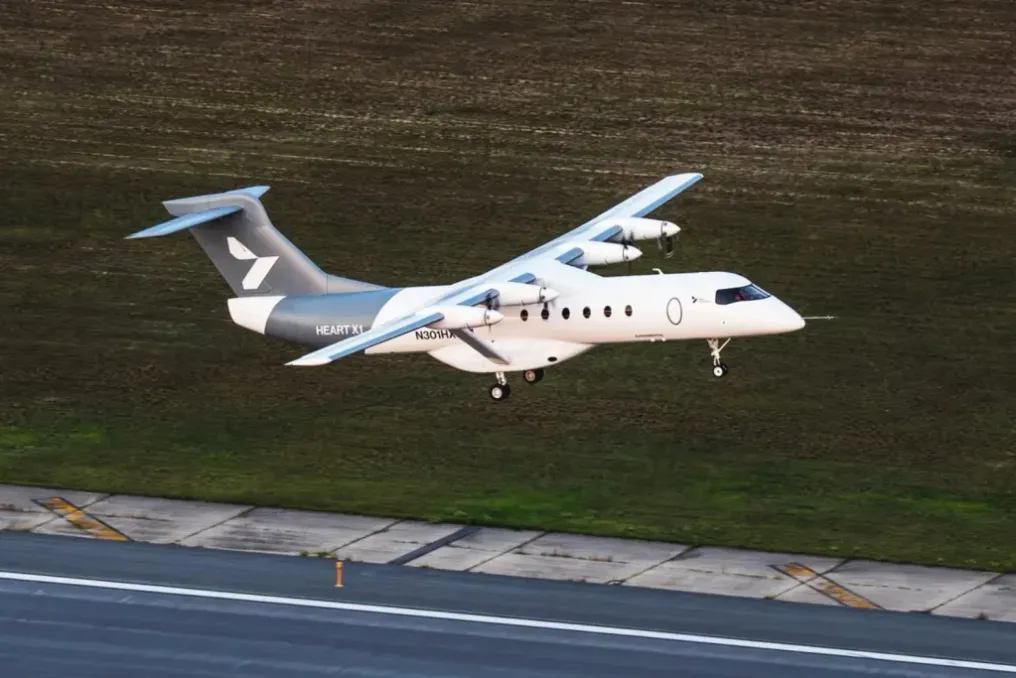
The X1, developed by Heart Aerospace, conducted its inaugural flight on August 12, 2026, in Plattsburgh, New York. During this test, carried out under a Special Airworthiness Certificate issued by the FAA, the all-electric aircraft remained airborne for a period of 27 minutes.
This prototype has a wingspan of 32 meters and a takeoff weight of 11,340 kg, reaching a maximum altitude of 335 meters. This achievement signals that electric aviation faces a challenge that goes beyond just the ability to take off, primarily requiring operational scale gain.
Although aircraft powered exclusively by electricity have existed for over fifty years and some models have been certified since 2020, the size of the aircraft remains a significant hurdle. The main difficulty lies with batteries, which store considerably less energy per unit of weight compared to traditional aviation fuel. Additionally, during the flight, fuel consumption reduces the aircraft's weight, while battery weight remains practically constant.
The X1 features a wingspan of 106 feet, a dimension similar to conventional regional turboprops. However, its current speed and range are still inferior to those of established models. The test was authorized by the FAA and took place in the experimental category, fulfilling the complete 27-minute flight profile.
The mission had two main objectives: to confirm that an electric aircraft of this size is capable of flying and to collect valuable data for the certification process. The X1 was designed as a predecessor to the ES-30, a 30-seat hybrid-electric aircraft that Heart Aerospace plans to manufacture. According to the company, this new model will be able to operate at significantly lower costs, specifically 40% below the costs of traditional regional aircraft.
With the first flight of the X1, Heart Aerospace has proven the viability of electric flight at a scale compatible with commercial aircraft. Anders Forslund, founder and CEO of Heart Aerospace, commented that electric commercial aircraft have the potential to transform the industry's economy and reduce air travel expenses. The company's vision includes offering more accessible, frequent, and environmentally friendly flights, with operations departing from airports closer to passengers.
It is important to note that the X1 does not yet represent a direct replacement for conventional regional aircraft. Its current role is to test the limits of electric propulsion at a larger scale, paving the way for the development of the ES-30.