For many years, India has recognized the vast energy potential contained in agricultural residues, cattle dung, and organic waste, but the main challenge remained transforming this potential into a commercially viable industry.
Now, the government is undertaking one of its most serious attempts. The Council of Ministers has approved the GOBARdhan scheme, the National Circular Bioenergy Scheme, with a total allocation of 23,731 crore rupees for the period from the 2026 to 2027 financial year until the 2035 to 2036 financial year. The scheme aims to tenfold increase domestic production of compressed biogas (CBG). The scheme integrates elements such as guaranteed demand and pricing, capital assistance, pipelines, and lending into a single structure.
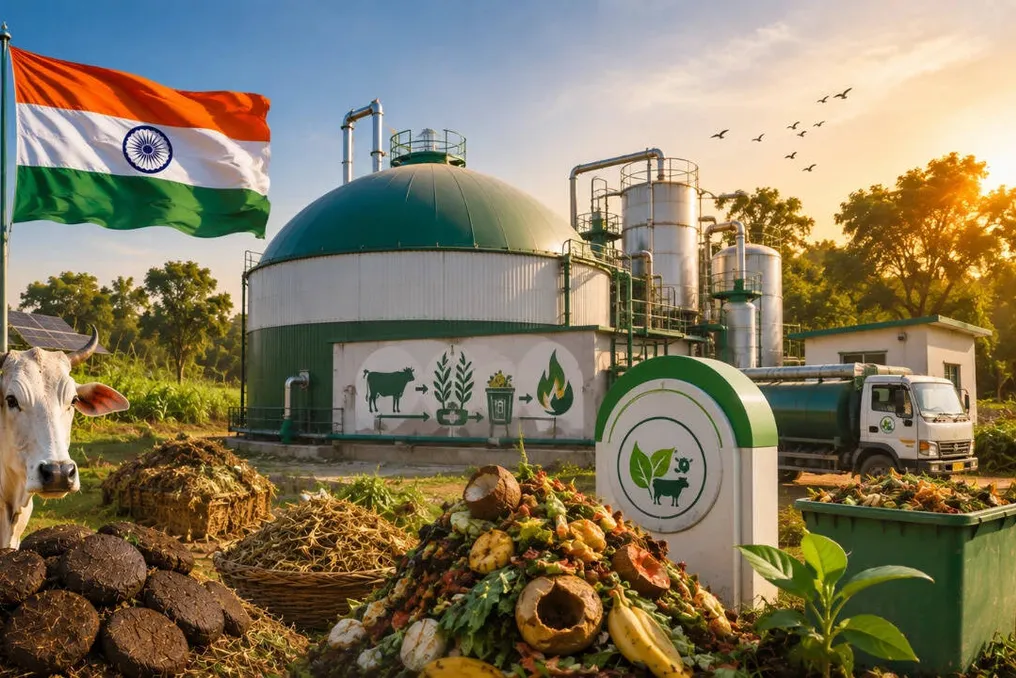
The core idea is to utilize waste that would otherwise be burned, stored, or decomposed and process it at a biogas plant to produce fuel similar to natural gas.
However, the government's ambitions extend further. It seeks to make villages centers of energy production, farmers suppliers to the energy industry, and organic waste an economic resource rather than just a disposal problem. It remains to be seen whether the new scheme can solve the problems that have hindered the CBG industry in India for many years.
What is GOBARdhan?
The GOBARdhan initiative is not entirely a new concept. It was initially launched in 2018 under the 'Swachh Bharat Mission-Grameen' program as a waste management program. Its initial focus was on converting cattle dung, kitchen waste, crop residues, and other organic material into biogas and bio-slurry, helping villages manage waste while simultaneously producing useful products.
The 2026 version is significantly broader. The government now positions GOBARdhan as the national framework for the compressed biogas industry, consolidating several existing measures under one roof and placing the scheme under the Ministry of Petroleum and Natural Gas. These measures include the 'Sustainable Alternative Towards Affordable Transportation' (SATAT) initiative, a market development assistance scheme for organic fertilizer, biomass aggregation equipment scheme, pipeline infrastructure support, and central financial assistance for CBG plants.
Simply put, the government is shifting from the question of 'how do we manage organic waste?' to 'how do we build an industry around it?'
How is waste converted into fuel?
The process begins with organic raw materials such as cattle dung, agricultural residues, sugar mill bagasse, and municipal organic waste. This material is fed into an anaerobic digester, where microorganisms break it down in the absence of oxygen, producing biogas. Raw biogas contains methane, as well as carbon dioxide and other impurities.
The gas is then cleaned to remove these impurities and compressed. The resulting compressed biogas, or CBG, possesses properties comparable to natural gas and can be used in the existing gas ecosystem. This is one of its main advantages: India does not necessarily need to create a completely separate fuel infrastructure for it.
The process also produces organic material that can be processed into fertilizer. This means that one plant can potentially generate multiple economic outputs: waste is converted into CBG, organic fertilizer, rural jobs, and additional income opportunities. This is the circular economy the government is trying to build.
Why does India need CBG?
The primary reason is energy security. According to the latest GOBARdhan document, India currently imports nearly 50% of its natural gas requirements. This makes the country vulnerable to international gas prices, shipping disruptions, and geopolitical turmoil. Domestic CBG offers a way to produce part of this gas from resources that India already has in abundance.
The government estimates that reducing dependence on imported fossil fuels through GOBARdhan could ultimately save over 40,000 crore rupees in foreign exchange. This is a government projection, not a guaranteed saving, but it illustrates the scale of ambition. There is also an environmental argument. Agricultural residues that are not utilized economically can become a waste disposal problem, and organic waste dumped in landfills can emit methane and other pollutants. Converting such material into fuel gives it economic value and potentially reduces waste-related emissions.
For farmers, the attractive aspect is the emergence of an additional market for residues and dung. For energy companies, it is another source of domestic gas. For the government, it is a way to link waste management, rural development, and energy security.
India has tried to implement CBG before. What went wrong?
This is where the history of GOBARdhan becomes more complex. India's push for CBG production predates the new scheme by several years. The government launched SATAT in October 2018 with the ambitious goal of establishing 5,000 CBG plants producing 15 million tonnes annually. However, the industry struggled to meet the initially planned pace.
A review conducted by the Parliamentary Standing Committee on Petroleum and Natural Gas in 2022 showed that only 40 plants were built by 2023-24, instead of the targeted 5,000. The committee also highlighted issues with financing, multiple clearances, pricing, and raw material availability. One of the biggest challenges was that a CBG plant requires much more than just a plot of land and a digester. It needs a reliable supply of biomass, equipment for collecting and transporting this biomass, storage facilities, technology, financing, and, crucially, a buyer for the gas.
The seasonality of agricultural residues is a serious hurdle. Crop residues may only be available in large quantities for a few months of the year, forcing plants to invest in storage and logistics if they want to operate year-round. The Parliamentary Committee specifically noted this issue. Bansal estimates that India produces about 230 million tonnes of surplus agricultural residue annually, indicating that the problem is not a lack of biomass, but the difficulty of turning dispersed and seasonal supplies into a reliable year-round supply chain. Therefore, GOBARdhan's emphasis on biomass mapping, aggregation infrastructure, and district-level planning is critical for ensuring high plant utilization.
There was also a funding problem. Banks and investors were wary of projects whose revenue depended on uncertain raw material supplies and fluctuating CBG prices. The committee noted concerns about low internal rates of return for plants and called for more favorable pricing. This is precisely the gap GOBARdhan is now trying to close.
Kapil Bansal, a partner specializing in energy transition and decarbonization at EY-Parthenon India, told TOI that the biggest change is that GOBARdhan addresses the entire CBG value chain, not just isolated bottlenecks. Previous measures addressed issues like biomass aggregation, organic fertilizer, pipelines, and financial aid separately, but developers continued to face uncertainty regarding demand, pricing, and financing. Bansal stated: 'The sector is moving from a project-based approach to a market-based approach, where visibility of demand, pricing, and financing is available before developers invest.' He added that combining guaranteed off-take, a ten-year price framework, capital assistance, pipeline connectivity, and credit guarantees should improve bankability and strengthen investor confidence.
What changes are in the 23,731 crore rupee scheme?
The government has structured GOBARdhan around six core components, each designed to address a specific weakness in the existing CBG ecosystem.
New changes introduced in the updated scheme
1. Guaranteed demand for CBG. Perhaps the most significant change is that producers will have greater certainty that someone will buy their gas. City gas distribution companies will purchase CBG based on a notified obligation, which increases from 3% in the 2026-27 financial year to 4% in the 2027-28 financial year and 5% from the 2028-29 financial year for the CNG transport and PNG domestic segments. This creates a predictable demand signal. This is important for investors because it is much easier to finance a plant when there is greater clarity on who will buy its product.
2. Stable pricing. GOBARdhan sets a government price for CBG at 2,110 rupees per MMBTU with a minimum ten-year validity. The goal is to provide producers with greater revenue transparency and make projects more attractive to investors and lenders. This directly addresses one of the problems identified in the previous CBG ecosystem: uncertainty about the economic viability of operating the plant after construction.
3. Capital assistance. Eligible new CBG projects can receive capital assistance of up to 2 crore rupees per tonne per day (TPD) of installed capacity. Importantly, the support is not limited to the main plant. It can also cover critical assets related to feedstock aggregation, organic fertilizer processing, and added value. Retrofitting projects expanding existing capacity are also eligible. This is crucial because the CBG economy depends on the entire supply chain, not just the digester.
4. Pipelines to connect plants with buyers. A CBG plant cannot be commercially successful if its gas cannot reach the market. Therefore, GOBARdhan provides for clustered and autonomous pipeline infrastructure connecting plants to trunk lines and city gas distribution networks. The goal is to reduce transportation costs, increase reliability, and expand the market available to producers.
5. Credit guarantees. The scheme also attempts to solve the financing problem through a special credit guarantee mechanism. By sharing some of the credit risk, the government hopes banks will be more willing to finance MSME-based CBG projects. This could allow smaller companies, cooperatives, women entrepreneurs, and first-time market entrants to enter an industry that has historically been dominated by large players and institutional initiatives.
6. District-level ecosystem fund. The last component focuses on the often least-discussed problem: where will the feedstock come from? The CBG ecosystem challenge fund will support biomass mapping, aggregation infrastructure, district-level development plans, technology adoption, process improvements, and added value for organic fertilizer. The goal is to create a local ecosystem around each plant, rather than viewing the plant as an isolated piece of infrastructure.
What does this mean for farmers?
The government's broader statement is that farmers must become participants in India's energy economy. Crop residues and dung can become feedstock for CBG plants, creating potential additional income for farmers and local aggregators. The benefit does not end with gas. The material remaining after the biogas production process can be processed into organic fertilizers, such as fermented organic fertilizer and liquid fermented organic fertilizer. This creates a second stream of income while returning nutrients to agriculture. The government already supports this side of the industry through the market development assistance scheme. These measures aim to create a cycle where agricultural and livestock waste becomes input for both energy and agriculture. This is why GOBARdhan is presented not just as an energy scheme, but also as a program for rural infrastructure development and waste management.
How big is the CBG industry in India today?
This is perhaps the most telling part of the latest government data. As of August 6, the GOBARdhan Unified Registration Portal recorded 1,908 registered CBG/Bio-CNG plants. Of these, 217 were operational, and another 339 were under construction, according to government data. These figures demonstrate both the potential and the challenges.