Egypt has made a significant move in its strategy to dominate the trade routes of the Red Sea and the Mediterranean by accepting two massive bulk carriers with a capacity of 82,000 tons, manufactured at the New Hantong shipyard in China.
Egypt has made a significant move in its strategy to dominate the trade routes of the Red Sea and the Mediterranean by accepting two massive bulk carriers with a capacity of 82,000 tons, manufactured at the New Hantong shipyard in China.
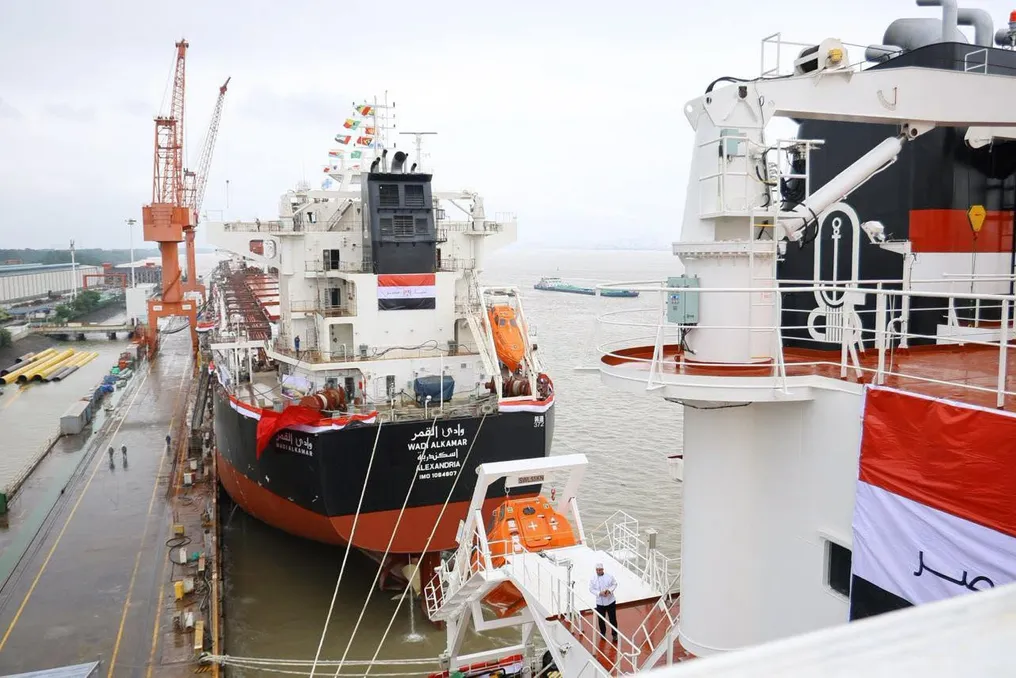
These vessels, named Wadi El-Nil and Wadi El-Kamar, were officially handed over to the National Navigation Company (NNC) during a ceremony in China. The Egyptian Minister of Transport, Kamel El-Wazir, attended the event.
The addition of these Kamsarmax class giants increases the active fleet of NNC to sixteen vessels. Both ships are 229 meters long and equipped with modern designs to improve fuel efficiency, aimed at reducing operating costs on international sea routes.
This delivery is part of an aggressive campaign by Cairo to revitalize its merchant fleet and establish the country as a global hub for transit and logistics.
The Ministry of Transport has outlined several key objectives. Among them is expanding the state fleet to 40 fully state-owned vessels by 2030 through subsidiary lines (including NNC, Arab Bridge Maritime, and Cairo Ferries), which will increase national cargo capacity to 30 million tons annually.
It is also planned to increase the number of commercial ports to 19 in the Mediterranean Sea and the Red Sea, and the total port area should grow to 100 million square meters. Furthermore, infrastructure modernization is foreseen, including the addition of 70 kilometers of deep-water berths (with depths of 18–25 meters), the construction of 35 kilometers of breakwaters, and increasing the tugboat fleet to 80 units.
The CEO of NNC, Mohamed Soliman Motaleb, stated that the company plans to take delivery of two more double bulk carriers by 2028. Notably, NNC is financing this expansion independently, which will allow it to modernize 54% of its fleet in less than four years—a record period for a state operator.
Previously, the partnership with New Hantong resulted in the delivery of the vessel Wadi El-Arish in January 2024, which is already in operation.
Maersk announced that the companies have reopened route AE19, which is part of the Gemini alliance services. This new route connects Asia, the Mediterranean, Saudi Arabia, and Europe, and the change was implemented immediately.
According to the joint statement, the decision made in partnership with Hapag-Lloyd resulted from detailed analyses of the security situation in the Red Sea area, signaling progress in the gradual return of the Suez corridor.
Previously, both shipping companies had notified a month ago about the resumption of route AE15 through the Suez Canal, motivated by the observed improvement in the security situation.
In December 2023, Maersk, like other major shipping carriers, had suspended all traffic passing through the Red Sea and the Gulf of Aden due to a series of attacks on ships perpetrated by Houthi rebels.
The corridor was partially reactivated, with the vessel 'Maersk Sebarok' making the first crossing since the suspension in December 2025, followed by the 'Maersk Denver' in January 2026.
Maersk and Hapag-Lloyd emphasized that they do not plan to make changes to other Gemini alliance services at this time. The statement clarified that although this change represents significant progress, they are not considering a broader alteration of the east-west network to fully return to the Suez corridor, as no specific schedule has yet been defined.