Truths that challenge us often turn out to be the ones that change us the most. While comforting ideas can make life easier, uncomfortable truths force us to question our beliefs, confront our weaknesses, and see reality more clearly.
Truths that challenge us often turn out to be the ones that change us the most. While comforting ideas can make life easier, uncomfortable truths force us to question our beliefs, confront our weaknesses, and see reality more clearly.
Growth rarely comes from avoiding difficult conversations with ourselves. It arises from accepting realities we would prefer to ignore, whether they are failures, fears, ego, relationships, or the search for meaning. Some books have the power to shatter illusions and reveal deeper insights into human behavior and life itself.
The book 'The Courage to Be Disliked' addresses one of the most common human fears—the desire to be liked by everyone. Based on the ideas of psychologist Alfred Adler, it explores the uncomfortable truth that we cannot control how others perceive us. Many people spend their lives seeking approval, comparing themselves to others, and carrying the burden of expectations. The book teaches that freedom is achieved when a person accepts the fact that not everyone will understand or appreciate their choices. True happiness begins when you stop living according to the opinions of others and start taking responsibility for your own life.
'Thinking, Fast and Slow' reveals an uncomfortable truth about human decision-making: our minds are not as rational as we believe. Daniel Kahneman explains that in everyday decision-making, people are influenced by biases, emotions, and mental shortcuts. We often assume we think logically, yet many of our choices are shaped by hidden patterns and assumptions. This book prompts readers to question their own thinking and recognize the errors they may unconsciously repeat. Understanding the limits of our minds helps us make more balanced decisions.
'The Subtle Art of Not Giving a F*ck' conveys an uncomfortable message: life will always involve problems, and happiness does not come from avoiding them. Mark Manson argues that the constant pursuit of positivity and success can create additional pressure. Instead, people should focus on choosing meaningful difficulties and accepting that challenges are a natural part of existence. The book challenges the notion that everyone can achieve a perfect life without pain or failure, showing that maturity comes from deciding which problems are worth facing.
'Man's Search for Meaning' explores one of life's heaviest truths: suffering is inevitable, but meaning can help us endure it. Drawing inspiration from his experiences during the Holocaust, Frankl explains how people can survive extreme conditions by having a reason to keep living. The book challenges the belief that a meaningful life is a life without pain. On the contrary, it suggests that purpose can be found even in difficult moments, and our reaction to suffering often determines who we become.
'The Road Less Traveled' begins with a simple but uncomfortable assertion: life is hard. M. Scott Peck explains that attempts to avoid problems do not make them disappear. Personal growth requires discipline, emotional honesty, and a willingness to meet challenges instead of running from them. The book examines themes of love, responsibility, relationships, and spiritual development, demonstrating that true transformation occurs through confronting difficulties.
Uncomfortable truths are not meant to demotivate. Their purpose is to eliminate illusions and help us view life with greater clarity. These books remind us that growth begins when we stop evading complex realities. By accepting our flaws, questioning our beliefs, and honestly meeting challenges, we create the opportunity to become wiser, stronger, and more self-aware.
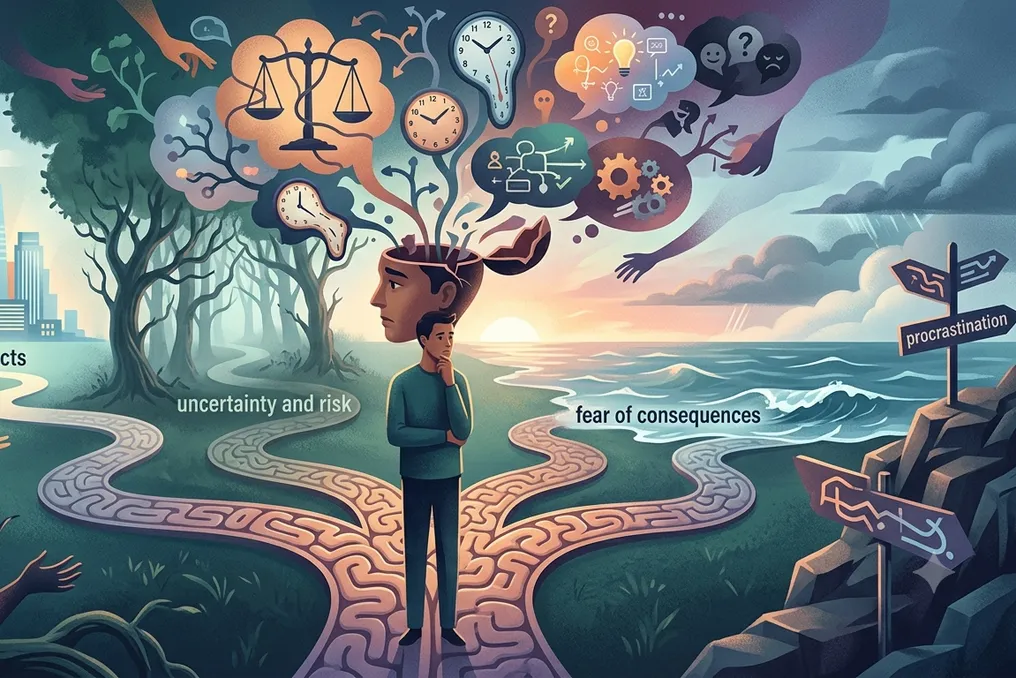
Life is shaped by the choices we make, but the decision-making process rarely boils down to a simple choice between good and evil. Whether you are choosing a career path, building relationships, coping with difficulties, or determining what is truly important, our decisions are often accompanied by uncertainty and emotional tension.
Many people get caught in a cycle of overthinking, fearing mistakes or searching for a perfect answer that may not exist. Difficulty in making decisions is not a sign of low intelligence or lack of knowledge; it stems from deeper psychological patterns such as fear of failure, perfectionism, emotional biases, past experiences, and the desire to avoid regret. Our minds often create invisible barriers that make even simple choices seem complicated.
Books dedicated to the psychology of decision-making help us understand these hidden influences and the scientific basis of our choices. They reveal how our thoughts and feelings affect decisions while offering ways to become more conscious, confident, and thoughtful in choosing our path.
Daniel Kahneman's book, 'Thinking, Fast and Slow,' explores two systems that influence human thought and decision-making. One system works quickly, relying on intuition and emotion, while the other relies on slower, logical reasoning. The author explains that many decisions are influenced by mental shortcuts called biases.
These simplifications help us make decisions faster, but they can sometimes lead to errors, incorrect judgments, and unnecessary doubts. Kahneman demonstrates that understanding how our minds work allows us to recognize flawed thinking patterns. By being aware of our biases, we can make more balanced decisions instead of simply reacting to the first impression.
Barry Schwartz, in his book 'The Paradox of Choice,' explains why having too many options can complicate the decision-making process rather than simplify it. In a world overflowing with endless choices, people often assume that more options will lead to greater satisfaction.
However, Schwartz shows that an excess of possibilities can generate anxiety, confusion, and the fear of making the wrong choice. The book introduces the concept that the constant search for the perfect option prevents people from enjoying the choices they have already made. It teaches readers that setting limits and accepting good decisions instead of perfect ones can bring more peace of mind.
The book 'Decisive' examines why people often struggle when facing important choices and offers a framework for making better decisions. Chip and Dan Heath explain that the decision-making process is often complicated by narrow thinking, emotional influence, and an excessive focus on short-term results.
The authors present practical methods for analyzing choices from different perspectives and reducing uncertainty. The book teaches readers how to avoid common pitfalls in decision-making and approach complex choices with greater clarity. It emphasizes that improving the process leads to better decisions, not trying to predict every possible outcome.
Dan Ariely, in his work 'Predictably Irrational,' argues that human decisions are often determined by emotions, expectations, and hidden factors, rather than pure logic. The book examines how people often make choices that seem rational at the moment but are actually shaped by unconscious influences.
Ariely explains why we sometimes act against our own interests and repeat patterns we do not fully understand. By understanding these irrational tendencies, readers can become more aware of the forces influencing their decisions. The book shows that recognizing one's own limitations is the first step toward making smarter decisions.
Greg McKeown, in his book 'Essentialism,' focuses on the difficulty of determining what truly deserves our time and energy. Many people face problems in decision-making because they try to do everything, please everyone, or avoid missing out on opportunities.
The book clarifies that constantly agreeing to unnecessary commitments can distract us from what is most important. McKeown teaches that effective decision-making requires a clear understanding of priorities. By mastering the ability to eliminate distractions and focus on essential choices, people can build a more meaningful and balanced life.
Decision-making is not just about choosing between options; it is about understanding the emotions, beliefs, and thought patterns behind those choices. These books show that hesitation often stems from deeper psychological factors, not just simple confusion. By studying how our minds work, we can increase awareness of our biases, reduce unnecessary rumination, and make decisions with greater confidence. The goal is not to make the perfect choice every time, but to develop the ability to choose wisely and move forward.
Money is often perceived as a practical tool for acquiring necessities and assessing financial success. However, our relationship with money is rarely logical. Fear can hinder investment, while anxiety can encourage overspending. Childhood experiences shape our perceptions of savings, spending, or wealth over many years. Behind every financial decision lies a complex web of emotions, beliefs, and personal stories.
To understand money, it is not enough to study budgets and investments; one must delve into human behavior. The books presented below explore the emotional aspects of finance, demonstrating how feelings influence financial decisions and why money often matters more than the numbers in a bank account.
Morgan Housel's book, 'The Psychology of Money,' analyzes how people's financial decisions are determined by behavior rather than intelligence. Through real-life stories and examples, Housel argues that financial success depends less on technical knowledge and more on emotional self-discipline. The publication explains how life experience influences financial perspective.
A person who has experienced economic hardship may view money differently than someone who grew up during a period of prosperity. These differences often lead to choices that seem irrational to outsiders but are entirely justifiable from the perspective of personal history. Housel also examines emotions such as greed, fear, envy, and impatience, showing how they can lead to poor financial decisions even in highly educated individuals. The central message of the book is that understanding emotional behavior is often more valuable than mastering complex financial formulas.
'Your Money or Your Life' encourages readers to rethink the true meaning of money. Instead of viewing money merely as currency, the authors urge readers to see it as a reflection of life energy, time, and personal values. The book explores the emotional impact of consumer culture and examines why many people chase financial goals that do not bring long-term satisfaction.
It motivates readers to assess whether their spending habits align with what truly matters to them. One of the book's strongest revelations is that emotional fulfillment often stems from purpose, relationships, and meaningful experiences, rather than constant consumption. By linking finance to personal values, the book transforms money from a source of stress into a tool for conscious living.
Financial psychologists Brad Klontz and Ted Klontz, in their book 'Mind Over Money,' study how unconscious beliefs affect financial behavior. The authors introduce the concept of 'money scripts'—deeply ingrained ideas about wealth that are often formed in childhood. These scripts can dictate financial habits throughout life. Some people grow up believing that money is dangerous, while others associate wealth with status, security, or happiness. Even if these beliefs are false or harmful, they can continue to influence adult decisions. The book explores emotional patterns such as financial anxiety, guilt, shame, and avoidance, offering practical exercises and psychological insights to identify and change unhealthy money attitudes, leading to healthier and more conscious relationships with finances.
Ken Honda, in his book 'Happy Money,' offers a fresh perspective on wealth and happiness. Based on Japanese philosophy and principles of personal development, Honda argues that money carries an emotional energy that affects how people experience financial success. According to Honda, many associate money with stress, worry, or conflict, meaning that even financial abundance does not bring peace of mind. The book calls for cultivating gratitude and a positive attitude toward money. Honda shows how generosity, appreciation, and mindful spending can transform the financial experience, emphasizing that financial well-being and emotional health are closely linked, not just wealth accumulation.
'Scarcity' explores how the feeling of lack affects human behavior. Whether scarcity relates to money, time, or resources, the authors show that perceived shortages can significantly alter the decision-making process. The publication explains that financial stress consumes mental resources, hindering clear thinking and effective planning. People experiencing scarcity often focus on immediate problems, ignoring long-term consequences. This viewpoint helps explain why financial difficulties are not just a result of bad choices, but a consequence of emotional pressure and cognitive overload.
Lynn Twist, in her work 'The Soul of Money,' examines deeper emotional and spiritual aspects of wealth. Drawing on her experience working with people from various economic backgrounds, Twist questions the notion that having more money automatically means being happier. She argues that many live in a state of scarcity, regardless of how much they possess, which breeds anxiety, dissatisfaction, and endless pursuit. Twist advocates adopting a mindset of sufficiency, acknowledging and valuing what one already has. Through personal stories and reflections, she demonstrates how gratitude and generosity can foster healthier relationships with money, showing that emotional fulfillment often comes not from accumulation, but from a sense of enough.
These six books prove that money is never just about mathematics. Financial decisions are shaped by emotions, personal experiences, cultural influences, and deeply rooted beliefs. Whether it is psychology, personal development, behavioral science, or philosophy, these books demonstrate that true financial well-being depends on emotional awareness as much as it does on financial knowledge. By exploring the link between money and emotions, readers can gain not only greater financial stability but also a more meaningful and fulfilling life.
Human attachment shapes almost all the relationships we build. Whether it concerns childhood bonds, romantic relationships, or friendship, how we attach to others influences how we love, trust, communicate, and cope with emotional intimacy. Some people easily open their hearts, while others face fear of rejection, emotional distance, or a constant need for validation.
These behavioral patterns are not random; they are often linked to our past experiences, beliefs, and emotional conditioning. Books on attachment psychology help us understand why we behave a certain way in relationships. They demonstrate how early experiences shape our emotional reactions, why we repeat the same patterns in relationships, and how to develop healthier connections.
The book 'Attached' explains how attachment styles influence behavior in romantic relationships. The authors present three main styles: secure, anxious, and avoidant, showing how each affects communication, emotional needs, and partner choice. This book helps readers realize why some people constantly seek validation while others prefer emotional independence. It teaches that recognizing attachment patterns contributes to building healthier relationships instead of repeating old emotional cycles.
For anyone interested in why they react differently to love, intimacy, and conflict, 'Attached' offers a simple introduction to attachment theory and relationship psychology.
Sue Johnson's book 'Hold Me Tight' explores the emotional foundation of romantic relationships and explains why people often experience recurring conflicts with partners. Based on Emotionally Focused Therapy, it shows that many relationship problems stem from deeper fears of loneliness, rejection, and feeling insignificant. Johnson argues that beneath arguments, people are often seeking emotional safety and security. The book teaches readers how to strengthen emotional bonds by understanding their partner's needs and responding with empathy rather than defensiveness.
'The Body Keeps the Score' examines how past experiences, especially trauma, can affect emotions, relationships, and ways of interacting with other people. Bessel van der Kolk explains that complex experiences can change the brain and body, determining a person's reaction to trust, vulnerability, and emotional closeness. The book illustrates why some individuals struggle with intimacy or feel unsafe even in supportive relationships, emphasizing the importance of healing emotional wounds to create healthier bonds.
'Insecure in Love' focuses on how insecurity affects romantic relationships and why some people constantly fear losing those they care about. Leslie Becker-Falk explains that attachment anxiety can lead to overthinking, seeking reassurance, and excessive dependence on a partner's approval. The book provides practical guidance on overcoming unhealthy relationship habits and strengthening self-esteem.
'Attached at the Heart' examines attachment from the perspective of parenting and early emotional bonds between children and caregivers. The authors explain how responsive and caring relationships in childhood influence emotional development, self-confidence, and the ability to form healthy relationships in adulthood. The book emphasizes the importance of understanding children's emotional needs and shows how early attachment experiences determine how a person interacts throughout life.
'Love Sense' explores the scientific basis of romantic love and explains why emotional connection is necessary for human survival and happiness. Sue Johnson challenges the idea that love is just a feeling, presenting it as a powerful emotional bond formed by our need for safety and connection. The book combines psychology and research to explain why people strive for deep relationships and how these bonds can be strengthened, helping readers view love as an attachment system, not just an emotional experience.
This book explores the psychology of successful long-term relationships and reveals the factors that contribute to maintaining a strong emotional connection in couples. John Gottman's research shows that healthy relationships depend on communication, mutual understanding, respect, and emotional responsiveness. The book clarifies how small daily interactions affect trust and attachment between partners, offering practical lessons for improving relationships and understanding behavior that creates long-term emotional security.
Human attachment is one of the most powerful forces shaping our lives. These books demonstrate that our relationship patterns are determined by our experiences, emotions, and the ways we have learned to seek connection. Understanding attachment psychology allows us to recognize unhealthy patterns, communicate better, and build deeper relationships. By realizing how we attach to others, we can move toward more secure and meaningful connections.