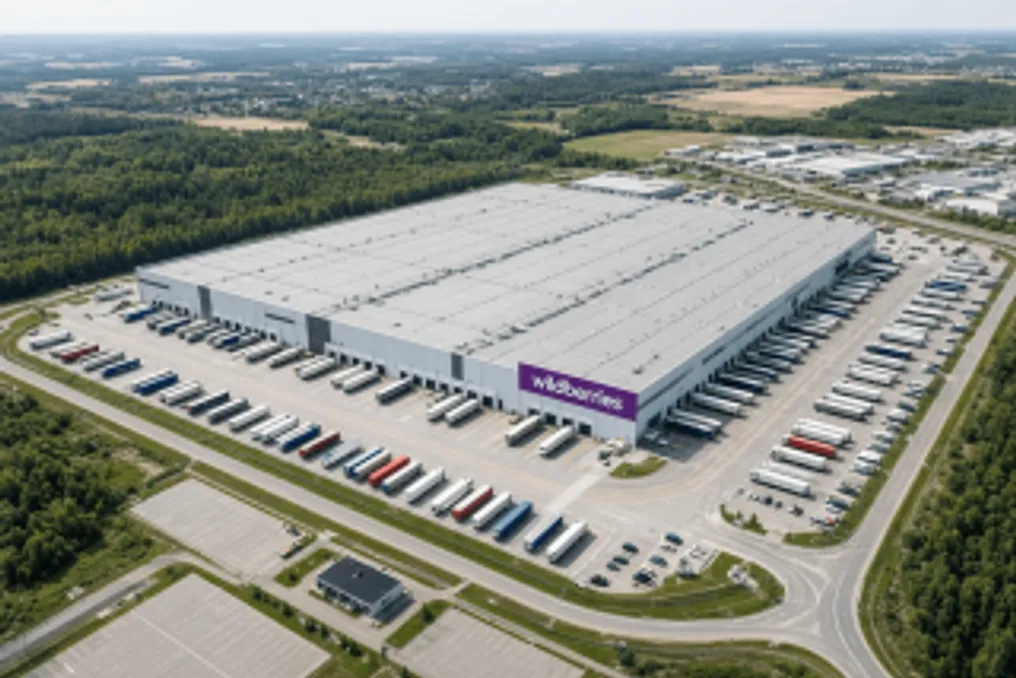
Sellers on the 'Wildberries' platform have begun filing mass complaints regarding payment delays for goods sold on this marketplace. According to a report by 'Verstka', such appeals are appearing in specialized market chats.
Sellers on the 'Wildberries' platform have begun filing mass complaints regarding payment delays for goods sold on this marketplace. According to a report by 'Verstka', such appeals are appearing in specialized market chats.
In the early 1980s, specifically in 1981, Volkswagen launched the Diesel Kombi, offering it in different configurations: Standard and Luxury passenger versions, as well as pickup models with single and double cabs for cargo transport. This utility vehicle was considered very versatile for its time, capable of carrying eight to ten occupants in passenger versions and supporting over one ton of gross weight in cargo versions, serving everyone from small merchants to large corporations.
Theoretically, the product had great appeal because the Kombi was already more affordable than many existing pickups on the market and possessed great adaptability. Volkswagen's decision to add a diesel version aimed to increase these advantages, taking advantage of the Brazilian government subsidy for diesel fuel in the early 1980s, which was considerably cheaper than gasoline, a particular advantage for fleet operators and transporters.
To achieve this, the manufacturer imported a 1.6-liter diesel engine technology from Europe, belonging to the same basic family used in other Volkswagen vehicles. This engine, which was naturally aspirated and did not use a turbocharger, generated only 50 hp and about 9.7 mkgf of torque, figures considered modest even for that period.
The performance was notably deficient; imagining a Kombi loaded with many passengers trying to climb a hill or overtake demonstrated the problem. With only 50 hp, the performance was unsatisfactory, affecting both comfort and safety in certain situations. In cargo versions, the scenario was even more critical, as the pickups, when close to maximum capacity, demanded a lot from the mechanical assembly, which lacked adequate power for the transported weight.
Besides performance issues, technical limitations arose due to the rush to launch. Although the engine remained in the rear, like in the air-cooled versions, it came to rely on a liquid cooling system. The radiator was placed at the front of the vehicle, forcing the liquid to travel a long distance between the front and the rear, exposing limitations under intense use.
Since the performance was already restricted, drivers often had to accelerate to the maximum to maintain acceptable speeds. On hot days and with heavy loads, reports of overheating were frequent, as the assembly operated constantly at its limit.
To worsen the situation, the Diesel Kombi cost about 30% more than the variants equipped with the traditional air-cooled boxer engine. These latter offered approximately 65 hp and more torque, in addition to being simpler, better known by mechanics, and significantly cheaper in purchase price. The only real advantage of diesel was lower fuel consumption, but the savings took a long time to offset the higher initial cost.
Business owners and fleet operators quickly identified this economic disadvantage. The financial return provided by diesel required several years of use to justify the extra investment, while dealing with a more expensive, slower vehicle that required greater mechanical attention. The result was as expected.
Between 1981 and 1985, the Diesel Kombi registered sales of approximately 13,000 units. In the same period, the conventional air-cooled versions exceeded the mark of 128,000 units sold, clearly demonstrating the market's strong rejection of the novelty.
Due to the disappointing commercial performance, Volkswagen quickly withdrew the line version. Over the years, many of the few surviving examples had their original engines replaced with more reliable and robust options. In various specialized workshops, adapting them with diesel engines from other applications or even gasoline engines became common, in an attempt to overcome the restrictions of the original assembly.
The Diesel Kombi entered history as a classic example of a product that seemed promising on paper but failed to meet market expectations. The concept was excellent, but the execution fell far short of what was necessary, resulting in one of the most notable commercial failures in the Kombi's trajectory in Brazil.
Ahead of what could be one of the largest IPOs in history, Wall Street is examining the future of Anthropic, valuing it based on expected revenue two years out. According to information from two sources familiar with the company's financial performance, Anthropic forecasts revenue in the range of approximately $190 to $200 billion by 2028. This figure significantly exceeds the current revenue pace of $47 billion, which the company reported in May, demonstrating the scale of growth that investors are being asked to support.
Bankers and investors are using enterprise value-to-revenue multiples based on these projections. The application of revenue multiples is a common practice for fast-growing software companies that have not yet reached a mature profit profile. However, looking two years ahead is less typical, reflecting the rapid expansion of Anthropic's business and the difficulties in setting benchmarks for a company that continues to heavily invest in developing its artificial intelligence infrastructure.
The pace of spending on AI investments has caused a decline in many popular tech stocks in recent months, including some firms comparable to Anthropic. Previously, among the fastest-growing companies to go public, there were instances where investors referenced expected revenue by 2028 during IPO preparation, such as with Cerebras Systems, and SpaceX's forecasts extended to 2029 before its June public offering at a record valuation.
This approach reflects the difficulty in valuing an AI company whose margins are still under pressure from massive costs associated with computational power, model training, and hiring personnel. Investors are betting that as Anthropic grows, its revenue will increase faster than the costs required to support that growth, allowing margins to expand.
For benchmarking Anthropic ahead of analyst day, public companies such as the cloud infrastructure firm Cloudflare, the enterprise software company Palantir, and Elon Musk's SpaceX are being considered. Public comparables are a critical part of the valuation process during an IPO, as they provide investors with a baseline for assessing companies with similar business models and growth profiles. The group of companies also helps determine which revenue or profit multiples should be applied to the company's financial forecasts.
Palantir is valued at 53 times its expected revenue this year, making it one of the most expensive stocks on Wall Street. LSEG data shows that SpaceX and Cloudflare trade at a multiple of 41.6x expected revenue for 2026. Each of these companies offers a different perspective on Anthropic: Palantir serves as a benchmark for valuing a fast-growing, AI-involved business; Cloudflare provides a comparison with a high-growth software and infrastructure company; and SpaceX demonstrates an example of a company valued partly on future scale expectations rather than current financial standing.
Traditionally established companies are valued more heavily on profit or EBITDA, giving investors insight into the business economics. However, for Anthropic, current EBITDA does not fully reflect the economics investors expect to see upon scaling. The company spends huge sums on GPUs and other computing power, model training, inference, and hiring. These expenses are necessary to support rapid expansion but may constitute a smaller share of revenue as the business grows.
The company's financial trajectory already shows how quickly this equation is changing. According to the company itself, Anthropic's revenue pace was around $9 billion at the end of 2025 before growing to over $47 billion by May. Anthropic projected revenue of no less than $10.9 billion for the second quarter of 2026, more than double the previous quarter, aligning with plans for first-quarter operating profit of $559 million.
The company stated that its revenue growth rate increased by more than tenfold annually over each of the three years leading up to 2026. This growth is the key reason why investors are willing to look as far ahead as 2028 when applying a revenue multiple. Thus, the valuation depends on the assumption that Anthropic's current expenditures are funding a business that will ultimately generate much higher revenue and margins. It is expected that training and inference will become more efficient as technologies improve, and personnel and other operating costs will represent a smaller share of revenue as the company scales.
"Can they reach a valuation of $2 trillion? Yes, they can, and I'm just curious if it will remain so over time," noted David Merkel, senior partner at investment firm Aleph Investments. "Does AI truly produce that much additional productivity... These are just questions we need to ask if we are thinking about pricing this, buying this."