Women in South Africa are achieving success in areas of property ownership, education, and leadership; however, recent labor market data shows that these achievements have not led to employment equality.
Women in South Africa are achieving success in areas of property ownership, education, and leadership; however, recent labor market data shows that these achievements have not led to employment equality.
This statistical data emerged during the celebration of Women's Month in South Africa, which was held under the slogan 'Empowered women strengthen the nation,' and attention was paid to women's participation in the economy.
According to the Quarterly Labour Force Survey published by Statistics South Africa, in the second quarter of 2026, women constituted slightly over half of South Africa's working-age population. Nevertheless, the official unemployment rate among women aged 15 to 64 was 37.5%, higher than the 30.3% for men, a difference of 7.2 percentage points.
Of the 21.3 million working-age women, slightly more than half were in the labor force, with nearly two-thirds employed, and the remaining 4.4 million unemployed. Statistics South Africa noted that although the female labor force participation rate has increased over time, it remains consistently lower than that of men.
The female labor force participation rate was slightly over half, while for men it was about two-thirds. The gap became even more noticeable when considering the proportion of the working-age population actually employed: the absorption rate for women was one-third, whereas for men it reached 44.9%.
In the second quarter, almost 9.6 million women were completely outside the labor force. Approximately 2.5 million constituted the potential workforce—these are people who are either willing to work but are not actively seeking employment, or are actively seeking employment but cannot start it. The majority of this group consisted of people who had lost hope in finding work.
This problem was particularly pronounced among young women. More than four out of ten women aged 15 to 24 had no employment, education, or training, compared to approximately one-third of young men. Furthermore, the indicator for women increased by 1.6 percentage points compared to the second quarter of 2025.
Differences also persisted in the types of jobs performed. Women held managerial positions less frequently than men: approximately one in 14 working women was a manager, while among working men, this figure was one in 10. Women were more often represented in clerical work and domestic labor. Clerical professions accounted for 17% of female employment compared to 5.8% for men, and domestic work accounted for 10.8% of female employment versus only 0.5% for men.
The gender gap in employment in South Africa is part of a broader trend. The International Labour Organization (ILO) estimated global unemployment at 4.9% in 2025, unchanged from 2024, and forecasts that it will remain at this level in the coming years. However, according to the ILO, women account for only about two-fifths of global employment and are less likely to participate in the labor force than men by 24.2 percentage points, indicating 'significant barriers to employment access.'
Seventy years after the march to the Union buildings, women have achieved better representation in education and the economy, but they remain underrepresented in top corporate positions.
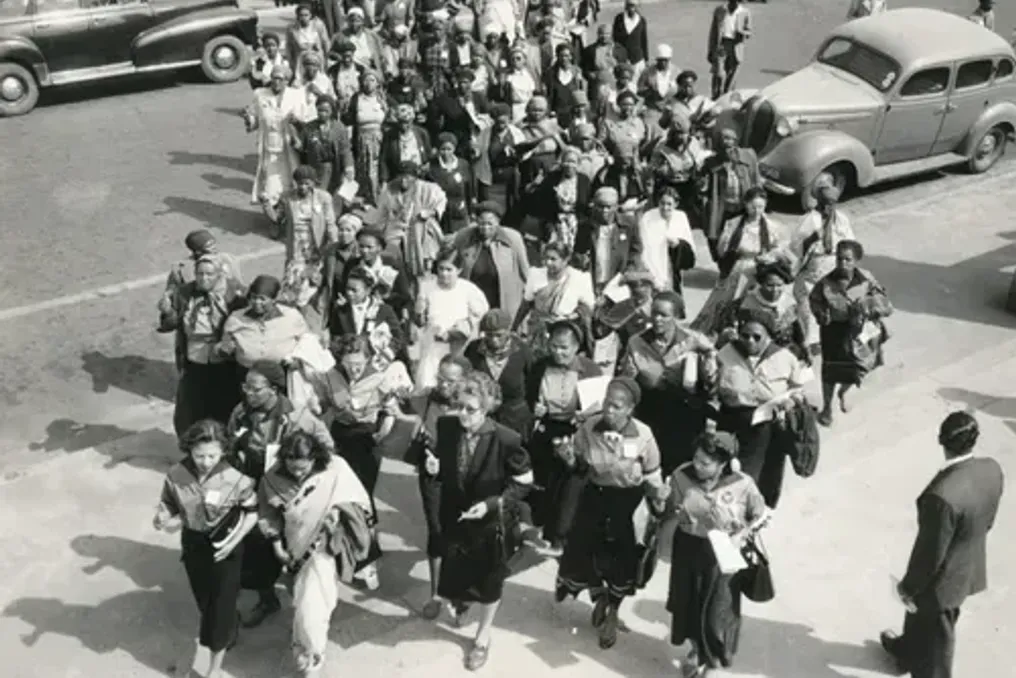
Seventy years ago, over 20,000 women marched to the Union buildings in Pretoria to protest the expansion of pass laws for Black women. The march on August 9, 1956, was organized by the Federation of South African Women and involved women of various races. Leaders of the procession included Lillian Ngoyi, Helen Joseph, Rahima Musa, and Sophia Williams-De Bruyn, who presented a petition to the government of Prime Minister J. G. Strijdom.
The women's demands went beyond pass laws. Their previous appeal to the Congress of the People included requests for childcare, housing, education, equal pay, as well as equal rights regarding property, marriage, and child custody. On the day of the march, the women stood silently for thirty minutes, singing the songs Nkosi Sikelel’ iAfrika and the protest song Wathint’ abafazi, Strijdom!
Seventy years later, women are better represented in education and the economy, but they still lack representation in senior corporate roles. Women constitute 46% of South Africa's economically active population. Nevertheless, a Just Share study published in BDO South Africa's Women's Month 2026 edition shows that in 2025, women held 38% of board seats and 27.4% of executive positions in companies listed on the JSE Top 40—an increase from 35% and 25% respectively in 2023, but this is still not enough to achieve parity. Only three companies on the JSE Top 40 list had a woman as CEO, and six had a woman as chairperson of the board.
BDO's own data demonstrates that the firm still has work to do: women make up 23% of BDO partners in South Africa, which is below the global average of 25%, although the firm claims that women are well-represented at the director level, which influences partnership. World Economic Forum data cited in the publication reflects a similar picture globally: women now surpass men in higher education, but account for only 29.5% of senior managers with higher education.
For the women mentioned in the report, progress is linked not only to representation but also to access. One participant, Tuto Masasa, a national consulting lead, distinguishes between mentorship and sponsorship. According to her, sponsorship means putting someone's name forward when they are absent, assigning them tasks that make their abilities visible, and using one's own authority to support that person. Masasa wrote: 'Many talented people do not lack ability. They lack access.'
Taraneh Rahimian, an audit partner, drew a similar conclusion based on personal experience. She advised: 'Seek mentors who will guide you, but also seek sponsors—people who will advocate for you when you are not in the room.'
Fayaz Mohammed, head of BDO's International Offshore Centre, stated that women need to put themselves forward for opportunities even before they feel completely ready. She noted: 'Confidence often develops after we take the leap, not before it. Do not let self-doubt convince you that you are less capable than you actually are.'
In 2025, women held 38% of board seats and 27.4% of executive positions in JSE Top 40 listed companies, higher than 35% and 25% respectively in 2023, but still short of parity.
Elzanne Lombard, head of BDO's finance department, provides one of the clearest examples of how sponsorship can change a career. When Lombard was studying, her family could no longer afford her education. She applied for a BDO scholarship, and the firm sponsored her third and final year. She joined as an intern in 2010 and advanced within the organization.
When the Head of Finance position opened in 2022, the then CFO, Daniel Botha, advised her to apply. Lombard wrote: 'He saw potential and strength in me that I myself struggled to see. For me, this is the main point: BDO believed in my potential, no matter who I was, and nurtured me into the Head of Finance I am today.'
Chan-re Petersen said that the people who influenced her career were those who invested their time, knowledge, and belief in her. She described receiving this support as gaining confidence and courage, adding that those who receive such support have a responsibility to pass it on. The report also points to practical aspects of sponsorship: giving a junior colleague the opportunity to present work, including them in a meeting, or sharing undocumented knowledge.
Bonga Mokoena, CEO of BDO South Africa, stated that the 70th anniversary of the Women's March should be seen as a call to action. He noted: 'Seventy years after the women of 1956 marched, BDO's global #GiveToGain theme challenges each of us to use our influence, sponsorship, and opportunities to lift others up.'
Mokoena added: 'This is how we build sustainable economies for all in South Africa: by removing barriers and ensuring that women are not just present in the economy, but have the power to lead, make decisions, and shape its future.'
Seventy years after the 1956 Women's March, South African women continue to face challenges related to poverty, unemployment, gender-based violence, and unequal opportunities. The article asserts that achieving genuine gender equality requires broader economic empowerment, education, leadership opportunities, and more decisive action against gender-based violence.
Every August, South Africa commemorates the legacy of over 20,000 women who marched to the Union Buildings in Pretoria on August 9, 1956. This act of resistance is considered one of the most significant in the country's history. These women of various races, many carrying infants on their backs, protested against pass laws that regulated not only their movement but also their dignity. They carried petitions, chanted, and declared with unwavering confidence: 'Wathint' Abafazi, Wathint' Imbokodo.'
The 1956 march serves as a powerful reminder of the sacrifices made for freedom and the long-standing demand for equality even before it was enshrined in law. It highlighted that unity is the strongest counter to division, demonstrating the remarkable achievements possible when women unite.
Women of the past faced immense hardships and overcame countless obstacles, transforming their darkest days into a brighter future for coming generations. Their courage, resilience, and determination paved the way for the rights and opportunities many enjoy today.
Today, 70 years later, their footsteps still resonate in our national consciousness. Although the country has made significant strides in advancing women's rights since the advent of democracy, many women continue to encounter systemic barriers to full participation in society and the economy. They are disproportionately affected by poverty, unemployment, gender-based violence, unequal access to opportunities, and underrepresentation in critical sectors. These issues serve as a stark reminder that the fight for gender equality is far from over and requires a collective commitment from all sectors of society.
At the heart of women's transformation lies economic empowerment. Despite numerous policy measures, unemployment, income inequality, and limited access to economic opportunities continue to disproportionately affect women. Many women-owned businesses still struggle to secure funding, procurement opportunities, and established supply chains. Therefore, it is necessary to strengthen support mechanisms that enable women to fully participate in the economy through greater access to capital, markets, skills development, technology, and entrepreneurial support. Economic empowerment means much more than just earning higher wages; it signifies increased autonomy, independence for women, and their ability to influence economic outcomes.
The government also recognizes that violence against women violates their dignity, safety, and constitutional rights, and hinders their full participation in societal life. Thus, combating gender-based violence has become a national priority. To demonstrate this commitment, President Cyril Ramaphosa recently established the first legislative National Council on Gender-Based Violence and Femicide in South Africa, marking a major step forward in the country's fight against GBV. The Council will lead national initiatives aimed at strengthening prevention, supporting survivors, reinforcing law enforcement, and coordinating actions between government and civil society.
Education and skills development are equally vital in advancing women's empowerment. Quality education opens doors to employment, entrepreneurship, and leadership positions. More needs to be done to encourage girls and young women to study science, technology, engineering, and mathematics, as well as to expand access to vocational and digital skills. Through the Human Resources Development Council, we focus on gender-inclusive economic growth and skills development to combat unemployment, which disproportionately affects women. We address gender gaps through technical education, digital skills, and training in in-demand professional fields. However, policy measures alone will not suffice for long-term change. South African society must confront deeply rooted patriarchal attitudes and stereotypes that continue to shape the experiences of women.
Gender inequality is often rooted in homes, schools, workplaces, and communities where discriminatory beliefs and practices are normalized. To achieve significant transformation, cultural attitudes must shift with a greater emphasis on equality, mutual respect, and the fair distribution of roles and responsibilities between men and women. It is equally important to involve boys and young men as partners in promoting gender equality and building a society that respects both women and men. Furthermore, significant efforts are needed to increase the representation of women in leadership and decision-making roles. While progress has been made in political representation, women remain underrepresented in corporate leadership, entrepreneurship, and strategic economic sectors. Various organizations must also actively invest in mentorship, leadership development, and succession planning to ensure that more women occupy positions where they can influence policy, institutions, and economic outcomes.
The transformation of women also requires acknowledging the disproportionate burden of unpaid care work, which women often shoulder while balancing professional and caregiving duties without adequate support. Key measures include improving access to childcare, implementing family-friendly workplace policies, and ensuring a fairer distribution of caregiving responsibilities to allow women to participate in education, employment, and leadership. As a government, we are also addressing systemic barriers through targeted allocation in public procurement, specialized financial funds, and multi-sectoral partnerships. Key interventions include implementing a target of 40% preferential procurement for the public sector, utilizing special financing schemes such as the Isivande Women's Fund, and creating structured market fairs. Moreover, the EmpowerHer Market trade fair has been established to promote women-owned businesses, expand market access, and foster investment linkages. This initiative provides women with tangible pathways to enter supply chains, scale their businesses, and transform their communities.
However, the story of women's transformation does not end here. Aluta continua. Real change is a process, not an event, and the path to full equality requires sustained and active participation. Government, business, civil society, traditional leaders, religious organizations, communities, and families all play a role in creating an environment where women can thrive. Ultimately, we must measure success by the degree to which every woman can live with dignity, safety, equality, and the freedom to realize her full potential. Only then will the vision of the women who marched in 1956 be fully realized.