Shenhai Zhiren, a company specializing in deep-sea robots in Guangzhou, announced the completion of an A-round financing round worth 500 million yuan, according to industry media on August 13th. New shareholders include Guanghe Ventures, Dachen Financial, GGV Capital, Yida Capital, China Insurance Investment, CETC Investment, and an energy technology fund backed by TotalEnergies and managed by Cathay Capital. Existing investors, including Zhengxuan, Yunze, Yunshi, Gaojie, and Xingzhi Capital, significantly increased their stakes.
The list of company investors also features GGV Capital, Lightspeed China Partners, ECC Capital, BYD Group, Shenzhen Capital Holdings, Guangzhou Fund, and Seas Capital.
Founded in 2020, Shenhai Zhiren focuses on independently developing comprehensive deep-sea robots. The company creates a matrix of suspended platforms for heavy operations and now utilizes autonomous underwater vehicle technologies and L4 autonomy to transition to unmanned and intelligent deep-sea operations.
Founder Ma Yiming graduated from Harbin University of Marine Engineering and Oceanography in 2013. He spent years in the R&D departments of a well-known European deep-sea robotics company, where visiting modern heavy robot manufacturing workshops convinced him of the need to create domestic counterparts.
In April 2026, the company released SEAgent 1.0, which it positions as the world's first large model for multi-agent decision-making tasks underwater. This model acts as a cognitive decision-making center, linking human intentions, device capabilities, environmental boundaries, and execution systems. SEAgent can determine a task given in natural language, fill in missing key information through multi-stage dialogue, and convert incomplete or non-standard expressions into structured instructions for subsequent execution.
The system understands task objects, work zones, timeframes, goals, and constraints. It can restructure task logic if the user changes the request during the process, and it can recognize explicit or hidden risk indicators in emergency situations, balancing information completeness and response efficiency. An important aspect is that the system monitors tasks: if a request exceeds the device's capabilities, violates safety limits, or does not meet environmental conditions, the system refuses to generate blind execution instructions, instead defining boundaries and suggesting alternative options.
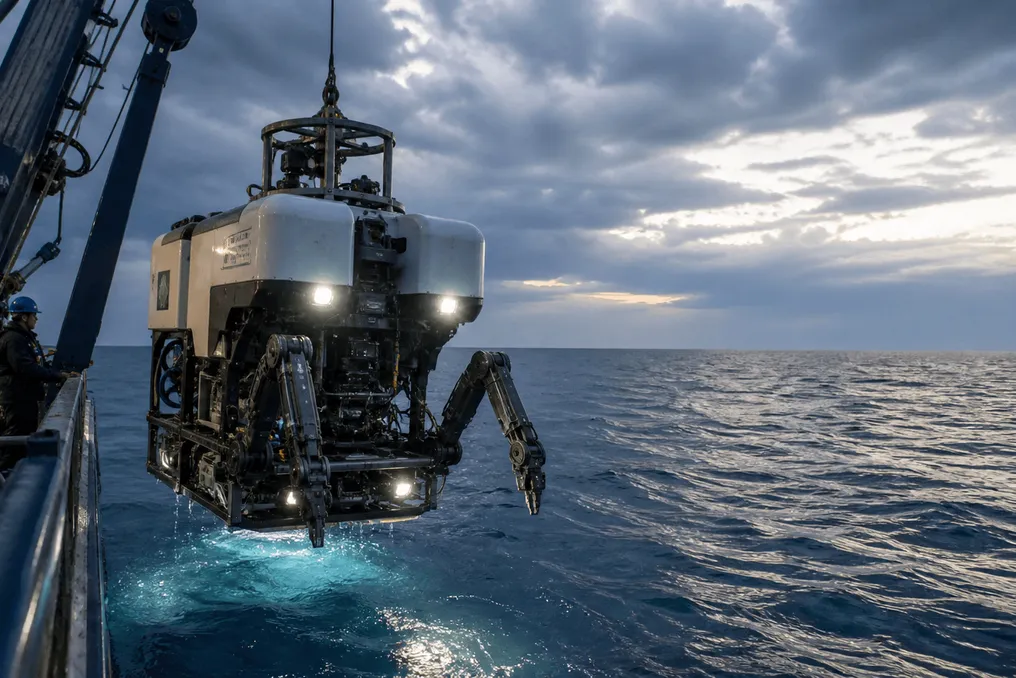
The product range includes specialized machines named after constellations: Aquila observation robots, Phoenix series cable-laying robots, Taurus cable-laying all-terrain vehicles, Pisces ballast tank inspection robots, Scorpio hull cleaning robots, and Sagittarius deck inspection robots. The flagship Phoenix 600 model measures 6.2 by 3.8 by 3 meters, capable of operating at depths of 3000 meters, penetrating trenches up to 3 meters deep, and performing protection, connection, and maintenance of optical cables with centimeter accuracy during L3 level intelligent operations.
Last year, the Phoenix 600 received a 100 million yuan order from a telecommunications group from the UAE. This marked the first commercial export batch of a domestic deep-sea robot, breaking the long-standing Western monopoly and providing China's underwater communication sector with its first fully domestic deep-sea robot. Currently, the products are used in international oil and gas, subsea cable communication, and offshore wind energy sectors, with clients in dozens of countries, including the UK, UAE, and Australia.