When traveling on the street, one may sometimes notice objects that cause one to stop or question the reason for their presence there. Were these objects related to black clothing, cosmetics, or did they evoke a sense of strangeness? If such things have happened, the natural reaction is to slow down and be vigilant when seeing such objects. According to various Hindu beliefs and Puranic tales, some things appearing on the path are associated with auspicious or inauspicious signs. According to the teaching of Shakun Shastra, it is preferable simply to walk past certain items lying on the road. Let us consider what exactly these items are.
Today, people tend to look for scientific explanations for all events, which is a positive aspect. However, our religious traditions also contain answers and warnings regarding daily life. It is important to understand that these beliefs should be considered purely as religious faith, not as scientific fact.
Dead animals on the road
Sometimes bodies or remains of animals are found on the road after their death. This usually happens as a result of traffic accidents or for other reasons. Religious beliefs advise avoiding contact with such dead animals. There is a belief that negative influence may be present around the bodies or their remains. Therefore, it is said that if one accidentally touches a dead animal, one should return home, take a bath, and put on clean clothes. From a practical point of view, distancing oneself from dead animals is also necessary due to the risk of infection.
Hair bun on the road
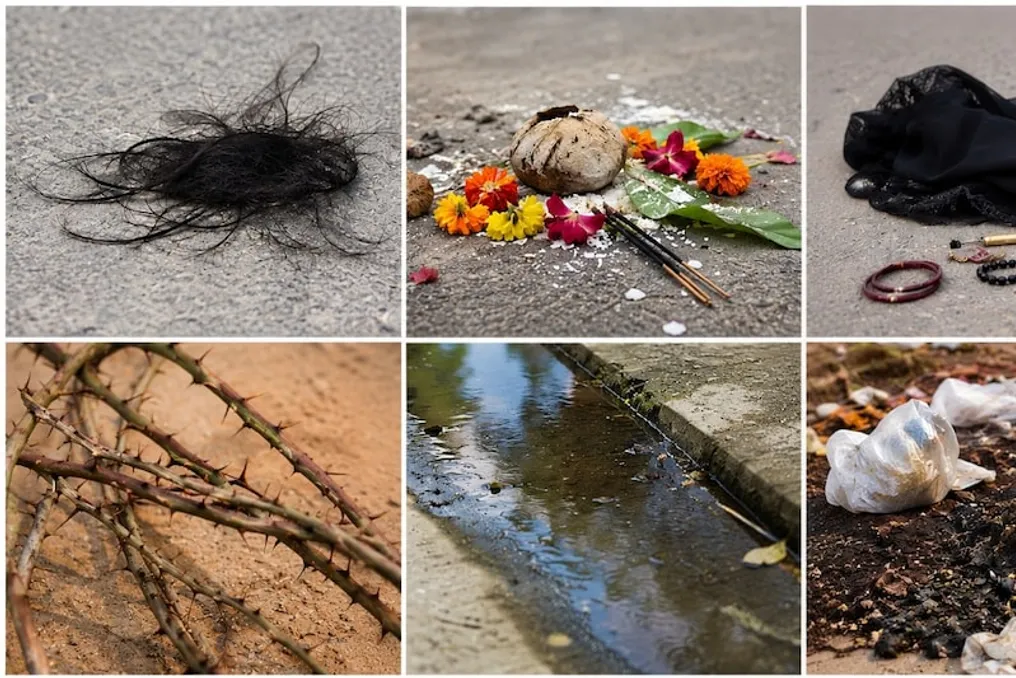
The second item is hair. In Hinduism, there are many religious traditions associated with hair, including the practice of shaving the head at birth, death, and certain rituals. According to religious beliefs, hair is associated with a person's physical and mental energy. For this reason, it is recommended to avoid picking up or touching cut hair found on the street or path. This is supported by both religious and cultural beliefs. Furthermore, from a hygiene perspective, it is better not to touch someone else's hair or dirt lying on the road.
Materials used for worship or rituals
The third point is materials used during worship, Havan, or other religious ceremonies. Sometimes, after a ritual is completed, the remaining materials are left on the road, at an intersection, or in a secluded place. Such materials may include flowers, ash, limes, coconuts, cloth, or other items for worship. Religious beliefs advise against touching such items without a valid reason or taking them home. This is especially true for items intentionally left at an intersection or in a specific place; in such cases, it is better to refrain from picking them up.
Black clothing or jewelry items
If you see scattered black clothing, kajal, sindoor, bracelets, or other jewelry items on the path, according to religious beliefs, they should not be picked up. In many traditions, such items are associated with special rituals, ceremonies, or talismans. Nevertheless, it is incorrect to assume that every item lying on the road is connected to some tantra. It is not necessary for every object to have some religious or negative purpose behind it. However, it is wise to maintain distance from unfamiliar objects instead of touching them.
Road covered in thorns
The fifth item is a road covered in thorns. In religious beliefs, thorns are associated with difficulties and obstacles in life. Therefore, it is recommended to avoid walking on sections of the road where there are many thorns. There is also a direct practical basis. Thorns can cause leg injuries and the risk of infection. Thus, regardless of religious beliefs or practical precautions, it is best to avoid such places.
Water after another person's bathing
The sixth point is water left on the road after someone has taken a bath. Some religious beliefs associate bathing with the purification of the body and mind. It is believed that after bathing, all impurities leave the body along with the water. Because of this, some traditions speak of the need to consciously avoid touching water left after another person's bath. However, from a modern perspective, it is better to stay away from unknown water collected or flowing on the road, as it may contain dirt and microbes.
Dirt on the road
The seventh and most important point is dirt lying on the road. This is not a specific item but general dirt, which may include feces, trash, clumps of hair, decaying matter, or other unclean things. One should avoid touching such things or walking barefoot on them. In religious beliefs, this is associated with impurity, whereas from a scientific point of view, contact with dirt carries the risk of infections and skin problems. Therefore, if such an object appears on the path, one should go around it, maintaining distance.