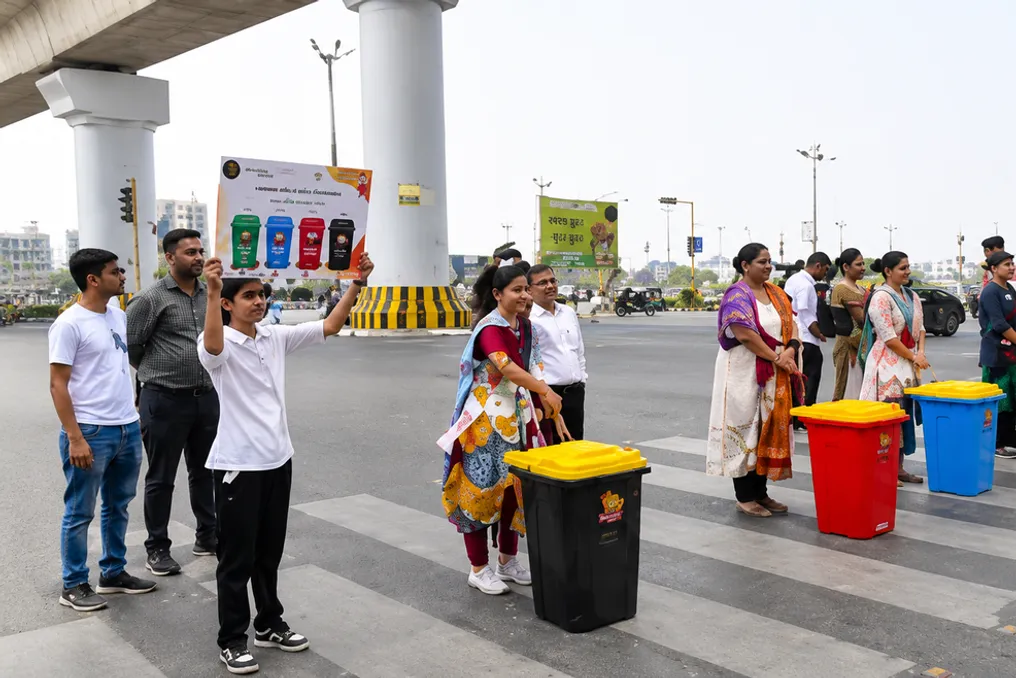
At one of the intersections in Ahmedabad where the red light usually gives drivers about thirty seconds of waiting and signaling, something different recently happened. Employees of the Ahmedabad Municipal Corporation (AMC) stopped at a busy intersection with four marked containers. They showed waiting passengers vegetable peels, plastic wrapping, used sanitary pads, and empty blister packs of medicine, asking them to guess which container each item should go into.
This simple street demonstration reflects a much larger mandate: Indian cities are being forced to take more seriously what happens to waste even before it leaves citizens' homes.
On February 19, 2026, a Supreme Court bench consisting of judges Pankaj Mittal and S. V. N. Bhatti, while hearing an appeal filed by the Bhopal Municipal Corporation, issued directives on how cities must ensure compliance with the country's solid waste management rules.
The essence of this ruling was that a clean environment is linked to the fundamental right to life, and cities are responsible for proper waste segregation and recycling. The court also placed the responsibility on elected local representatives, such as councilors, mayors, corporators, and ward members, to help citizens understand the principles of source segregation. Thus, waste management could no longer be an issue limited to sanitation departments and garbage trucks.
The bench referred to data from the Central Pollution Control Board, according to which India generates about 170,000 tons of municipal solid waste daily, with significant volumes remaining untreated, ending up in landfills, or going unaccounted for. The court also warned that repeated violations could lead to increasingly severe measures.
The demonstration at the traffic light in Ahmedabad illustrates exactly this approach. Instead of expecting residents to learn the rules through circulars and notifications, AMC employees brought out four containers and everyday waste items to where hundreds of people were already waiting.
These efforts are not merely symbolic. Ahmedabad generates nearly 3,200 tons of solid waste daily, but currently, only about 29% of it is sorted at the source. The rest is sent predominantly unsorted to the city's overloaded Piranha landfill, where decades of mixed waste pollute groundwater in nearby settlements.
Between January 2025 and May 2026, AMC issued over 3.54 lakh notices for littering, dumping, and other sanitary violations, imposing fines totaling almost 16.95 crore rupees.
The rules demonstrated by AMC at the stop divide waste into four categories:
- 1) Wet waste, such as food scraps and kitchen waste, which is subject to composting;
- 2) Dry waste, including paper, plastic, and metal. Separating these from food waste helps preserve their value for recycling;
- 3) Sanitary waste, including used tissues and blades, which must be separately packaged to protect workers handling them manually; and
- 4) Household hazardous waste, such as expired medicines and batteries, which can poison soil and water if mixed.
Thus, the four containers start with four very common decisions made when cleaning a plate, opening a bag, changing a sanitary pad, or throwing away old medicine blister packs.
This is where such a street exercise can matter. Fines are applied after sorting has failed. A 30-second demonstration can show a passenger what to do when they return home.
For sanitation workers, these small household choices become part of their workday. When food scraps, sanitary waste, plastic, and hazardous materials are thrown into one bag, someone further down the recycling chain may be forced to manually deal with that mixture.
AMC also warned residents against dumping or burning waste in public places, as monitoring compliance with waste rules across the city is becoming stricter.
However, the more serious test will happen far from the traffic light—inside kitchens, residential complexes, shops, and offices throughout Ahmedabad. For the city to significantly improve its current sorting rate of 29%, thousands of people will have to remember the same lesson after the green light turns on: peel, wrapping, sanitary pad, and medicine blister—each has its destination.