During the Perseids meteor shower that continued into Thursday evening, nature presented a magnificent light show. Some spectators were amazed, while others greeted the spectacle with applause.
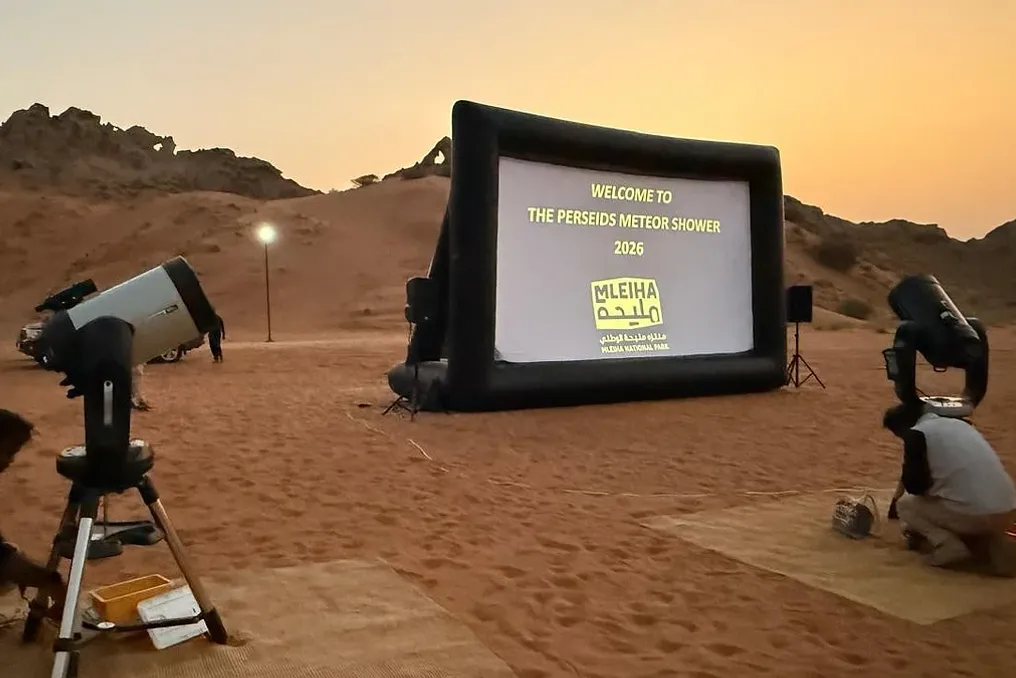
The author joined over 300 participants at Mleiha National Park in Sharjah to watch meteors and other celestial bodies. Although the number of registered meteors per hour was low, each one was an impressive fireball leaving a colorful trail.
Four particularly bright meteors were counted, displaying blue, red, and white streaks. Different colors arise from metal atoms that vaporize and glow in the meteor trails. Magnesium and nickel cause the blue streak, while sodium or iron create orange, yellow, or red hues. Most of these phenomena lasted only a few seconds.
The event began with an astronomical presentation that thoroughly explained the Perseids meteor shower phenomenon and gave guests an idea of what to expect throughout the evening.
Prabhu, Education Coordinator at the Mleiha Archaeological Center, explained that the Perseids meteor shower occurs as Earth passes through a trail of debris left by Comet 109P/Swift-Tuttle. The meteoroids from this comet burn up in Earth's atmosphere at high speed, about 59 kilometers per second, forming bright streaks of light.
The comet was discovered in 1862 by Louis Swift and Horace Tuttle. It takes 133 years to orbit the Sun, and it last visited the inner solar system in 1992.
Prabhu noted that despite the annual nature of this celestial event, viewing conditions are not always ideal. He mentioned that 'last year's Perseids event was not perfect due to the bright moon.'
In recent days, the meteor shower reached its peak, and residents of the UAE traveled to various locations, including Al Quaa and Al Qudra, to witness the phenomenon.
Several telescopes were set up for guests to observe celestial objects besides meteors. Additional activities were also organized, such as a water rocket launch area and a meteor hunt, where participants used metal detectors to search for meteorites in a designated zone.
The weather was warm while guests spread out mats for evening astronomical observation. However, as the evening progressed, it became cooler and more pleasant. The author noted that he could never have imagined how enjoyable an evening in the desert during mid-summer could be.
Upon entry, everyone was given transparent red paper to cover their phones to block white light. Ensuring complete darkness during celestial observations is one of the most crucial aspects, as it significantly facilitates viewing the night sky.
Midway through the event, all lights were turned off, and phones were put away, plunging the area into pitch blackness. It took the eyes about 30 minutes to adapt, but after that, the sky became much clearer to see.
Throughout the evening, Venus, the star Vega—the fifth brightest star in the night sky, the double star Albireo, and Saturn were visible through the telescopes. Saturn looked particularly spectacular, with clearly visible rings, and its moon Titan was unmistakably discernible.
For ten-year-old Sohan and his younger brother, seven-year-old Suvan, this was their first experience of such a celestial event. They cheered joyfully every time they saw a meteor. Sohan shared: 'It was so exciting. We liked everything. I managed to spot two fireballs.'
Indian tourist Irfan arrived in the UAE for work and plans to return on Saturday. His friend invited him to the event. He remarked: 'It was a new experience for me, and I really enjoyed it. I have never seen so many astronomy enthusiasts in one place for such a celestial event.'
After the event concluded, driving back to the city, streetlights and signs seemed especially bright because the eyes had adjusted to the dark. Nevertheless, the author kept the memory of the magnificent natural spectacle in his heart.