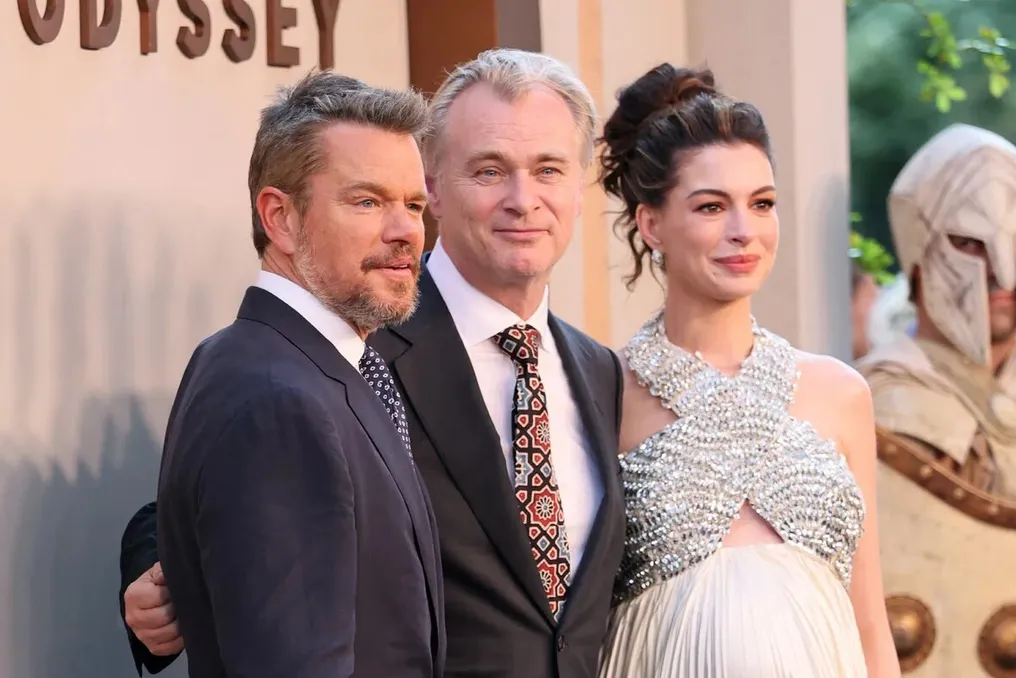
The article's author visited Christopher Nolan's new film 'Odyssey' in the small Greek town of Markopoulo Mesogaias, located in the Eastern Attica region of Greece. This historic municipality is only fifteen minutes away from the ruins of the Artemis Vravrona temple (ancient Brauron), dedicated to the goddess of nature and fertility.
The cinema where the screening took place was named Artemis and was situated behind the magnificent Orthodox Church of Saint John, built in 1904. The author noted that viewing it in this small setting, unlike the IMAX hyperbole advertised with million-dollar budgets, allowed for the film to be seen on a more human scale, forcing the spectacle to align with truth and reality.
After returning to New York, the author watched the film in the city's largest IMAX theater but still prefers the version seen in the Greek town, considering it more authentic.
The Question of Homer's Ownership
A question arises as to whether Homer's works, 'The Iliad' and 'The Odyssey,' belong to the people sitting in the modest theater in Markopoulo, or if they are part of a constructed antiquity created by certain European racist scholars, such as the Austrian Jakob Philipp Fallmerayer (1790–1861).
The author argues that through this ideological project, modern Greeks have systematically alienated themselves from their own linguistic, literary, and philosophical heritage. This was achieved by rewriting the fact of Greece as the fictional foundation of 'Western civilization,' while actively erasing its geographical, historical, and cultural ties to its natural habitat in Asia Minor—Anatolia, where Greece, Turkey, the Levant, Egypt, and North Africa converge, forming a deeper historical truth.
This insidious ideological maneuver, similar to what underlies the racist actions of white supremacists like Elon Musk, has deprived Greece of its heritage, taking it literally stone by stone to the British Museum or the Louvre to serve contemporary colonial and Eurocentric goals, creating something non-existent.
Nolan's film falls entirely within the scope of this large-scale project of cultural appropriation, where Europeans find antiquity to create artificial cultural authenticity. Fallmerayer's famous thesis claimed that modern Greeks are not connected to the ancient Hellenes, believing that the population was completely replaced by Slavic and Albanian migrations.
The author criticizes how they loved the ancient Greeks and their art and philosophy, and then colonized them by textually and archeologically stealing and museumifying them. He emphasizes that the long-term project of decolonizing Greek cultural history, aimed at returning it to the Greeks themselves, has been ongoing for a long time, whereas Nolan's view of 'The Odyssey' moves in the opposite direction, becoming part of a prolonged project of cultural appropriation that is Hollywood's mighty Trojan horse.
In fact, Homer was neither British, American, nor German; he lived in the 8th century BCE in the Ionian region, on the western coast of Asia Minor, in modern-day Turkey. The author concludes that regardless of the perspective, Homer would feel much more comfortable in the small Greek town where he saw Nolan's 'Odyssey' than anywhere in Western Europe or North America.
The author notes that Nolan's film, despite much praise, is part of this grand project of cultural appropriation, where Europeans use antiquity for their artificial cultural authenticity. He points out that among the film's large cast, only one actor of confirmed Greek descent—Michael Vlamis—who has Greek, Serbian, and Lebanese origins, plays a supporting role. The other actors are mostly from Hollywood, Los Angeles County, local.
Despite the fact that the talented and perfectionist director, like Nolan, could not ignore the limitations of these actors, the author wonders why he gave 'The Odyssey' such a palpable American and British, Anglo-American look and atmosphere. Perhaps this is intentional—to create a resolutely Anglo-American 'Odyssey' for our time.
Meanwhile, the diverse cast drew criticism from another side: Musk made much nonsense objecting to Lupita Nyong'o being chosen for the role of Helen. However, such decisions are within the authority of studio executives striving to reach all demographic groups for financial gain. Examples are given: British-Indian actor Himesh Patel as Eurylochus, John Leguizamo as Euemäus, Lupita Nyong'o as Helen of Troy and Clytemnestra, and transgender actor Elliot Page as Sinon.
Imperial Cinema
The author admits that he himself is not a fan of Nolan's cinema. The louder the propaganda from his studios and premieres of new films, the more suspicious and dismissive he becomes of his work. Despite the huge positive and sometimes negative resonance surrounding his version of 'The Odyssey,' he remained calm until the viewing.
The propaganda machine promoting the film deliberately amplified Musk's racist reaction to increase appeal to the demographic environment initially targeted by the production studios. The author recalls spending years teaching Adorno and Horkheimer's innovative idea of mass media as mass deception.
Setting aside 'Odyssey' or 'Oppenheimer,' one should consider Nolan's fixation on time and memory in his other films—'Memento' (2000), 'Inception' (2010), 'Tenet' (2020), where fans believe he is creating 'cinematic time machines' through puzzle narratives showing how time and memory define personality.
The author considers this astonishing arrogance—challenging the most elementary force of time. French phenomenologist Paul Ricoeur conducted a thorough philosophical study of this topic in his seminal three-volume work 'Time and Narrative' (1983–1985).
In Nolan's hands, time and memory take on a completely different purpose and texture. His approach is the most astonishingly arrogant desire to colonize time and subject the mimetic registers of our working memory. Time, memory, and being—the basis of our fragile and vulnerable life—he wishes to command, control, manipulate, process, and reorder in the main character's living memory, with whom an ordinary person cannot identify.
The author draws a parallel with the Project for the New American Century (PNAC), neo-conservative nonsense that sought to designate an entire century as 'American' (implying Israeli), i.e., to claim the very measure of time and memory. Nolan's cinema, like Samuel Huntington's theses 'Clash of Civilizations,' Francis Fukuyama's ideas 'The End of History,' and Benjamin Netanyahu's madness 'Greater Israel,' is part of the same insane and sick way of imperial thinking.
By focusing on Odysseus's post-traumatic stress disorder, the film is actually pro-war, not anti-war. It deeply humanizes military leaders while simultaneously dehumanizing their victims.
Nolan's cinema about time and memory is the ideological backdrop and consequence of PNAC. Both processes boil and stumble, but ultimately fail. The author admits that his views on cinema are shaped by masters of world cinema, which is the direct opposite of Hollywood blockbusters, to which he is allergic despite past experience as a consultant for famous Hollywood directors.
He feels most comfortable with filmmakers such as Yasujirō Ozu, Satyajit Ray, Abbas Kiarostami, Nuri Bilge Ceylan, Elia Suleiman, and Osman Cemben, among many other visionaries. The author particularly dislikes the films of Quentin Tarantino and Christopher Nolan because in every frame, every take, and every scene, in every superstar character, in the very tone of their work, they carry the arrogance and self-satisfaction of their respective imperialisms.
Nolan enjoys and displays the power and wealth that allow him to make a film of this scale. Every time he sees so much power and arrogance, he seeks refuge. The author was born and raised under the influence of Soviet formalism by Sergei Eisenstein and Italian neorealism by Roberto Rossellini, Vittorio De Sica, Luchino Visconti, and others. He would prefer one magnificent shot from 'La Strada' (1954) or 'Bicycle Thieves' (1948) over all this arrogant, forceful, excessively masculine shooting by Nolan and Tarantino. One shot from 'Apocalypse Trilogy' (1955–1959) and he would be happy, never looking at such unrestrained pomp. One shot from 'Tokyo Story' (1953) or 'Ran' (1985), and he would reject all this showy imperial cinema of Nolan.
The IMAX Spectacle
It is said that Nolan's 'Odyssey' is an anti-war film. The author disagrees, and even if it were, it would be an anti-war stance from the perspective of nuclear-privileged fantasy of the white savior. People around the world do not like such fantasies and find them offensive.
Odysseus in Nolan's version has PTSD: after conceiving the idea, building the Trojan Horse, and provoking the slaughter of his enemies, he suffers nightmares of the perfect execution. This is exactly like what happened with his 'Oppenheimer.' First, you provoke and cause chaos and the killing of fragile humanity at your discretion, and then you make a film about the trauma of the massacres you inflicted upon the world.
Israel is a master of this kind of cinema, with films such as 'Lebanon' (2009), 'Waltz with Bashir' (2008), and 'Beaufort' (2007). The world must first endure Israel's crimes, and then feel sympathy for the perpetrators when they recall their deeds against people in their dreams.
By focusing on Odysseus's PTSD, the film is actually pro-war, not anti-war. It deeply humanizes military leaders while simultaneously dehumanizing their victims. It focuses on the hero's psychological trauma, not on transforming his murderous arrogance into pride.
Undoubtedly, Nolan has the right to his version of 'The Odyssey,' just like any other reader of Homer's epic. The great scholar and translator of 'The Odyssey,' Emily Wilson, is mistaken: the film should be judged as a film, not by the English translation of the Greek original. The problem lies in the overwhelming bravado propaganda trying to turn Nolan's film into a unique cinematic event, which it certainly is not.