There is a place in the world where, it is said, time changes its course, and where people who have visited it feel that their hair and nails grow faster than usual.
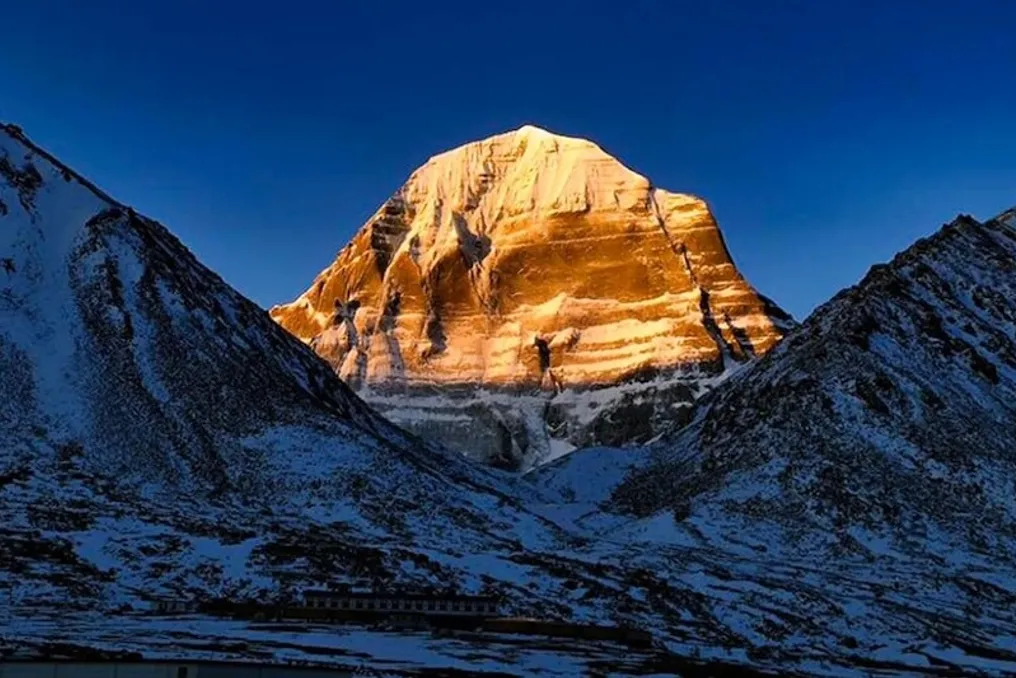
The world has seen the ascent of the highest peak—Mount Everest, reaching an altitude of about 8849 meters, conquered by thousands of mountaineers. However, there is another mountain, 2200 meters lower than Everest, meaning it is approximately 6638 meters high, but no one has yet managed to reach its summit. Everyone who tried to conquer it faced difficulties: some returned due to weather conditions, while others' journeys were interrupted halfway.
In Hinduism, the Kailash mountain range is considered the abode of the god Shiva. It also holds special significance in Buddhism. In Jainism and Tibetan tradition, Mount Kailash is revered as an extremely sacred place. Furthermore, local beliefs are associated with numerous mysterious stories. Some call it the dwelling place of gods, while others speak of a secret city existing in its vicinity. Today, we examine the enigmatic Mount Kailash, located in Tibet—a mountain composed not only of rock and ice but also connected to centuries of countless mysteries and religious beliefs.
Why is it so difficult to climb Kailash?
When the Kailash mountain range is mentioned, one imagines a huge, snow-covered, almost pyramidal structure. But Kailash is not just a center of faith; its geographical location and natural structure make it unique. Why is climbing Kailash so difficult?
One reason is the extremely complex geographical conditions. There is a very high altitude here, the weather can change rapidly, the trails are difficult, and the icy conditions make mountaineering extremely dangerous. But the question arises: if a person reached the highest point in the world, like Everest, why couldn't they reach the summit of Kailash?
The answer lies not only in religious belief but also in history. In the 20th century, many foreign mountaineers showed interest in climbing Kailash. In some expeditions, attempts were halted due to bad weather and harsh conditions. Stories related to Kailash mention sudden weather changes, getting lost, and unusual experiences during the ascent. Although many of these events lack independent scientific evidence, it is precisely this that adds extra mystery to Kailash, as they are based on local beliefs and mountaineers' accounts.
Can a person age faster on Kailash?
It is common belief that some people who visited the Kailash region noticed that their hair and nails grew faster than usual. Internet stories also claim that a person can age in just a few hours on Kailash. This is sometimes called the Rapid Aging phenomenon. However, it is crucial to understand one thing here:
To date, there is no reliable scientific evidence confirming that a person's age increases several times faster on Kailash, or that the speed of time changes there. At high altitudes, exposure to low oxygen levels, severe cold, physical strain, dehydration, and changing environments can certainly affect the body. Nevertheless, this cannot be considered proof of sudden aging by decades. Nonetheless, these unproven stories only deepen the mystery of Kailash.
Did mountaineers agree to climb Kailash?
Among the great mountaineers of the world is Reinhold Messner. He climbed Everest without oxygen. But in the case of Kailash, his stance was different. There are many claims online related to his name concerning Kailash, but opinions on his exact words differ.
Nevertheless, it is obvious that a special relationship has developed between mountaineering and religious feelings towards Kailash. Instead of conquering it, Kailash is considered more important to respect its sanctity.
Is Kailash not a natural mountain?
Now let's move to one of the biggest mysteries of Kailash. From a distance, its shape looks very unusual. Many people think it is a giant pyramid. This is why the suggestion is occasionally put forward that Kailash might not be an ordinary natural mountain, but a huge pyramid built by an ancient civilization.
These ideas are also linked to statements by Russian scientist and ophthalmologist Dr. Ernest Muldashev, who put forward a number of controversial hypotheses regarding Kailash. However, these assertions are not recognized as verified facts in mainstream geological science. From a geological point of view, Kailash is a natural mountain structure. Nevertheless, its unusual appearance has made it a subject of mystery and fantasy.
Is there a city of Shambhala in Kailash?
Another mysterious story associated with Kailash is the story of Shambhala. In Tibetan Buddhist traditions, Shambhala is mentioned as a spiritual and mystical land. Over time, many legends have spread around it.