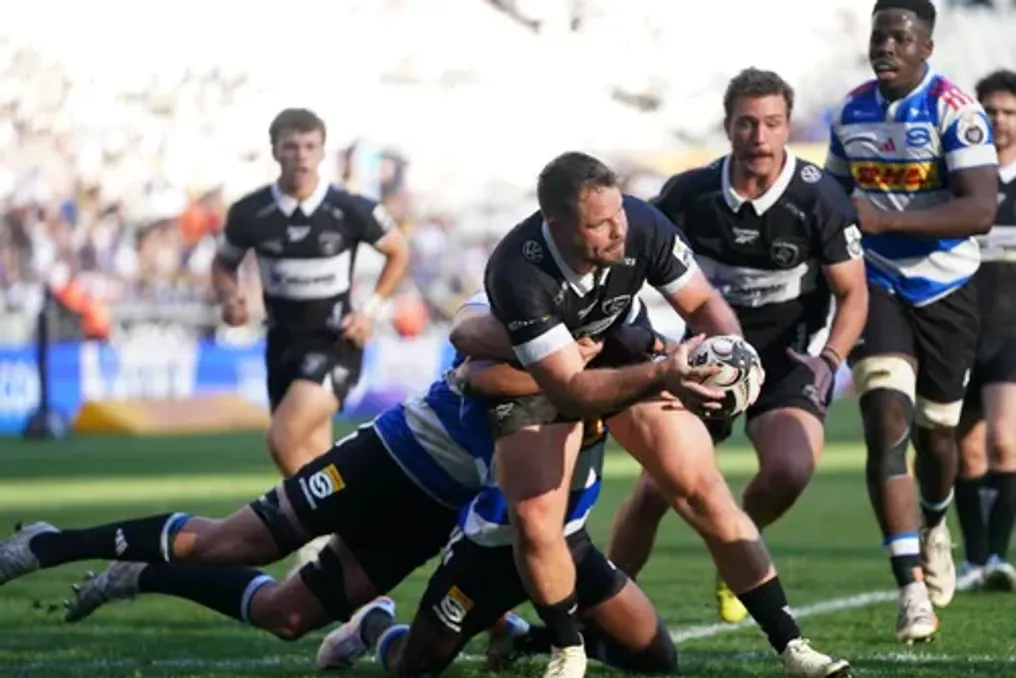
When the Sharks team underwent rebranding a week ago, it elicited a mixed reaction among fans, which reminded the author of the early stages of his career as a sports writer.
In early 1996, the author worked in the sports section of The Mercury newspaper, when newspapers were still the primary source of information for the public, competing only with evening news on television and radio. This period was characterized by public discontent being expressed through phrases such as 'vent its spleen,' which, according to medieval beliefs, was associated with anger stored in the spleen.
When the team was renamed Natal Sharks, it caused strong indignation among numerous legions of Natal rugby fans, especially after Craig Jamieson's victories in the Currie Cup in 1990, 1992, and 1995. Angry letters appeared in local newspapers, and the telephone line was overloaded. The Mercury conducted a poll that showed overwhelming support for the old name 'Banana Boy,' while 'Sharkie' received only a negligible number of votes.
However, Sharks CEO Brian van Zyl and his board of directors conducted the necessary analysis. They understood that a quick update would allow them to stay ahead of their South African rivals. The professionalization of rugby, which culminated at the 1995 Rugby World Cup in South Africa, allowed players and rugby unions to earn money, marking a new phase after the amateur era ended.
At the end of 1995, a working group visited the UK and the US to study football, American football, and basketball teams. Discussions focused on branding and merchandising. During this trip, Natal rugby legend Hugh Rhys-Edwards participated, who mentioned that the brand manager of Manchester United advised them: 'Well, you can't sell a banana.'
This is where the energetic Sharkie image originated. Interestingly, in May 1996, the Sharks reached the Super 12 final against the Auckland Blues. Although they lost to Sean Fitzpatrick's team at Eden Park, the excitement surrounding the abandonment of the 'Banana Boys' had already subsided. Later that year, the Sharks defeated Transvaal in the Currie Cup final at Ellis Park, and the return to Durban was accompanied by a city centre parade.
At that time, the Sharks were considered innovators in South African rugby, and their rivals eventually followed suit, as the Lions, Stormers, Bulls, and Cheetahs began their existence.
Thirty years later, the Sharks adjusted their brand again, aiming to facilitate the team's marketing beyond the traditional rugby audience. This is particularly important as professional rugby increasingly competes in a broader sports and lifestyle market. The key element is transforming the Sharks into a 'Club.'
The author prefers the term 'Club' over 'franchise,' considering the latter meaningless, and finds 'province' and 'union' dull and outdated. The Sharks consulted again with leading global sports teams such as Bordeaux, Toulon, Toulouse, Northampton, Bath, and Saracens, which are 'Clubs.' The author is pleased that the Durban team is now officially named Sharks Rugby Club.
It should be noted that the Stormers also became a 'Club.' The Cape Town team changed its appearance last year by developing a new jersey badge and simplifying its identity by removing 'Western Province' from the team names. However, they retained the legacy of Western Province by placing the famous blue and white stripes on the Stormers' jerseys, which did not provoke objections from fans. The Stormers continue to enjoy the best stadium attendance in South Africa.
The Sharks continue to play in black and white, as they have since 1890. Another misconception is that Sharkie was completely discarded. The actual mascot was present in the stands, dancing with fans, during the Currie Cup match between Sharks XV and Boland in KwaMashu a week after the new rebranding. There is a revised Sharkie icon, looking fiercer, which will primarily be used for match promotion and advertising, but old Sharkie merchandise is still welcomed in the Kings Park stands.
Perhaps the true lesson from the history of the Sharks' rebranding is this: thirty years ago, fans feared that a change in name meant abandoning everything they loved about Natal rugby. Instead, the Sharks evolved into one of the strongest brands in world rugby. The 'Banana Boys' were not erased; their history simply became part of a larger story. The same must happen now: a modern club must evolve to attract a new audience but must never forget the people and traditions that created it.