At the second World Championship for humanoid robots, which will take place in Beijing, robots are expected to set new world records. These 'athletes' do not know fatigue and are ready to break all existing records. The grand opening will take place on August 22nd at Beijing's 'Ice Ribbon.'
The event is jointly organized by the Municipal Government of Beijing and China Media Group. The program has been expanded from three days to five, and sessions are now held both during the day and in the evening.
Statistics: Significant Progress
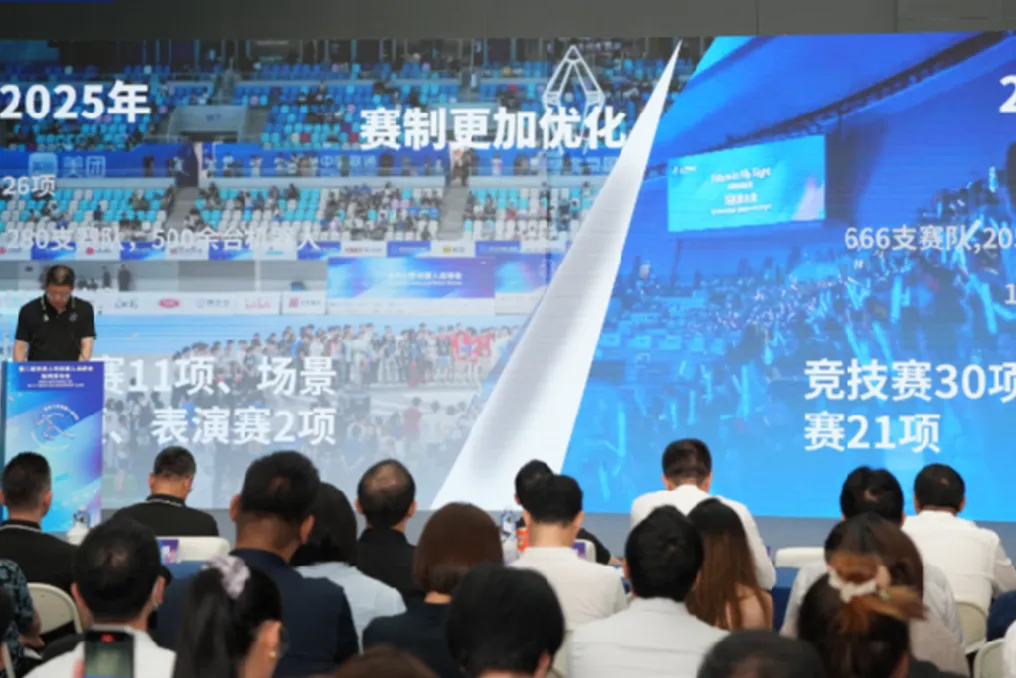
This year's competition includes 51 competitive events and 1301 matches over five days, nearly double the debut edition, which featured 26 events and 487 matches. 666 teams and 2056 robots from 16 countries across six continents are participating, representing a 138% increase in teams and a fourfold increase in robots.
Teams from robotics leaders such as the USA, Germany, and Japan are taking part in the competition. Additionally, Brazil has assembled a team of five World Robot Cup champions. Domestically, the competition involves 157 enterprises, 641 teams, and 1975 robots, with all major industry players present. Teams from 27 Chinese universities are competing, covering 30 provinces, autonomous regions, municipalities, and special administrative regions.
Innovations: Transition from Demonstration to Practical Readiness
The updated program includes 30 competitive and 21 scenario events, compared to six scenarios last year. Scenario tests simulate nine real environments: residential buildings, hotels, industrial facilities, emergency rescue operations, logistics, libraries, retail, office services, and vehicle charging.
Two new tests expand the boundaries of robot capabilities in practical conditions. The 'Agile Hand' test checks precision in assembling tools, weighing powder, stacking blocks, hammering nails, opening bottles, unpacking, gripping with tweezers, and connecting cables. This involves micro-vision, motion planning, force control accuracy, and operational precision. The 'Integrated Five' test requires robots to perform agile operations, stable object transfer, and heavy lifting while running a 100-meter distance.
Stricter Rules
Time limits have been significantly reduced to increase complexity: the 100-meter run has been cut from three minutes to one, the 400 meters from 15 minutes to five, and the 1500 meters from 40 minutes to 15. Autonomy requirements have also become stricter: all running and competitive disciplines must be completed fully autonomously, without remote control, except for the 100 and 400-meter obstacle races.
In scenario events, full autonomous completion carries a weight coefficient of 1.0, whereas completion with remote control is limited to a coefficient of 0.5. A significant change was made to the rules of robot football: a goal is only counted if the ball touched at least two teammates during play, which is a deliberate step to reduce individual performances of a single robot and encourage team coordination. This rule tests the ability to cooperate and communicate, not just the hardware capabilities of individual machines.
What to Watch For
Gold medals will be awarded in all nine sessions, with 12 being determined on August 23rd, second only to the closing ceremony. The opening night ceremony will feature a 7 vs 7 football match, as well as preliminary 400 and 100-meter runs. Finals for freestyle wrestling and 5 vs 5 football will take place before the closing ceremony.
Records are expected to be broken on the track. In April, a humanoid robot covered a half marathon in 50 minutes and 26 seconds, faster than the human world record. Robot football players have also improved their skills, learning to dribble, shoot powerfully, and make saves.
Freestyle wrestling competitions will take place over eight sessions in three weight categories: 40 kg, 58 kg, and 80 kg, and they will be significantly more competitive than last year. On August 24th, a new competitive element—weightlifting—will be added, awarding gold medals in both light and heavy weights. Dance disciplines have increased from 29 teams to 108, where robots compete in street dance, ballroom dance, and cheerleading. 223 judges will work at the event this year—100 more than last year, including 28 international-level judges, 75 national-level judges, and 120 first-level judges. The arbitration committee has been strengthened to promptly resolve disputes.