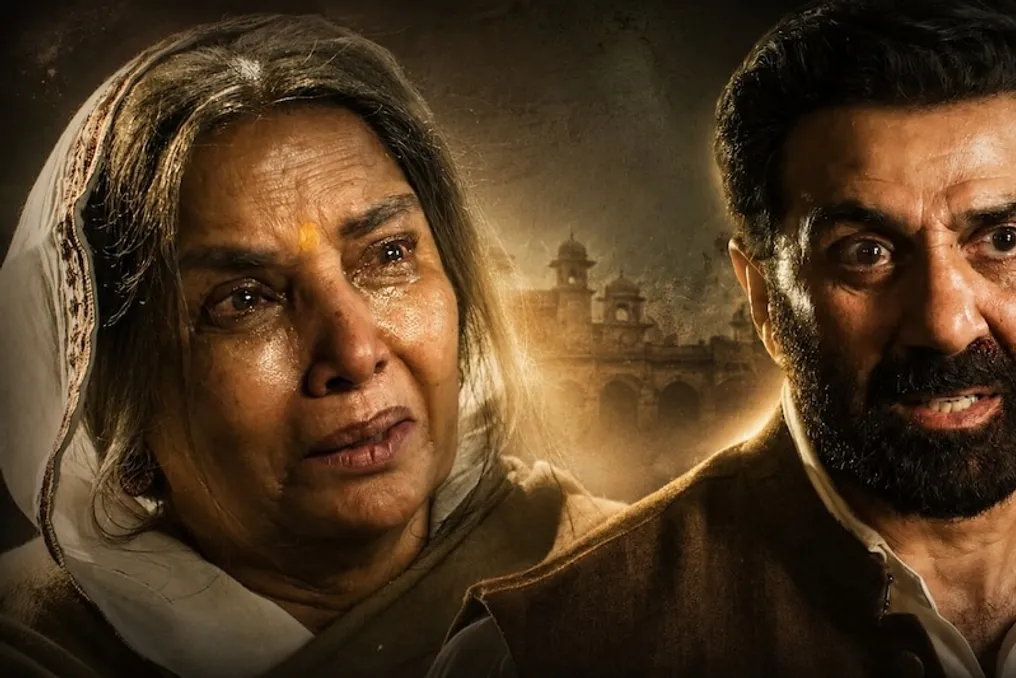
Actor Sani Singh from the film 'Gader' played Siknder Mirza in the film 'Bantwara,' defending an Indian woman in Pakistan. Critics do not accept this story because there was no reconciliation on that side during the 1947 partition. Promoting his film, Sunny quotes his father Dharman, saying: 'India is the mother, and Pakistan is the aunt.'
There should be connections between neighboring countries, but presenting this through the memory of the cruelest events of the past seems unfair. It is wrong to dig up old wounds for healing. The film 'Bantwara' is based on a play by Pakistani writer Asghar Wajid, written in 1989 titled 'Jis Lahore Nahi Vekhya, Oh Jamyay Nahi' (He who has not seen Lahore is not born). This play was banned in Pakistan because it was claimed that it ignored harsh realities in favor of romanticizing humanity.
Earlier, Diljit Dosanjh's film 'Main Wapas Aunga' was discussed, which also touched upon the theme of partition. Its message was that people on both sides suffered during the partition. Undoubtedly, this is true. However, when it was stated that people on both sides were subjected to equal violence, debates began.
People often talk about 'digging up a corpse' that starts to rise. Some events and tragedies in history are like these 'dug-up corpses' that surface when mentioned. Memories of the partition are precisely those whose pain cannot be shared with anyone. A three-hour film or a four-minute song cannot approach this horror; there is no drama in the stories of the partition, and background music and songs are entirely absent.
Professor Emeritus from Stockholm University in Sweden and renowned historian Professor Ishtiaq Ahmed presented a candid and impartial overview of the 1947 partition in his historical book 'The Punjab Bloodied, Partitioned and Cleansed,' which sends shivers down the spine. Ishtiaq Ahmed wrote this book using secret British government reports, contemporary newspapers, and most importantly, interviews with eyewitnesses, victims, and even attackers living in both countries.
What happened in Punjab from March to December 1947 was not just the partition of India—it was the most terrible 'ethnic cleansing' in human history. Five of the most painful incidents selected from this book are enough to understand that the wound of the partition is deeper and will never heal than what is shown on screen.
1. The Horrific Night of the Well in Toha Khalsa: Women Jumping into Wells to Preserve Honour
In March 1947, before the official dates of independence and partition were determined, horrific violence erupted against Sikhs and Hindus in the rural areas of Rawalpindi (West Punjab). Toha Khalsa is a small picturesque village in the district of Rawalpindi. According to testimonies recorded in Ishtiaq Ahmed's book, an armed mob surrounded the village from all sides during the second week of March. The men of the village did not have special weapons. The attackers made a demand: either they must change their religion or hand over their sisters and daughters to them.
The decision made by the women and elders of the village was heartbreaking. According to the elderly woman Lajwanti and other witnesses, about 90 Sikh women and unmarried girls gathered and decided that death was better than selling their honour into the hands of the attackers. One by one, embracing infants and murmuring 'Waheguru,' the 90 women began jumping into the village's deep well. The well filled with bodies. Those who fell deeper drowned, while those who jumped later suffocated in the well due to lack of space and decreasing water levels.
This was not limited to Toha Khalsa. In dozens of villages in Jhelum, Rawalpindi, and Multan, fathers themselves cut off their daughters' heads with swords so they would not fall into the hands of the attackers. Can any film ever show the pain of the cry of such a father who killed his own daughter?
2. The Massacre at the Rice Mill in Sheikhupura: Hundreds of Bodies Scattered in One Complex
In August 1947, when the Radcliffe Line was announced and Sheikhupura (West Punjab) came under Pakistan, Hindus and Sikhs who had lived there for centuries suddenly became strangers and helpless on their own land. An atmosphere of rumors and panic reigned in the city of Sheikhupura. The administration and local officials gave assurances of safety to non-Muslims and asked them to take shelter in a large rice mill complex and gurdwara.
Hundreds of families gathered in the factory complex along with their children, elderly, and household belongings. They believed that the army and police would protect them. However, the truth revealed by Ishtiaq Ahmed in his book is chilling. On August 25 and 26, 1947, local police and a bandit mob surrounded the rice mill. People were told to come out under the pretext that they would be loaded onto army trucks and sent to India, so they had to leave in small groups. As soon as the people came out, they were fired upon. Those hiding inside the factory were attacked from within.