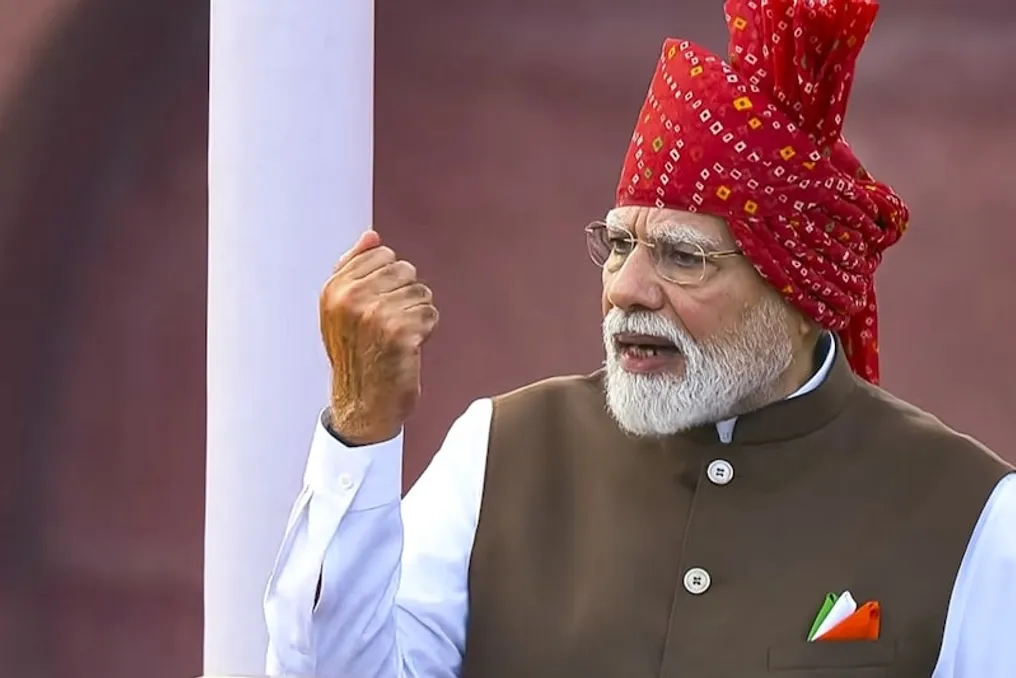
During the Independence Day celebrations, addressing the Red Fort podium, Prime Minister Narendra Modi mentioned the concept of 'Seven Streams of Power' (Saptadhara) in the context of India's economic growth. He emphasized that the time is not for slowing down but for changing the pace of work by rethinking approaches. According to him, what took seventy years to achieve must be accomplished in seven years.
The 'Seven Streams of Power' concept includes areas such as Manufacturing, Food Processing, Digital Innovation, and Green-Blue Economy.
In Narendra Modi's view, the first pillar of this concept is the country's manufacturing potential. It is necessary to become highly competitive globally in terms of quality, scale, and cost to meet global standards. The Prime Minister stated that the country should present itself to the world as a reliable partner in the global supply chain, covering processes from design to production, which requires achieving world standards in cost, quality, and scale.
Regarding the second element, PM Narendra Modi noted that it is related to agriculture and the food industry. The goal is to make Indian products a global brand by boosting agriculture and food processing. He added that world markets are opening up to Indian farmers, and through Free Trade Agreements (FTAs), various Indian products, from spices to bajra, gain access to new large markets. India must ensure direct movement of produce from farm to export market.
The third strength, according to Prime Minister Modi's presentation, is technological innovation. He highlighted the need for digital and communication technologies, noting that today is the era of robotics, artificial intelligence, quantum technologies, space, and data centers. India needs to become a global hub for innovation. The Prime Minister mentioned India's growing successes and experience in UPI and Digital Public Infrastructure (DPI), stating that the goal should be to disseminate such technological solutions to other countries worldwide, as well as advance India in next-generation communication technologies.
The fourth strength, pointed out by PM Modi, is 'Gati-Shakti'. He stressed the need for rapid and unimpeded development in the coming years. This includes the necessity for high-speed rail connections, modern highways, inland waterways, airports, and multimodal logistics hubs. He also emphasized the importance of port-led development, which will give an impetus to the pace of development.
The fifth element of the 'Seven Streams of Power' is India's defense potential. Speaking from the Red Fort podium, PM Narendra Modi reported that defense sector production has increased by approximately four times in the last 12 years, and the focus remains on self-reliance in defense. He stressed that the country's defense sector should not remain merely a market but should become a major supplier of defense goods. The Prime Minister insisted on striving for global leadership in sectors ranging from next-generation technologies to hypersonic systems, as well as achieving self-sufficiency in defense production.
Narendra Modi's concept also includes the green and blue economy. He stated that the country possesses all the necessary resources to achieve this goal. He specifically highlighted the need for India to achieve global leadership in green hydrogen, renewable energy, and energy storage. Regarding the blue economy, he noted that the fisheries, coastal tourism, and ocean technology sectors can become new avenues for growth for India.
The seventh stream of 'Seven Streams of Power' is India's soft power, which includes yoga, Ayurveda, holistic healthcare, creative resources, and tourism, on which attention must be focused. Prime Minister Modi noted that yoga has helped connect the entire world with India, and Yoga is becoming a source of energy for the whole world.