On August 12, 2026, the ASUS Zenbook DUO 2026 was launched, the latest notebook from ASUS's premium line. The event took place at Casa Bisutti in São Paulo, gathering journalists, influencers, partners, and industry professionals.
On August 12, 2026, the ASUS Zenbook DUO 2026 was launched, the latest notebook from ASUS's premium line. The event took place at Casa Bisutti in São Paulo, gathering journalists, influencers, partners, and industry professionals.
Diego Fernandez, ASUS's LATAM Marketing Director, began the presentation by discussing the brand's position in Latin America. He reported that ASUS not only maintains leadership in gaming notebooks in the region but has also achieved market share leadership in consumer notebooks in Brazil, according to GfK data. It was within this context of leadership that ASUS chose to launch the Zenbook DUO in the country.
Fernandez emphasized the strategic importance of Brazil for ASUS, stating that the company is committed to introducing its innovations to Brazilian consumers more quickly. He stressed that the launch of the ASUS Zenbook DUO after gaining market share leadership reinforces the brand's path of delivering advanced technology to those who need daily productivity and mobility.
Murilo Tunholi, ASUS's Technical PR in Brazil, presented the product, highlighting its design and practicality. Considering that many users already work with multiple screens daily, the new version of the Zenbook DUO offers not only two screens but also high performance, lightness, and remarkable battery life of up to 18 hours with both screens active, or 32 hours with only one screen on.
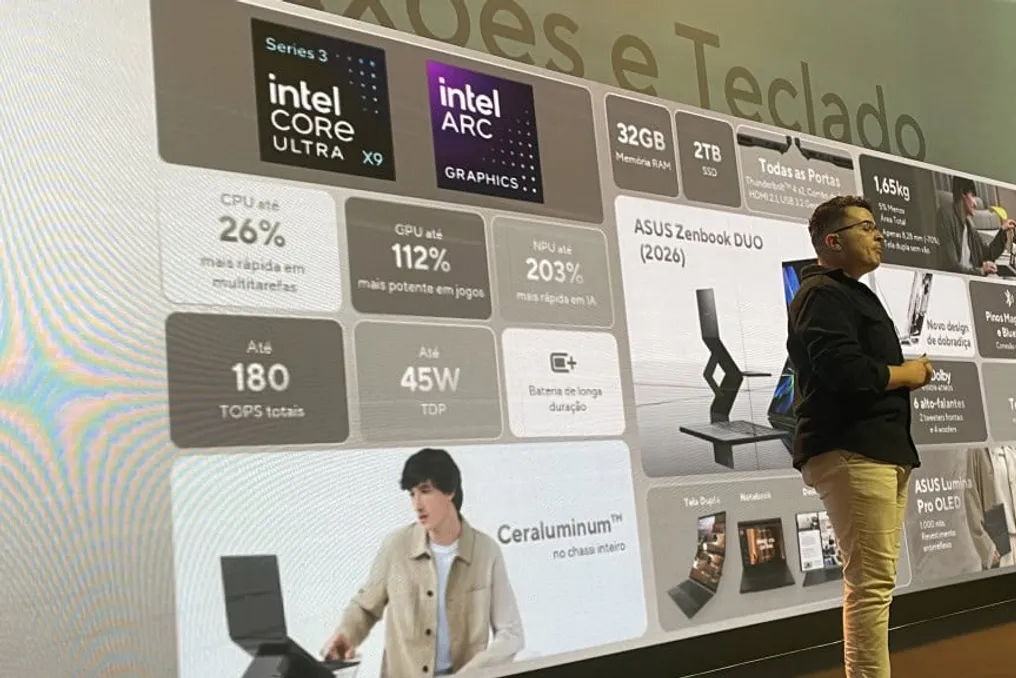
Tunholi detailed that this notebook complements the existing Zenbook line, which includes the Zenbook S14 and Zenbook A14 and A16 models. The DUO features two impressive screens, a body constructed from Ceraluminum—an exclusive material that provides greater lightness and resistance—and a powerful processor, the Intel Core Ultra X9 Series 3. Weighing only 1.65 kilograms, it is ready to meet both performance and mobility demands.
The executive also clarified the positioning of the Zenbook DUO in the brand's Brazilian portfolio, classifying it as an ultra-premium and top-of-the-line product for consumers. However, he mentioned that several features of this model are also available in other Zenbooks and even in ASUS Vivobooks, ensuring that consumers do not necessarily have to opt for the ultra-premium segment to access cutting-edge functionalities.
The ASUS Zenbook DUO 2026 has differentiated usage modules, allowing it to be applied in various contexts and routines:
This is the standard use, where the keyboard remains attached to the machine, without the need to use both screens simultaneously.
In this mode, one screen is positioned above and another below, supported by a rear stand that allows the notebook to be elevated without extra accessories, similar to the functionality of the Nintendo Switch 2. The angle can be adjusted according to the desired height. This mode can operate with or without a keyboard, as the touchscreens support a virtual keyboard. There is an ergonomic limitation that each user must consider.
The two screens are arranged vertically, side by side, with the keyboard connected. This mode is recommended for programmers, scientific researchers, or journalists who need parallel screens for comparing materials. Together, the two screens offer an expanded area of 19.8 inches.
The notebook is placed horizontally on a surface, with the screen expanded or duplicated, allowing two people to work at the same time, each using one screen.
The ASUS Zenbook DUO (2026) is the first notebook in the country to incorporate the Intel® Core™ Ultra X9 (Series 3) processor, recently released by Intel. This chip features 16 CPU cores, integrated Intel® Arc™ B390 graphics, and a total platform capacity of up to 180 TOPS for artificial intelligence tasks.
Internal tests conducted by ASUS, comparing the new model with the 2025 generation of the Zenbook DUO (which used the Intel Core Ultra 9 Series 2), demonstrated that the new chip provides up to 26% faster multitasking, up to 112% more powerful graphics in games, and up to 203% faster AI processing.
To support this increase in performance, ASUS redesigned the notebook's cooling system, implementing larger fans, each with 97 blades, and a TDP of up to 45 W.
Carlos Buarque, Intel's Marketing Director in Brazil, commented on the partnership, stating that it aims to bring innovation and performance into daily life through thin, light notebooks with longer battery life. He cited the ASUS Zenbook DUO with the new Intel® Core™ Ultra X9 processor as an example of the union between high performance and energy efficiency in a portable format.
Although classified as a productivity notebook, the Zenbook DUO 2026 also has gaming capabilities. Murilo Tunholi explained that the Intel Core Ultra X9 Series 3 has a very robust integrated graphics card, comparable to a dedicated laptop GPU. He demonstrated that it is possible to run Cyberpunk 2077 with all settings on maximum, achieving 28 frames per second—an experience similar to a console—and that the resolution can be reduced to obtain more frames while maintaining the 1.65 kg weight. Furthermore, the device runs Battlefield 6 with high FPS rates, eliminating the need for an additional laptop for leisure time.
The model introduces a dual-battery system with a combined capacity of 99 Wh, supporting up to 32 hours of video playback using a single screen, or up to 18 hours with both screens on. Fast charging allows reaching 60% charge in 49 minutes using a USB Type-C port.
The chassis is made of Ceraluminum™, a ceramic material developed by ASUS, which the company describes as 30% lighter and three times more scratch-resistant than traditional anodized aluminum. The retractable hinge and magnetic pin system enable the five usage modes mentioned (notebook, dual screen with or without keyboard, desktop, and shared) without the need for external monitors, adapters, or additional accessories.
In specifications, the notebook weighs 1.65 kg in total (1.35 kg for the main body plus 0.3 kg for the detachable keyboard), has a chassis 5% smaller than the 2025 model, and has reduced the spacing between the two 14-inch OLED screens by 70%, contributing to a sense of visual continuity. The ASUS Zenbook DUO (2026) UX8407 was launched in Brazil on August 12, 2026, with a suggested price of R$ 29,999.00, and is available at the ASUS Store and partner retailers.
The main advantage of a notebook compared to a desktop is evidently its portability, which is essential for professionals who work outside the home or students who attend in-person classes. Thus, opting for a compact device represents a significant differential for those looking for a good computer.
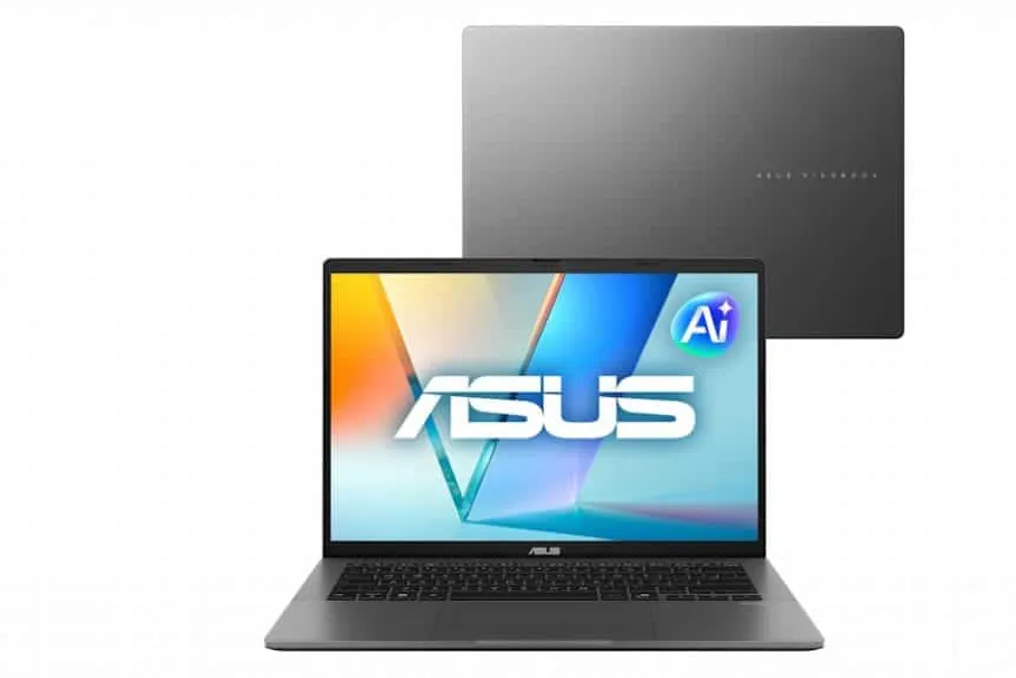
The Olhar Digital portal conducted an evaluation of an Asus model that features a 14-inch screen, a good set of components, and ease of transport in bags or backpacks.
The Asus Vivobook S14 has a simple metallic structure, weighing 1.4 kg and measuring 1.6 cm thick. Its casing complies with standard military resistance certifications and features a hinge that allows the screen to open completely up to 180 degrees.
The 14-inch screen uses an IPS panel with a matte finish and a resolution of 1920 x 1200 pixels. The 16:10 aspect ratio makes the panel slightly taller than conventional screens, providing a larger area for reading text and manipulating spreadsheets.
This model is equipped with the Intel Core Ultra 5 225H processor, a chip designed to manage multiple simultaneous tasks and support the system's internal artificial intelligence functionalities. The configuration includes 16 GB of RAM and a 512 GB SSD for storing programs and files. It is important to note that the RAM is soldered to the mainboard, which prevents future memory upgrades.
Graphics processing is handled by the integrated Intel Graphics card, which uses the system's own memory. Due to the absence of a dedicated video card, the notebook is not suitable for recent high-demand games, nor for advanced 3D modeling or video editing software.
The internal battery has a capacity of 70 Wh, aiming to ensure autonomy during periods of work without the immediate need for access to an outlet. Charging is done via a 65 Watt power supply connected to the USB-C port, and the charging system can recover approximately 60% of the battery in about 50 minutes.
In terms of physical connectivity, the machine offers two USB-C ports (supporting video and power transmission), two traditional USB ports (Type-A), an HDMI output to connect monitors or televisions, and a combined input for headphones and microphone. For wireless connections, the device supports Wi-Fi 6 and Bluetooth version 5.3 for peripherals.
The Asus Vivobook S14 combines good hardware in a compact and light body, making it recommended for those who need a portable notebook for daily use, whether for work activities, study, or internet browsing. The metallic finish gives the model a premium look, and it also features a backlit keyboard and a webcam with a physical security shutter.
However, the fact that the RAM is soldered restricts possibilities for future hardware upgrades, and the lack of a dedicated graphics card discourages its use for gaming or more demanding tasks.