It is not necessary to own a cutting-edge tablet for study or leisure activities; more economical models are capable of performing basic tasks, such as viewing PDFs, participating in video conferences, watching online classes, or simply browsing social media and accessing streaming services.
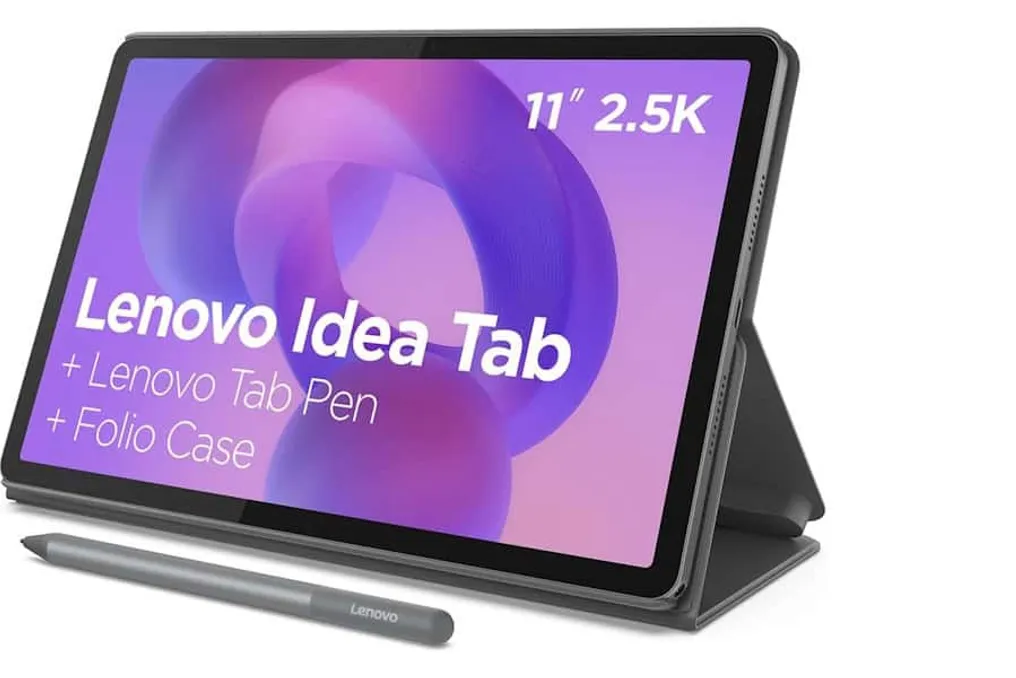
In this context, Olhar Digital conducted an evaluation of the 11-inch Lenovo Idea Tab, a device notable for coming complete with a protective case and a stylus pen in the packaging. Below, we detail all the specifications of the device.
The Lenovo Idea Tab features an aluminum construction in gray, giving it a sense of solidity. It weighs 480 grams and has a thickness of 7 millimeters, characteristics that facilitate daily transport in a backpack or using the tablet with your hands while reading. The physical volume and power controls are located on the top and side, depending on the orientation, which optimizes access when using the tablet in landscape mode.
The 11-inch panel offers 2.5K resolution and a 90 Hz refresh rate, ensuring that texts are displayed clearly and that navigation is smooth when scrolling through pages. However, a negative point lies in the 500 nits brightness combined with reflective glass, which can make viewing content difficult in outdoor environments or under direct sunlight.
Lenovo equipped this model with the MediaTek Dimensity 6300 processor, an intermediate category chip that performs well for light work routines and studies. It supports opening text applications, internet browsing, checking emails, and consuming streamed videos. Furthermore, the processor can manage split-screen with two applications simultaneously, provided they do not require high computational power.
However, for more intensive demands, this tablet is not recommended. It lacks the capacity to run heavy games or video editing software without causing system slowdowns. Therefore, it is a device focused on basic use, not high-demand tasks.
The battery has a capacity of 7,040 mAh, providing autonomy for a full day with moderate use, covering web browsing, social media, and occasional video viewing. Tests conducted with continuous video playback indicated that the charge lasts between 8 and 10 hours in this intensive usage mode.
Recharging is done via the USB-C port, and the device comes with a 20W charger in the box. The total time to fully recharge the battery is approximately two hours. It is important to note that the device does not support fast charging, meaning the user must adapt to this waiting time to have the battery fully charged.
One of the biggest differentiators of the Lenovo Idea Tab is that it includes a protective case and a pen in the box, which expands functionality without generating additional costs. This aspect can be advantageous for students, as it allows them to take notes directly on the screen using the supplied pen.
The four speakers, which support Dolby Atmos, deliver clear and powerful sound for calls and videos. However, there is an absence of bass frequencies in music playback, suggesting the need to use headphones or external speakers to achieve superior audio quality.
An additional advantage is that the model maintains the P2 input for wired headphones and allows internal storage expansion via a microSD card up to 1 TB. Connectivity is limited to Wi-Fi, offering no options for mobile data chips (4G or 5G) or a fingerprint reader. The cameras, with 8 MP on the rear and 5 MP on the front, fulfill basic functions, capturing low-resolution photos, but useful for occasional video conferences.
The main appeal of the model lies in the combination of a high-resolution screen, good battery durability, and a complete kit with a case and pen in the package, all at an affordable price. This reduces the need to purchase accessories separately for study or typing purposes.
The device is ideal for students and readers who need a device to write texts, take notes, read documents, and watch videos. For those looking to save money on a complete set for academic life, the model fulfills this function well.
Disadvantages include the low screen brightness for use under sunlight, limited performance in games, and the lack of mobile network support. Additionally, the stylus operates with AAA batteries, not with an internal rechargeable battery.
Thus, the tablet is not advisable for those planning to play complex titles, edit videos, or use the internet outside of Wi-Fi areas. The main focus of the device is simple productivity, and in this aspect, it demonstrates great competence.