Researchers from Utrecht University in the Netherlands discovered that the rate of global warming is as crucial a factor for the stability of the Atlantic Meridional Overturning Circulation (AMOC) as the temperature level reached. This finding was published in the journal Nature Climate Change this Thursday, the 13th.
The investigation demonstrates that an accelerated increase in temperatures can cause the circulation to lose its stability at a warming level significantly lower than what was predicted in studies considering only a thermal limit.
In simulated models, the AMOC managed to maintain its stability under slow warming of more than 4°C. However, it collapsed when the gas concentration increased at a faster rate, occurring near 2°C of warming.
The results were generated through climate models designed to compare different rates of atmospheric CO2 growth. This conclusion helps clarify why previous projections established different limits for a potential disruption of the circulation, reinforcing that slowing down warming reduces the risk of a sudden change in the oceanic system.
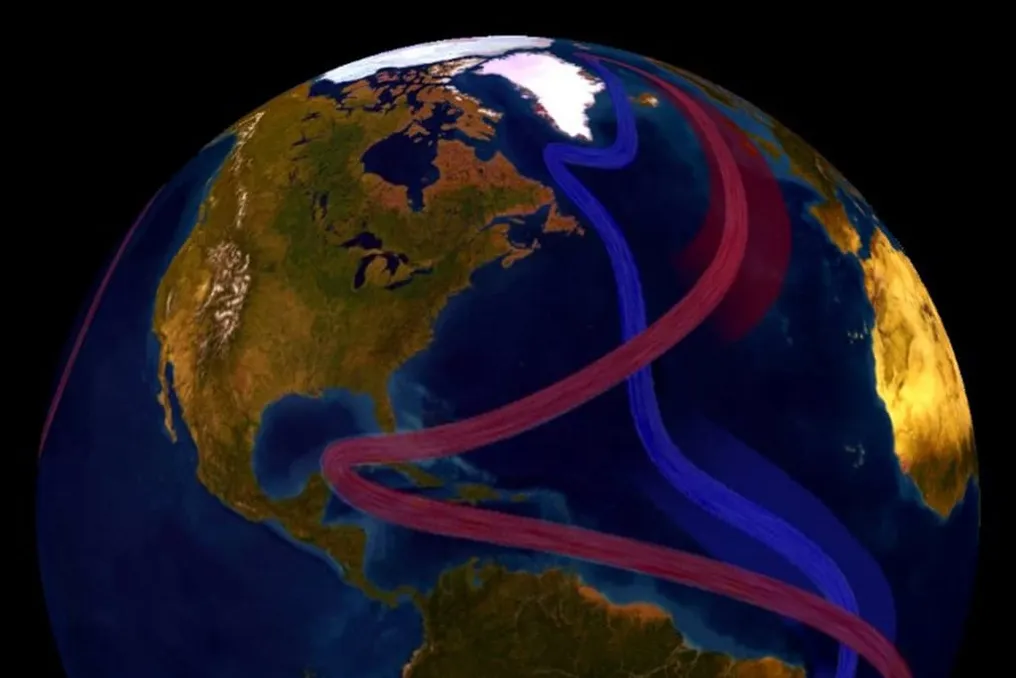
The AMOC is responsible for moving ocean currents that transport warm water from tropical zones towards the North Atlantic, redistributing heat globally and helping to maintain moderate temperatures in Western Europe.
For years, scientists have studied the possibility of the circulation reaching a tipping point, where the current structure of the AMOC could be replaced by a much weaker state in just a few decades. Factors that can impact this system include planetary warming and the increase in meltwater coming from polar regions.
The new work, led by researcher René van Westen from the Utrecht Institute for Marine and Atmospheric Research, challenges the notion that there is a single temperature capable of causing the circulation's collapse. The team assessed how the speed of climate change affects the ocean's ability to adapt.
To do this, the researchers conducted two climate simulations with the progressive growth of carbon dioxide concentration. The distinction between them lay in the speed of this increase: in one scenario, the increment was 0.5 parts per million per year; in the other, it reached 2.5 parts per million annually, a rate similar to the current one cited in the study.
The outcomes were opposite. In the slower change scenario, the AMOC remained stable even after warming exceeded 4°C, and did not collapse upon reaching 5°C. In contrast, in the faster CO2 growth situation, the circulation lost stability around 2°C of warming.
This disparity was attributed to the ocean's reorganization capacity. Henk Dijkstra, Professor of Dynamic Oceanography and co-author of the study, explained that a more gradual transition allows various ocean layers, from the surface to the deepest depths, to gradually adjust to the new conditions. In a faster change, this adaptation process cannot keep up with the climatic transformation.
The researchers estimated that the critical warming speed approaches 0.3°C per decade. According to Van Westen, this rate is close to what the planet is already experiencing. The researcher used the analogy of a vehicle approaching a barrier: the faster the speed, the less time there is to change course.
The research also seeks to contextualize previous findings by the same group. In 2024, scientists had demonstrated, using a modern and complex climate model, that the increase in meltwater in the North Atlantic could decrease the stability of the AMOC. However, in that work, the amount required to generate instability was considered excessive to suggest that this mechanism, in isolation, represented a probable threat to the current circulation.
A subsequent study analyzed different warming trajectories and indicated a possible tipping point around 2060, in both an intermediate and a high-emission scenario. In these models, the limit seemed to be close to 2.5°C of global warming.
The new analysis provides a possible justification for the divergence between these estimates. Although the AMOC may have a critical limit linked to the influx of meltwater, the researchers argue that there is no universal temperature that determines its rupture; vulnerability also depends on how quickly the planet warms.
This conclusion has direct implications for climate policy, warning against strategies that focus solely on the maximum temperature reached and accept a temporary overshoot of a limit, followed by a subsequent reduction. Based on the logic presented, the speed of temperature rise must be considered, as slower warming gives the ocean more time to adapt, reducing the risk of short-term stability loss.