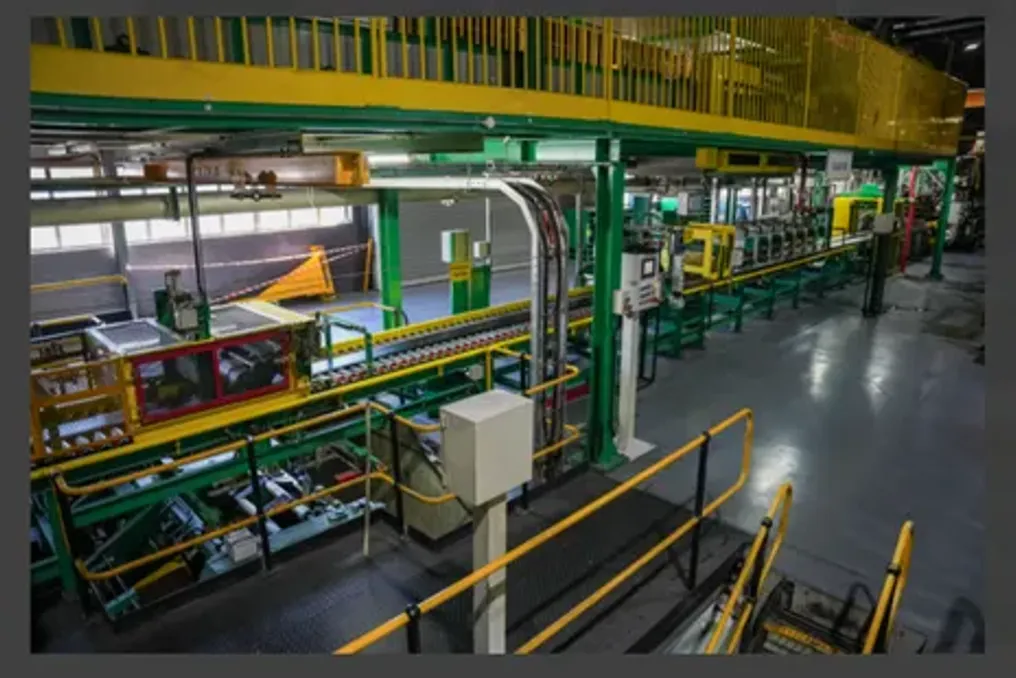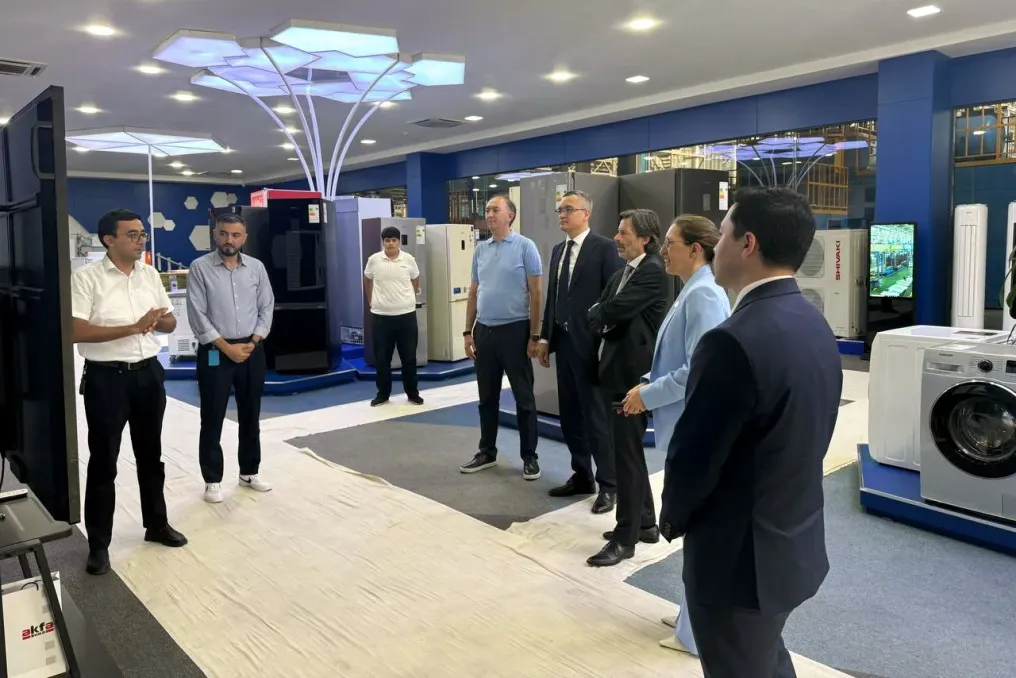
The Secretary-General and CEO of the International Electrotechnical Commission (IEC), Philippe Metzger, visited TEXNOPARK to familiarize himself with the company's production facilities, technological infrastructure, and innovative projects.
The Secretary-General and CEO of the International Electrotechnical Commission (IEC), Philippe Metzger, visited TEXNOPARK to familiarize himself with the company's production facilities, technological infrastructure, and innovative projects.
During the visit, the IEC representative received detailed information about TEXNOPARK's activities aimed at localizing production, import substitution, and producing high value-added products.
The parties discussed issues of increasing the efficiency of industrial enterprises, implementing modern technologies, creating new jobs, and utilizing international experience.
Particular attention was paid to the application of IEC international standards in production processes, the development of international cooperation in standardization, and expanding the participation of Uzbek enterprises in the work of IEC technical committees.
Furthermore, the meeting participants emphasized the importance of more active involvement of domestic producers and industry specialists in the process of developing and improving international standards based on the real needs of enterprises.
Dunlop Tyres South Africa has completed a large-scale modernization of its uMnambithi production complex in Ladysmith, which cost R1.7 billion. New production facilities were installed in the workshops, including a compound mixer, tread and sidewall production lines, and advanced vulcanization technologies.
These improvements are intended to increase the factory's production capacity and ensure the supply of tires for passenger cars, SUVs, and light trucks for both local and African markets. The R1.7 billion investment was made by the parent company, Japan-based Sumitomo Rubber Industries (SRI), over three years.
Dunlop reported that the new equipment will improve the quality and stability of production, as well as allow for the manufacture of low rolling resistance tires. The modernized plant will continue to supply tires to vehicle manufacturers in South Africa, such as Toyota, Isuzu, Ford, Volkswagen, and Nissan.
During the investment completion ceremony, SRI President and CEO Yasuaki Kunisu emphasized that the company's business in South Africa holds a critically important place within its global strategy. He noted that the automotive industry is one of the key sectors supporting the country's economy and employment, and the company is responsible for reliably supplying high-quality tires to Original Equipment Manufacturers (OEMs).
Minister of Trade, Industry and Competition Parks Tau stated that this investment demonstrates continued confidence in South Africa's manufacturing sector. According to him, the plant is part of a broader value chain in the country's automotive industry, and the government will continue to support local production.
Tau added that this plant does not exist in isolation but is at the center of South Africa's automotive value chain, supplying OEM partners including Toyota, Isuzu, Ford, Volkswagen, and Nissan. He also stressed that the R1.7 billion investment in local production is supported by fair conditions, and the government understands that creating such conditions is a shared responsibility.
The MEC for Economic Development in KwaZulu-Natal, Rev Musa Zondi, noted that this investment illustrates the role of public-private partnerships in stimulating economic growth and supporting local production.
Dunlop CEO Lubin Ozuks stated that the impact of this investment extends beyond the factory itself. He noted that this investment places the uMnambithi operation at the forefront of tire manufacturing innovation in Africa, while enabling the production of next-generation tires required by both vehicle manufacturers and consumers.
The Chinese company DeepSeek officially launched its new artificial intelligence model, V4 Pro, on Thursday, the 13th. The company seeks to consolidate its position against local competitors while increasing its hiring, computational capacity, and fundraising efforts.
This new model, named V4-Pro-0813, features enhanced functionalities designed for AI agents and can be accessed via API, application, or web. Furthermore, DeepSeek released new pricing tables for the APIs of the V4 Pro and V4 Flash models.
The announcement gained more visibility after the V4 Flash, a more economical version from the company, demonstrated superior performance compared to the preview of V4 Pro, presented in April, in certain third-party tests. This result generated interest, given that Pro was conceived to be DeepSeek's most sophisticated model.
According to Reuters, this performance suggests that the company may have significantly accelerated its technological progress between the preliminary phase and the official launch. Currently, DeepSeek faces more intense competition within China, with companies such as Moonshot AI, Zhipu AI, MiniMax, Alibaba, and ByteDance also launching new models.
DeepSeek gained global recognition at the beginning of 2025, driven by the success of the R1 model, which fueled discussions about the feasibility of creating advanced AI systems at costs lower than those practiced by North American corporations.
However, sustaining this prominence requires considerable capital and infrastructure. As reported by Reuters, the company was planning a new funding round with an estimated valuation of around $74 billion (equivalent to approximately 384 billion reais), after having raised about $7.4 billion (approximately 38.4 billion reais) in its first external round in June.
This fundraising signals a strategic shift for an organization that previously avoided seeking external capital. It also illustrates the growing cost inherent in the AI race, which includes acquiring chips, maintaining data centers, and hiring specialists.
DeepSeek aims to expand its workforce by at least double in various areas, including teams dedicated to AI agents and data centers. Reuters also reported in July that the company increased private hiring of engineers specializing in chip design, aiming to develop its own artificial intelligence chip and reduce dependence on suppliers like Nvidia and Huawei.
In summary, with V4 Pro, DeepSeek does not just aim to maintain the notoriety achieved with R1; the company is strengthening its structure, team, and investment capacity to face an increasingly fierce competition in the Chinese artificial intelligence market.