Microsoft has encountered a new security issue in the Windows operating system related to a vulnerability named ShieldBreak. According to TechCrunch, security researcher Nightmare Eclipse disclosed information about the new vulnerability in recent versions of Windows following disagreements with Microsoft regarding previous zero-day vulnerability disclosures.
This threat is particularly prevalent for residents of South Africa, as many small business office, school, home PCs, and desktop computers still run on Windows. Therefore, if you receive a mysterious application this week, the correct response would be to treat it as an investment plan sent via WhatsApp from an unreliable relative.
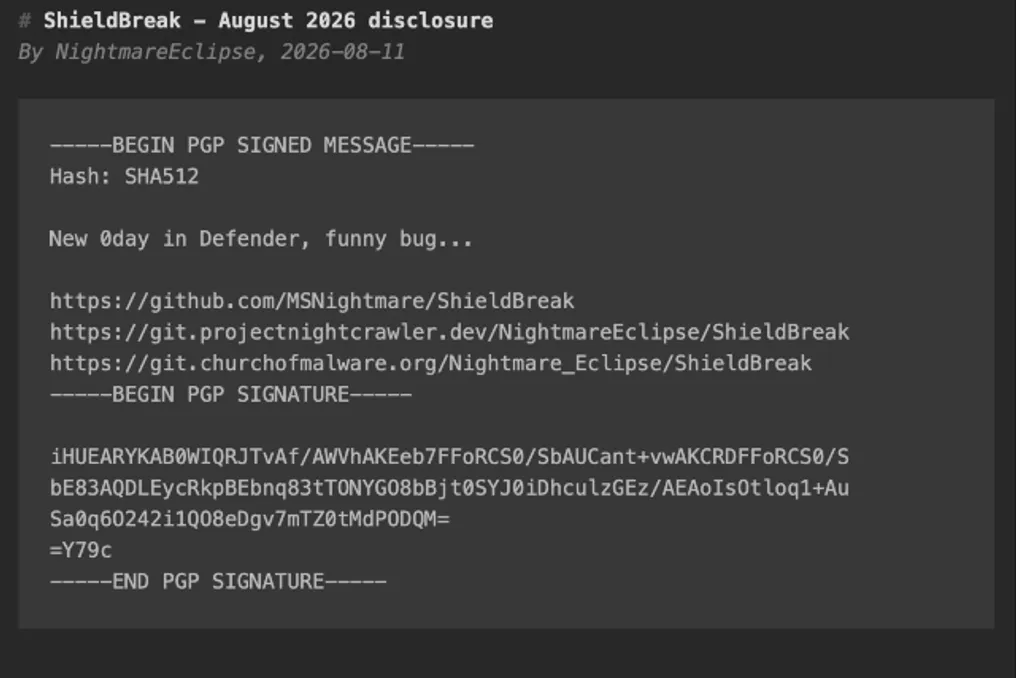
The ShieldBreak vulnerability targets Windows Defender, the built-in antivirus engine of Windows. A successful attack allows an attacker to move from low-level user access to full control over the device and data. In a post dated August 11, 2026, Nightmare Eclipse dubbed it 'New 0day in Defender' and provided links to public ShieldBreak repositories. The proof of concept was released as a Windows application, which requires the user to run it to activate the exploit.
Security researcher Will Dormann reported that he conducted brief testing of ShieldBreak, noting that 'Defender must be enabled for the exploit to work.' Dormann specified that this flaw applies to Windows 10, Windows 11, including the latest version 25H2, as well as Windows Server 2025.
As of now, Microsoft has not released a fix for ShieldBreak. A Microsoft representative told TechCrunch that the company 'is aware of the claimed vulnerability and is actively investigating the validity and potential applicability of these claims.' The disclosure occurred after Microsoft's regular August update (Patch Tuesday). Krebs on Security reported that in this month, Microsoft released updates for at least 398 vulnerabilities in Windows and supported software, including one weakness that is already being actively exploited, and two others that were publicly described before the patch release.
The conflict behind ShieldBreak had been brewing for months. It is reported that Nightmare Eclipse published details of several flaws in Microsoft products, including Windows, and that some earlier Windows flaws were subsequently used in real attacks. In May, Microsoft did not name Nightmare Eclipse in the MSRC blog post, but criticized uncoordinated disclosures, stating that a number of zero-day vulnerabilities were made public without prior exchange of details with Microsoft. The company emphasized that uncoordinated disclosure, placing proof-of-concept code for unpatched flaws into the hands of attackers, 'is never justified and has real consequences.'
The same post stated that the Microsoft Digital Crime Unit would continue to prosecute attackers and 'those who facilitate their criminal activities,' coordinating with law enforcement when necessary. Microsoft later retracted comments in a social media post, although the original blog remains published.
For the average user, the practical advice is simple: keep Windows Update enabled. Restart when the system prompts for an update. Do not download random executables just because someone online claims they prove a certain point. Your laptop does not care about ethical debates; it just needs a patch.