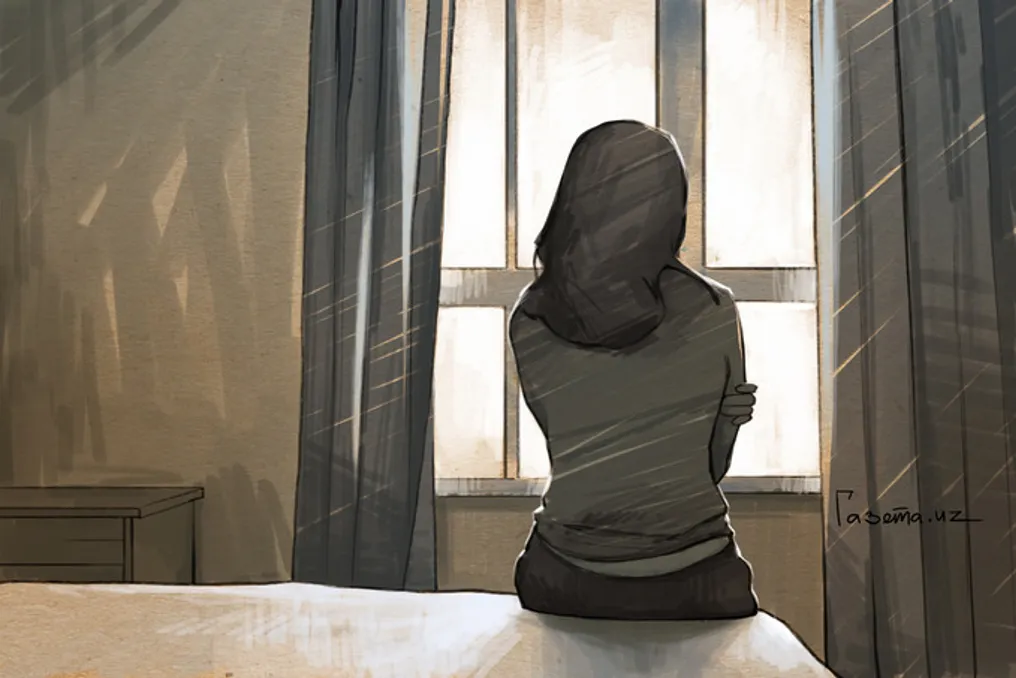
Irina Matvienko, founder of the anti-gender violence project Nemolchi.uz, gave a lecture at the Human House gallery dedicated to various forms of violence—both obvious and hidden. During the meeting, she detailed the types of violence, methods for recognizing it, and where to seek help. The newspaper prepared a summary of her speech.
Psychological Pressure
People often mistakenly believe that violence manifests only through physical impact, such as bruises or beatings. However, such manifestations are usually only the final stage. Before physical violence occurs, signs of psychological and financial pressure are often observed, which can last for months or even years. These forms of influence can exist without direct physical contact, but this does not diminish the harm experienced by the victim. Nevertheless, in the moment these situations arise, they are rarely called 'violence,' although awareness of these types is growing recently.
The main goal of an abuser is to psychologically suppress the person. When a woman seeks help, realizing the need to leave such an environment, she is advised to file a statement. However, she often replies that she is afraid or fears she will be killed.
A situation was described where an adult girl reported violence from her father. He shaved her bald and beat her with a phone charging cord, leaving long red swollen stripes on her body. Despite this, the girl did not report to law enforcement due to panic fear of retaliation. Initially, it was assumed that the man had a strong build, but in reality, he was quite thin. The father suppressed her will so much by maintaining constant fear of physical punishment that she did not try to resist.
Most abusers show remorse after filing a statement: they start crying, mention family, and ask the court to mitigate the sentence, promising that such things will not happen again. Women tend to believe and forgive, but in most cases, the violence continues. Sometimes public disclosure of the situation can provoke further escalation of conflict and abuse. In one story, the girl managed to leave the family for another country, find work there, and her life stabilized.
Manipulation of Care
Consider an example where a spouse asks his wife to lose weight supposedly for her health. This statement alone does not provide a clear answer about the presence of violence. The context is key: the situation differs greatly if the phrase is said two months after childbirth, or if the woman has long suffered from excess weight with associated problems. It is important to understand that abusers often use such phrases not out of sincere care, but to sow feelings of insecurity and dissatisfaction in the victim, thereby increasing control.
In addition to the context, the actions accompanying such a request are important. Does the spouse show care by going to the doctor together, buying suitable food, helping to eliminate stressors, preparing special food, or offering a gym membership? Or does he limit himself to phrases like: 'Just eat less and walk around the block 20 thousand steps a day'? Any specialist would confirm that this 'formula' is not universal, and the reasons for weight fluctuations can be very diverse.
Manipulation of Care
Manipulation of care can also manifest through small but constant remarks that 'drip' daily: 'Shorts don't suit you,' 'Try not to laugh loudly, you look vulgar,' or 'I care about your health, so you will only eat celery.' Although externally this may appear as a lack of coercion or prohibitions, the woman in such a situation feels constant pressure and an internal sense of inadequacy.
Other forms of control can be masked as care. For example, the phrase: 'You know I love you so much, but I don't like that you have an open Instagram. Let's you close it.' For some people, social media activity is irrelevant, while for others, it is a way to communicate with friends, get news, and self-express. This control can then deepen: suggesting closing the page can turn into demanding the deletion of Instagram, and then into requesting the password for the account to read Telegram chats.
The spouse may also insist on joint location tracking. In some cases, this happens with mutual consent. However, it is critically important to assess who actually has the right to make decisions in the family and how truly free the second partner's consent is. Can the woman refuse such a proposal without any negative consequences? If she says, 'I don't want to share my location with you,' and her partner replies, 'Okay, whatever you say,' and they continue to live without conflict, it may be acceptable. But if the woman cannot refuse, even if it is unpleasant for her, she may agree, knowing the possible consequences, considering it a safer option. Such consent is also a form of violence, even if it appears otherwise externally.
Financial Control
Unhealthy control over finances can exist even in couples where spouses have equal income. Sometimes a woman is forced to provide a report on every expense or her bank card is taken away entirely. Under these conditions, the wife receives the amount the husband deems appropriate and must 'justify' every purchase. In traditional families, this control can be exercised by both the husband and the mother-in-law. This is not about large purchases, such as expensive gadgets or trips to the Maldives, but about daily necessities. Most often, women spend money on children—on clothes, groceries, stationery, toys, or personal hygiene products, and each such expense requires explanation. In some cases, women have to ask for money even to buy underwear if the old ones are worn out. Meanwhile, men can often visit friends, go to cafes, or travel outside the city without feeling the need to justify their expenses.
Isolation
Isolation begins with establishing prohibitions, such as restrictions on communicating with friends. There was a recorded case where a partner deliberately attended the girl's meetings with friends and caused scandals there. As a result, the friends started gathering without her because they found it more comfortable to spend time than listen to shouting. This woman was afraid to disobey her partner because he created scenes for any reason, even at her workplace, which led to her being fired from several jobs. The situation escalated to the point where she was afraid to answer a call, fearing he would come to her new workplace and cause a scandal, leading to dismissal. The partner also undermined her relationship with her relatives to such an extent that they blocked her. Upon speaking with her, it turned out that she deleted correspondence because her phone was being tracked. Ultimately, she found herself in a state of complete isolation, suffering from fear, mental depression, and low self-esteem. In such a situation, it is extremely difficult to exit the cycle of violence independently and seek support.
The reason an abuser seeks to isolate the victim is to deprive her of the ability to receive support from those around her. Thus, in case of a difficult situation arising, she finds herself trapped.
Gaslighting
Gaslighting is a method where the manipulator forces the victim to doubt their own adequacy, memory, and ability to perceive reality. According to the author, this is one of the most dangerous types of manipulation. The term comes from the name of a 1944 film where the husband adjusted gas lamps and moved furniture, and when the wife pointed this out, he denied what was happening, saying, 'You imagined it.' A person living in such an atmosphere inevitably begins to lose trust in themselves. For example, women consult specialists with the question of whether their situation is abuse. In such cases, the picture completely matches the methods of abuse. The woman is in an environment of violence but does not realize it herself, does not believe her own feelings, or what she sees.
The abuser achieves their goal—the complete subjugation of the victim's psyche. An insecure person will not complain and will comply unconditionally with the manipulator's instructions.
Pressure Through Silence
There are situations where partners do not communicate with each other for a day after an argument. Or one partner stops talking, leaving the other in a state of uncertainty about what happened and what was done wrong. Women experiencing this violence report that they do not know what exactly caused their partner's offense, yet they feel guilty and constantly try to guess the reason for his displeasure. This causes enormous stress. Furthermore, women themselves often use a similar tactic—silence, hoping that the partner will 'figure it out' on his own.
This situation needs to be analyzed from the perspective of power dynamics in the relationship. Often, the woman subjected to psychological and financial pressure has only one way to express pain: silence. It is safer for her to express her dissatisfaction, resentment, or disagreement through silence, as any other methods could worsen her situation.
Threats
Legislation in Uzbekistan provides for accounting for threats to life and health, although proving them can be difficult. The most common manipulation is the threat of depriving a child in case of divorce, which is especially relevant for women who are economically dependent on their partner. The woman often fears that if the husband has housing and funds, and she is a homemaker, the court will leave the children with him. However, courts often decide to leave the children with the mother, taking into account the best interests of the child, including their psychological state. A woman has the right to apply for alimony even during marriage, as well as for her own maintenance while the child is young.
Economic dependence is often generated by questions like: 'Where will I go? What will happen to me?', especially if the marriage was concluded before the age of eighteen, when a person does not yet have formed life orientations.