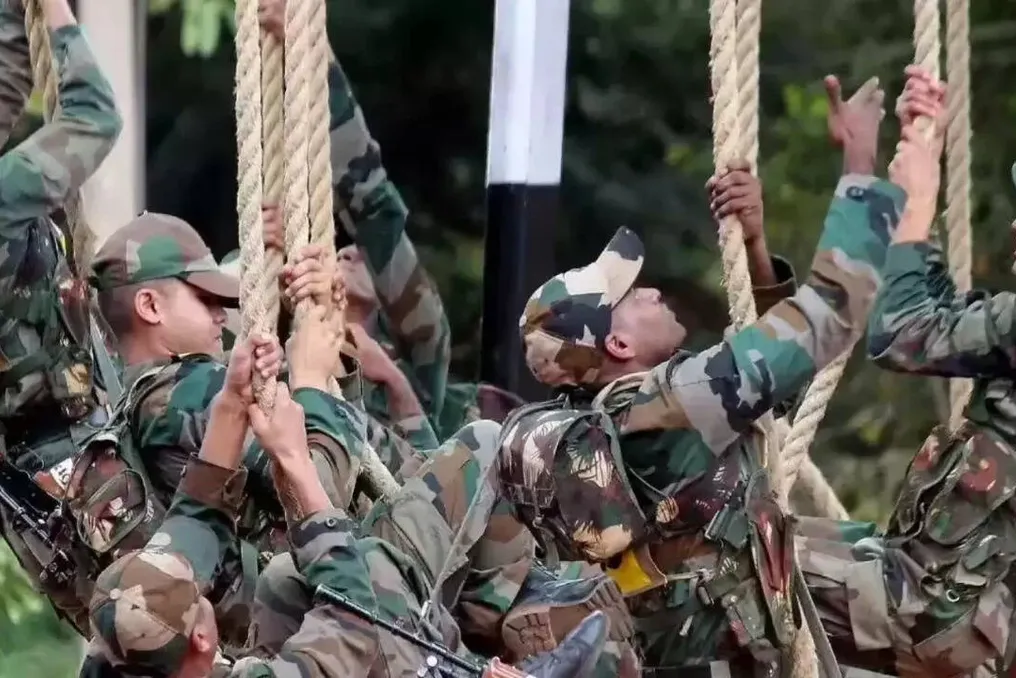
The first group of Agniveers recruited under the Agnipath scheme is reaching an important milestone. The four-year service of this initial batch will conclude at the end of the current year. The Indian Navy, which began training Agniveers earlier than the other two services, is now among the departments that must implement policies for retention and exit processes.
This achievement comes approximately four years after the first naval Agniveers arrived for training at INS Chilka in November 2022. Since the Navy started training before the Army and Air Force, the completion of the first batch cycle will be an important test for the initial phase of the Agnipath model.
The first batch of approximately 2600 naval Agniveers (including women) completed 16 weeks of basic training at INS Chilka in March 2023, after which they proceeded to professional and naval training. The first Agniveer graduation ceremony was held at INS Chilka on March 28, 2023.
According to the Agnipath scheme, the service period is four years. At the end of this period, Agniveers can apply to continue service in the permanent cadre. Under the existing structure, no more than 25% of Agniveers from each batch can be retained. The government plans to consider applications through a centralized process that takes into account performance over the four years of service, organizational needs, and the policies of the respective service. This means the first batch will provide the services with an opportunity to conduct the first full evaluation of the model, covering recruitment, training, operational work, performance, and final retention.
Full details of the service-specific assessment matrix for the first batch have not been made public. The official Agnipath structure clearly states that selection must be centralized, objective, and based on merit, not automatic service extension. In the current context, it is explicitly stated for the Navy that applications for permanent enlistment after four years will be considered centrally based on objective criteria, including performance over the four years of service. The Navy can recruit no more than 25 percent of Agniveers in each batch according to its needs and prevailing policy. Furthermore, organizational requirement is a key factor in the initial government structure. Therefore, the final selection will balance individual performance with workforce needs and the specialized skills of the service. It is important to note that an Agniveer does not have an automatic right to permanent enlistment. In the current context of the Navy, it is directly stated that the service is not obligated to retain Agniveers after the four-year term.
The first exit cycle runs parallel to an internal review of the Agnipath model. According to recent reports, all three services are considering increasing the current limit of 25 percent. The armed forces require a significantly higher retention percentage. This issue is under review, but changes to the existing policy have not yet been approved. The situation with the Navy is particularly critical because sailors are trained in operating complex weaponry, sensors, communication systems, and other technical equipment. Losing a large number of trained personnel after four years of training and operational experience would mean a loss of resources and time invested by the service. A formal policy decision is needed for the government to determine whether it will change the limit. Until then, the existing 25 percent structure remains in place.
The first batch of the Army and Air Force will follow later. The first battalion of Agniveers in the Indian Army arrived for training in November 2022. Although they completed basic training in early 2023, the first Army batch was trained and inducted later. The first battalion of the Indian Air Force began Agniveer training in December 2022. The first Army batch will complete its four-year term in early 2027. The Army is also reportedly considering the need for a higher level of retention than the current 25 percent limit, but this has not yet been approved.
Agniveers who are not retained are entitled to a social security package. The government has also created numerous pathways for the further employment of these individuals in paramilitary forces, police, and other government organizations. Before the first exit cycle, the central government announced the reservation of 50 percent of vacancies for constable (general duty) in the Central Armed Police Forces (CAPFs) and rifleman in the Assam Rifles for former Agniveers. Concessions regarding age and certain recruitment stages were also provided for the respective former Agniveers. The Ministry of Home Affairs is also working on recruitment rules and the category of former Agniveers to create an organized pathway for entry into CAPFs and Assam Rifles.