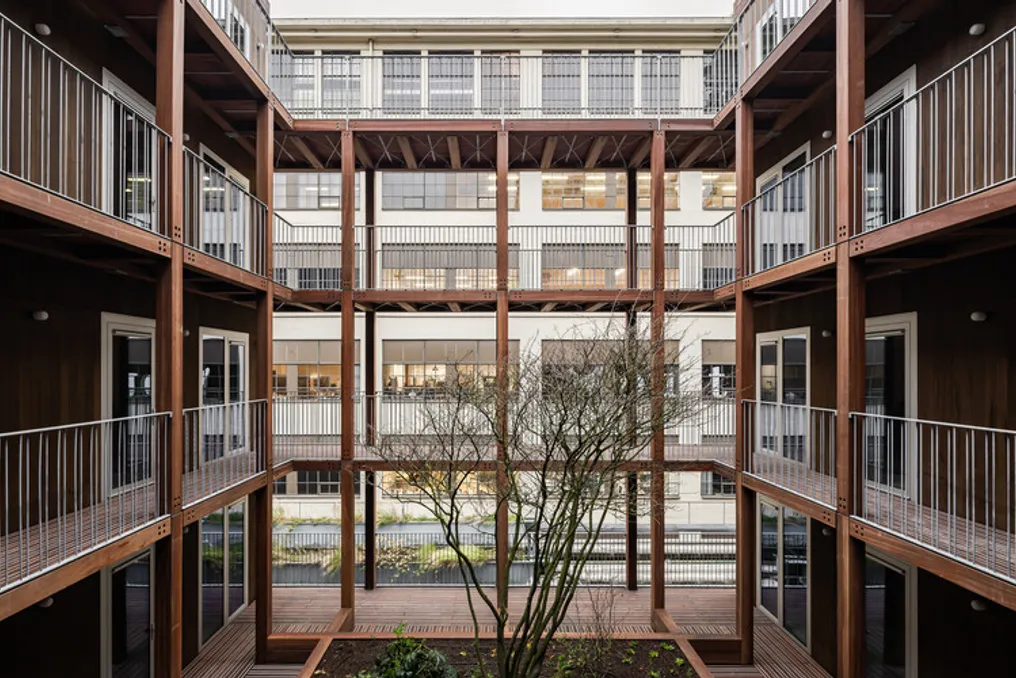
The KAAN Architecten office has finalized the Matchbox project, which is a compact mixed-use building with a wooden structure. This development is located in the Strijp-S district of the city of Eindhoven.
The KAAN Architecten office has finalized the Matchbox project, which is a compact mixed-use building with a wooden structure. This development is located in the Strijp-S district of the city of Eindhoven.
Matchbox was designed to become a quiet landmark within the former Philips industrial complex. The project presents a sustainable option in contrast to traditional concrete-based construction methods.
The building was erected almost entirely using wood and integrates offices, rental social housing units, and common outdoor areas, all within a well-defined modular design.
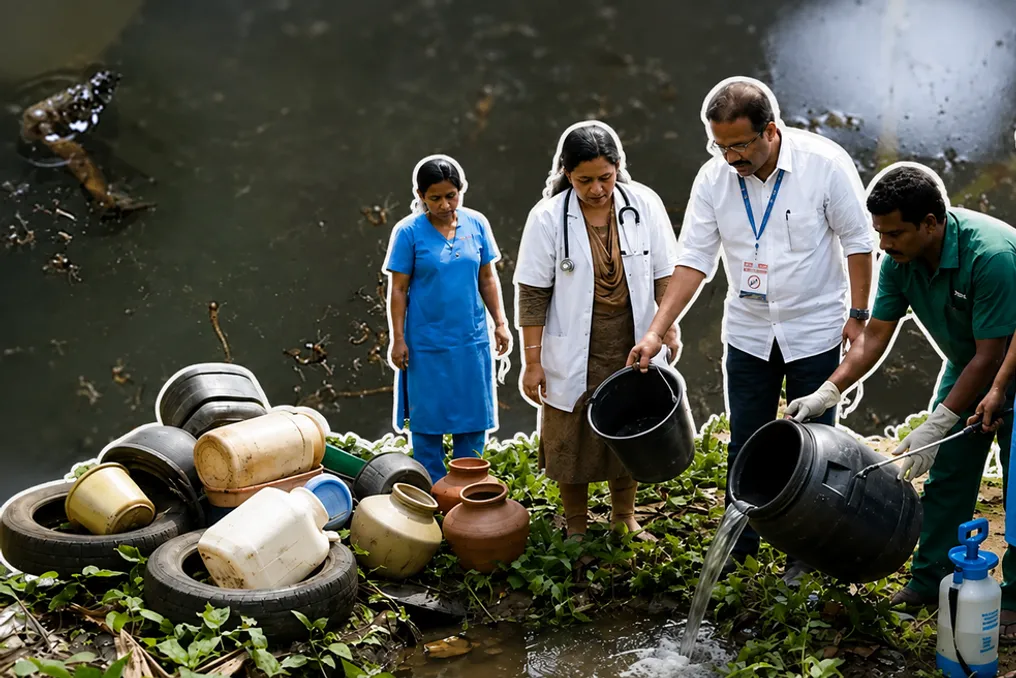
During the monsoon season in Alappuzha, water accumulates everywhere: canals rise, drainage systems fill up, and puddles remain long after the rain stops. Additionally, there are less noticeable spots, such as flower pots in the yard, old tires against the wall, buckets collecting rainwater, or poorly drained downspouts. These objects may seem harmless, but for mosquitoes looking for a place to lay eggs, they represent ideal conditions.
This is precisely the problem faced by residents of Vadakkal. In 2016, researchers surveying the Alappuzha area discovered mosquito breeding sites in 64.2% of the checked houses. This meant that in a street with ten houses, outbreaks could be present in six of them, posing a dengue threat in the most familiar places, right near people's homes.
Two years later, this figure significantly decreased—from 64.2% to only 8.6%. The reason was that the residents themselves began actively searching for breeding sites, inspecting homes, communicating with neighbors, and taking measures in areas where water collected.
These efforts became part of a study conducted by researchers from the ICMR-National Institute of Virology division in Kerala and TD Medical College in Alappuzha between November 2016 and October 2018. The study aimed to answer a specific question: whether residents themselves, when properly organized, could achieve results that routine vector control programs had failed to attain in a district where dengue, chikungunya, and leptospirosis regularly recurred?
The researchers first tried to understand the internal situation in these areas during the mosquito season before asking residents to change anything. They studied exactly where water accumulated, what families knew about dengue, and which preventive measures actually reached the homes and which remained unnoticed.
As a result, an effective structure was formed. A steering committee was established in each area, overseeing smaller cluster committees. This model was based on the same principle of grassroots organization that underlies Kudumbashree—Kerala's women's self-help network, whose roots partially trace back to the Alappuzha municipality.
These committees posted notices, visited homes, distributed brochures, and used a WhatsApp group to coordinate all actions in real time. Checking for stagnant water where mosquitoes breed ceased to be a random inspection visit by an inspector and transformed into mutual assistance among neighbors week after week.
Residents also noticed, and later confirmed through data, that uncollected garbage itself retained water and created breeding grounds. Therefore, the cluster committees began managing waste collection independently, aligning with the already known model of decentralized waste management in the city, based on the same principle currently applied in India for broader handling of untreated kitchen waste.
Over time, the indicators began to reflect what residents saw on the ground. In Vadakkal, the proportion of houses with mosquito breeding sites dropped from 64.2% to 8.6%. In Pazhavakadu, this figure decreased from 16.7% to 6%.
Other indicators used by the researchers moved in the same direction. In Pazhavakadu, the container index, measuring the proportion of containers holding water where mosquito larvae or pupae were found, decreased from 24.8 to 12.1. The Breteau index, counting positive breeding containers per 100 surveyed houses, fell from 21.3 to 7.3.
In Vadakkal, the container index dropped from 37.7 to 18.1, and the Breteau index—from 47.7 to 8.6. All these figures pointed to a clear shift: by the end of the intervention, far fewer houses and containers served as havens for mosquito breeding.
The researchers concluded that community involvement must occupy a central place in public health policy, rather than being peripheral. This argument became even more relevant as the Kerala Health Department repeatedly issued dengue warnings during monsoons in various districts, including Alappuzha, and the state registered over 8000 dengue cases by mid-2024.
A significant part of the solution started with residents noticing the things around them: a bucket filling up in the yard, a clogged drain, a discarded tire holding rainwater. Then, they helped their neighbors notice these problems too. For a disease whose breeding sites can be just a few steps from the front door, such community vigilance can have a measurable effect before the next outbreak begins.
The South African National Biodiversity Institute (SANBI) requires a budget of 741 million rand to carry out infrastructure upgrade works at Kirstenbosch Gardens and Pilanesberg National Park.
The committee was informed that the network of South Africa's national botanical and zoological gardens, managed by SANBI, is facing significant infrastructure challenges that jeopardize its ability to perform vital functions in nature conservation, research, education, and tourism.
The SANBI report addressed infrastructure issues at Kirstenbosch Gardens and Pilanesberg National Park. It was emphasized that both reserves are vital for nature conservation, tourism, community development, and heritage preservation.
Gantsho explained that such gardens, including the renowned Kirstenbosch National Botanical Garden, are not only centers of biodiversity and social cohesion in urban environments but also important contributors to the local economy and job creation. However, the infrastructure supporting these functions is under severe strain due to historical underfunding, aging facilities, and growing needs.
The committee chairperson explained that the main difficulty lies in the substantial gap between available funding and actual infrastructure needs. Although DFFE allocated 180 million rand for 2024/2025, the projected infrastructure need for 2027/2028 alone is 741 million rand, with the shortfall expected to reach 839 million rand by 2029/2030.
This deficit hinders the maintenance and modernization of crucial assets such as water supply systems, security, electricity, roads, and visitor amenities. Many gardens were established over a century ago, and their aging infrastructure requires urgent restoration to meet modern standards of safety, accessibility, and sustainability.
Gantsho added that operational complexities exacerbate these financial constraints. SANBI is forced to prioritize income-generating infrastructure, nature conservation sites, and compliance with legal and regulatory requirements. The complexity of infrastructure planning increases due to the need to balance commercial activities with mandates for nature conservation and education, which includes events, restaurants, and plant sales.
She also mentioned that expanding green energy and water conservation initiatives, while necessary for sustainability, requires significant initial investments that are difficult to secure under current budgetary limitations.
Furthermore, staffing and capacity have suffered. Critical vacancies, especially in horticulture and technical fields, limit the ability to effectively maintain and develop infrastructure. While volunteer support and public-private partnerships help partially, they cannot replace permanent strategic investment.
Despite these difficulties, SANBI has achieved notable successes, including the completion of the Boomslang walking trail and the modernization of research and visitor facilities. Current and planned projects, such as the installation of PV solar panels, irrigation upgrades, and enhanced security, demonstrate a clear vision for the future.
However, Gantsho warned that without increased and sustained funding, there is a risk of infrastructure deterioration, threatening the gardens' ability to serve as global centers for biodiversity, tourism, and public engagement.