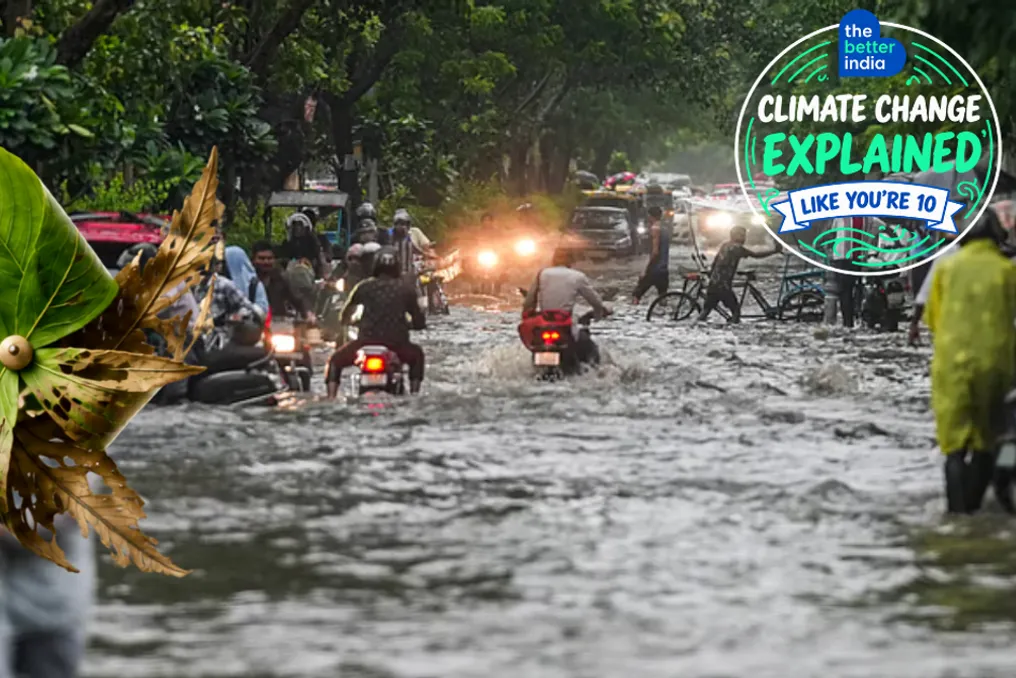
In Colaba, when the sky was clear during the day, after a cup of tea it turned gray, and the first large raindrops turned the street into something more than just a puddle—a brown, moving river. In one hour of rain, scooters stopped, and people started carrying shoes because the water reached the second step of the neighboring shop. This situation is familiar to millions of Mumbai residents during the monsoon season: 'It only rained for an hour. Why is my street flooded?'
For a street to flood in an hour, two things must happen: too much water must fall from the sky and too quickly, and this water must have nowhere to go. In Mumbai, both these conditions are currently met. One problem is related to the atmosphere, and the other is related to what the residents themselves have built.
What is actually happening
If we talk about one problem, we are lying. Therefore, it is necessary to consider both causes.
When did this start? Ask anyone over 50
Grandmothers might say that Mumbai has always experienced heavy rains, as the monsoon is the life rhythm of the city. However, they also note changes. Previously, rains fell evenly over several days, but now they pour down in sudden downpours—it seems as if the entire sky empties in one or two hours, and then stops.
This is not just memory. On July 26, 2005, Mumbai received 944 millimeters of rain in a day, comparable to the annual rainfall for many Indian cities. That day became a benchmark of disaster for the city, but the reason people talk about it lies not only in the amount of precipitation.
First Cause: The Sky (Climate Aspect)
A scientific explanation can be presented through the metaphor of a kitchen sponge. The air above our heads can be compared to a sponge: a warm sponge retains more moisture than a cold one. Since humanity burns coal, gasoline, and gas, the air is gradually heating up, and the warmer atmospheric layer becomes a 'bigger sponge.' For every degree of warming, it is capable of holding approximately 7% more water. When this 'sponge' becomes saturated and compresses, it releases much more water simultaneously, leading not to light drizzle, but to walls of water in an hour.
This is not a supposition, but recorded data. A study published in the journal Nature Climate Change showed that extreme precipitation in central India has roughly tripled between 1950 and 2015. Leading meteorological services in the country, such as the India Meteorological Department (IMD) and the Indian Institute of Tropical Meteorology (IITM), record that short, intense downpours are becoming more frequent and are the main cause of urban flooding. In 2025, the IMD registered a sharp increase in extreme precipitation events, and rain-related disasters became the deadliest climate threat in the country that year.
Thus, the atmosphere brings stronger squalls than before. This is a consequence of climate change—real and measurable. But this is only half the story.
Second Cause: The Land (What We Have Built)
Here is the part that should alarm everyone: even if the amount of precipitation had not changed, Mumbai would still flood worse than fifty years ago. The reason is that we have eliminated the places where water used to go.
Water follows gravity, finds lowlands, seeps into the soil, collects in lakes, and is discharged into the sea through rivers and streams. Mumbai was originally situated on a natural drainage system that included wetlands, mangrove swamps, salt pans, and rivers like the Mithi, which carried rainwater into the Arabian Sea. However, these areas have been filled in. Between the beginning of the 1990s and 2005, Mumbai and Thane lost about 40% of their wetlands—natural sponges that absorb floodwaters—due to construction. The Mithi River, the city's main outlet, was narrowed due to encroachment and development (including the Bandra Kurla complex built on its wetlands) to half its size. Consequently, when the rain started in 2005, the choked river could not carry the water downstream, and it rushed onto the streets of Mumbai.
Furthermore, when the soil is covered with concrete, rainwater that previously seeped into the ground no longer has anywhere to go. Water that was previously absorbed now remains on the surface. Twenty years later and billions of rupees later, the Mithi River remains choked and silted up, and construction along it continues.
You can imagine it this way: the sky is now pouring more water into a bucket whose bottom we are unknowingly sealing. The inflow increases, while the outflow capacity decreases. That is the essence of a flooded street in one sentence.
Why 'Just One Hour' Is Enough
Now the initial question finds its answer. Your street floods in an hour because the downpour has become stronger than before (climate change), and because the water can no longer leave or soak in as it once did (land use changes). Mumbai's own climate plan explicitly acknowledges that if the rain of July 26, 2005, were to repeat, parts of the city would flood even with drainage modernized to handle 50 mm per hour. The bucket simply became too small, and the sky keeps filling up.
Version for Family Conversation
Here is how you can explain this to your daughter in the evening while watching the rain outside the window:
Daughter: 'Why is the road turning into a river? It just started raining!'
You: 'There are two reasons, dear. Do you know that a sponge can only hold a certain amount of water before it starts dripping? The air above our city is like a giant sponge, and it heats up due to smoke from cars and factories. A warm sponge holds more water. So, when it compresses, it dumps a lot of water all at once.'
Daughter: 'Okay, so where does the water go?'
You: 'That is the second reason. This whole area used to be swamps and a river that carried rainwater to the sea. We built roads and buildings over them. Now the water falls faster and has nowhere to go. That is why the road floods.'
Daughter: 'Can we fix this?'
You: 'Partially, yes. That is good news.'
What Each of Us Can Do
Here, climate change stops being just a headline and becomes something you can participate in. None of these solutions will solve the problem completely, but together, if enough people adopt them, they will change the consequences of one hour of rain for the city.
At Home
Collect rainwater that falls on the roof. A simple rooftop rainwater harvesting setup—a barrel, a pit, a PVC pipe—directs water from the terrace back into the ground instead of overloading the already strained sewage system. A resident of Malad built a working version with IIT-Bombay for a few thousand rupees; in Mumbai, hostels over 300 sq. m are already required to have such a setup, and the BMC offers a property tax discount for such environmental measures.
Create a permeable well or a rain garden. Even a small patch of land not covered with concrete—gravel, a shallow pit, a few deeply rooted plants—allows water to seep where it fell, rather than running onto the road.
Keep Your Street Drain Clean
Nullahs partially flood due to plastic waste. What your family throws into the drain in January will clog your street in July. Don't feed the blockage.
In Your Building and Neighborhood
Remove Asphalt Where Possible
Urge your community to replace hard cement with permeable pavement, preserve green belts, or plant trees in the courtyard. A shaded area covered with soil absorbs rain and cools the building—a micro-forest of 20 trees by one Mumbai resident keeps his house temperature about 5°C lower.
Protect the water bodies near you. A neighborhood lake, pond, or wetland is free natural insurance against floods. Ordinary citizens—software engineers, retirees, schoolchildren—have restored clogged ponds and lakes across India, raising groundwater levels and providing space for water accumulation. Join or create a lake restoration group.
Protect Mangrove Swamps
The remaining mangrove swamps of Mumbai serve as the city's coastal defense wall. Report spills or destruction (Maharashtra has a hotline for mangrove protection) and support civil groups fighting their conversion.
As a Citizen
Ask one question about every new project: 'Where will the rain go after this structure is built?' When new construction appears in your area, this single question, asked in writing by enough residents, helps protect floodplains and natural waterways. Support the demand to 'manage water where it falls,' not just 'divert it.' Support local demands for restoring wetlands and rivers alongside large drainage systems. Experts clearly state that a concrete drainage system alone cannot save a city that constantly erodes its natural sponges.
Reduce the Sky Problem Too
'The warm sponge' shrinks only when the world burns less coal, oil, and gas. Your voice, your travel routes, your electricity consumption are individually insignificant, but they are levers that influence the size of this sponge.
Because the whole point of this series is this: climate change happens not only at summits and in frightening reports. It happens on your street, in one hour of rain. And just as it arrived through a thousand human choices, a thousand human choices can help us resist it.
Real Solutions Highlighted in The Better India
This is not theory. People are already implementing the aforementioned measures—here are some of their stories.