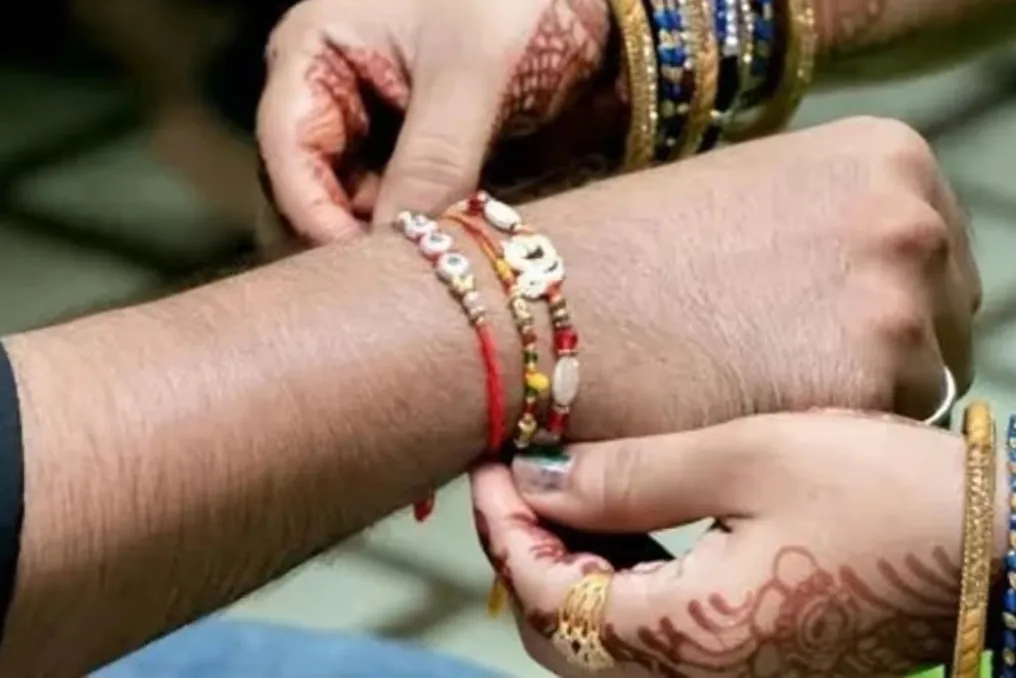
The festival season presents an excellent opportunity to start your own business, especially with the approaching Raksha Bandhan festival. You can launch a business producing and selling rakhis, starting with very modest investments, while the earning potential is quite significant.
Raksha Bandhan holds great significance in India, and markets dedicated to this event are abundant with various types of rakhis. This year, the festival is celebrated on August 28th.
During Raksha Bandhan, there is active sales of rakhis, which indicates the considerable size of this market. According to data from the Confederation of All Indian Traders (CAIT), the market volume shows annual growth. In 2018, it was 3000 crore rupees, increasing to 3500 crore in 2019, then reaching 5000 crore in 2020, 6000 crore in 2021, 7000 crore in 2022, and exceeding 10000 crore in 2023 and 2024, with a projected growth to approximately 17,000 crore rupees by 2025. Thus, starting a rakhi sales business provides access to a vast market.
You can start a rakhi production business by investing only 10,000 rupees. With such a small starting capital, you can achieve substantial profit. As demand grows, you can increase production volumes and investments to gain even greater benefits. Success in this venture will also depend on creativity, as there is huge demand for designer rakhis in the market. Products can be sold both through offline points and online platforms.
When launching a rakhi production business with a budget of 10 thousand rupees, most of the funds should be directed towards purchasing raw materials. Making rakhis requires silk threads, beads, decorative elements (such as Kundan, stones, beads), glue, rakhi stands, and packaging materials (plastic covers, gift boxes). Additionally, to start without complex equipment, scissors, a glue gun, thread, and a needle, as well as other small tools, are needed. From the initial investment of 10,000 rupees, you can purchase silk threads and other necessary goods wholesale for 5000–6000 rupees. 1000–2000 rupees will need to be allocated for purchasing production tools, such as scissors, a glue gun, thread, and a needle. The remaining funds will go towards product packaging and transportation.
The calculations presented relate only to a modest initial stage, but profits can be increased by adjusting the plan according to your capabilities. This activity allows you to start working without mechanized assistance at the initial stage and then scale the business. Various types of rakhis are in high demand in the market: cartoon, divine, musical, or LED, as well as rakhis-bracelets covered in gold or silver. Methods for creating them can be studied through video tutorials on YouTube, and then products can be made from raw materials and put up for sale. According to one estimate, 1000 rupees worth of raw materials can yield 100–150 rakhis.
A simple rakhi made from ordinary thread can be created in just 5 minutes, with material costs amounting to only 5 or 10 rupees. The manufacturing process is quite simple: take several silk threads and braid them into a plait. Then, decorative beads or shiny stones can be attached using glue. Adding beads gives the product a more attractive look, and with good packaging, such a rakhi can easily sell for 20–30 rupees. Cartoon rakhis for children require an investment of 10–15 or a maximum of 20 rupees. Silk thread, a cartoon character (made of plastic or fabric), glue, beads, and ribbons are used to make them. Such rakhis sell for 70–100 rupees in the market.
The main task is realizing the finished products, for which both offline and online sales channels exist. You can contact local shops, boutiques, or grocery stores for wholesale sale of rakhis, or organize your own sales point. Online platforms also ensure active sales of rakhis, allowing you to earn significant profit under your own brand.
The rakhi market begins to actively form one month before the Raksha Bandhan festival, and sales increase as the date approaches. If we consider an approximate financial calculation, rakhis manufactured at a cost of 5–10 rupees can easily be sold for 30–50 rupees. Designer models can reach a price of 100 rupees. Typically, with an investment of 1000 rupees, 100 rakhis are produced, generating a profit of 3000–4000 rupees. Consequently, with a starting capital of 10,000 rupees, one can earn from 30,000 to 40,000 rupees. Since the Raksha Bandhan time is approaching, this small business can be tested, and if sales increase, production can be planned for the next year.