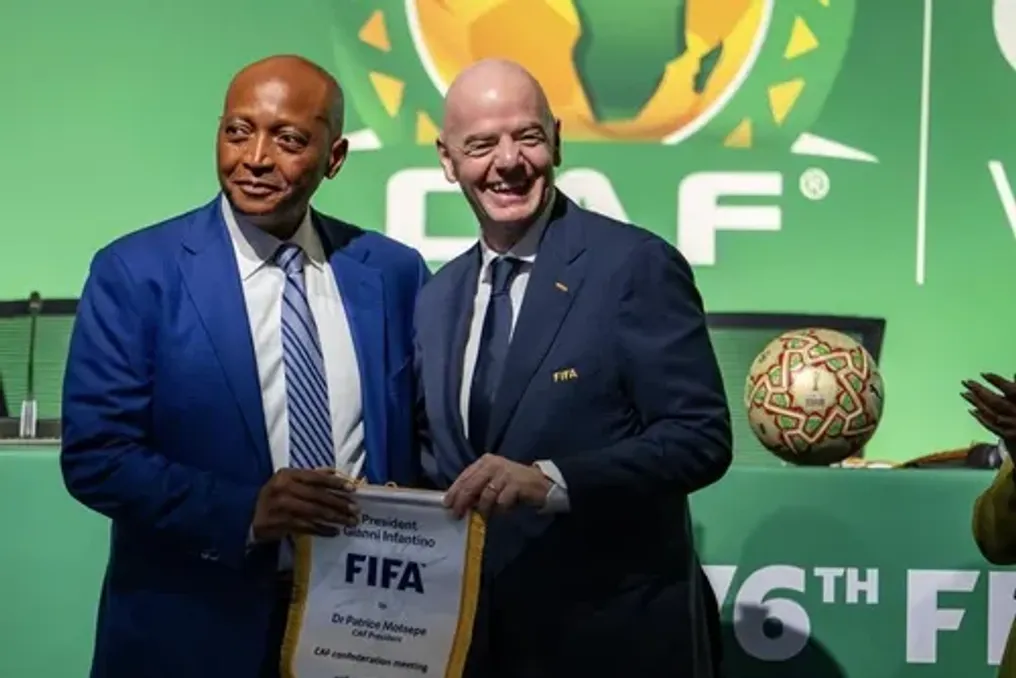
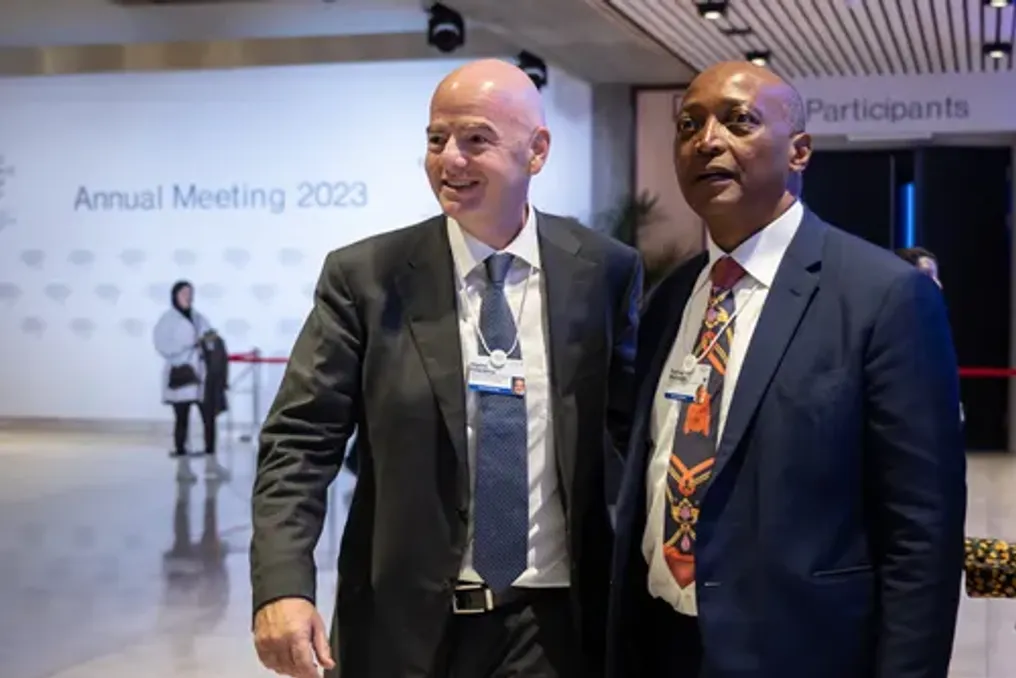
The support for Patrice Motsepe of Gianni Infantino as FIFA president raises serious questions regarding the principles of loyalty and methods of governance in African football. Critic Ziyad Motala analyzes the consequences of such political alliances and the need for leadership accountability.
In January 2020, Patrice Motsepe attended a dinner in Davos with Donald Trump. Possessing the confidence often associated with billions of dollars, Motsepe stated that he was appointed as the continent's official representative, telling Trump: 'Africa loves America' and 'Africa loves you.'
This gesture was not an expression of sympathy for an unknown political figure whose qualities emerged later. By that time, Trump had been spreading years of racist lies that the first Black president of America was not a true American. It was also reported that he referred to African countries and Haiti as 'shithole countries,' imposed travel bans primarily targeting Muslim countries, and implemented border policies that separated thousands of children from their parents. The world heard a recording where he vulgarly spoke about women, which could embarrass a drunken teenager. Just a few weeks before Motsepe's statement of continental affinity for Trump, the House of Representatives initiated impeachment against him for abuse of power and obstruction of Congress.
It seems this is the kind of person Africa loved, although Africa, unfortunately, was not consulted. The reaction was so strong that Motsepe subsequently apologized. He admitted that he has no right to speak on behalf of anyone but himself, which, according to the author, is a useful principle that, however, did not last long.
Currently, Motsepe holds the position of president of the Confederation of African Football (CAF). This week, all 54 African football associations unanimously supported Gianni Infantino for another term as FIFA president, despite the growing number of serious questions about his management in other areas. Notably, not a single federation, even one insisting on the unfashionable idea of independent thinking, opposed him. The word 'unanimously' should disgust anyone with democratic instincts.
Disagreement exists in real communities, and dissent in serious institutions. Thoughtful people sometimes come to different conclusions. It is theoretically possible for fifty-four separate organizations studying a controversial figure and reaching the same judgment to do so just as fifty-four consecutive coin tosses land on heads. One must admire this statistical achievement.
Apparently, from Cairo to Cape Town, from Dakar to Dar es Salaam, every football administrator studied Infantino's resume, pondered, consulted their conscience, and independently declared: 'Another one more, please.' Not a single dissenting vote, not a single abstention, not a single bureaucrat who accidentally found backbone.
Motsepe explained the philosophy behind his support: Infantino, according to him, is not just a friend but a 'loyal friend' who 'was loyal to Africa.' Motsepe stated that he comes from an environment where one cannot betray loyal people. The author calls this a touching, yet astonishing description of institutional governance.
CAF is not a stockwell, and FIFA is not a family wedding. The presidency of world football is not inherited by a cousin who remembers a visit when someone was sick. The important question is not whether Gianni Infantino was loyal to Patrice Motsepe, but whether he was loyal to the principles that his office is supposed to represent.
Motsepe seems to believe that Infantino's apology regarding the failed investment proposal to FIFA completely resolves the contradiction. Even if accepted, even if the matter of investments is neatly packaged and removed from the table, it does not eliminate subsequent problems.
This FIFA president presided over the invention of the FIFA Peace Prize, and then presented it to Donald Trump. Infantino told Trump that he deserved the award and assured him that he could count on Infantino's and the entire football community's support. The football community, apparently, realized its political stance at the same time as the rest of us.
Infantino also took a phone call from Trump regarding the suspension of American forward Folarin Balogun after a red card at the World Cup. The FIFA disciplinary body subsequently postponed the automatic suspension, allowing Balogun to play against Belgium. FIFA insists on the independence of its judicial bodies. Perhaps they are independent. Independence takes on a slightly theatrical character when the President of the United States can call the FIFA president about an upcoming disciplinary case, and the punishment becomes more lenient.
There was far less enthusiasm when Omar Abdul Kadir Artaan from Somalia arrived in Miami. Artaan was not a president, not a billionaire, and did not own a tower; he could offer no political support. He was simply Africa's best male referee in 2025, selected by FIFA itself to officiate its World Cup. American immigration authorities denied him entry. FIFA suddenly developed a field mouse constitution. Immigration services explained this as a matter for the host government. This organization is capable of moving billions, restructuring international calendars, negotiating with governments, demanding guarantees from the host country, and compelling national federations to obey. But when an African referee is presented to an American immigration official, the presumed governing body of world football starts looking at its shoes. Is there any evidence in CAF's magnificent unanimity that the humiliation of one of Africa's top officials caused even a sigh? It seems 'loyalty to Africa' does not require great loyalty to Africans.
Then there is Gaza. Russia invaded Ukraine in February 2022, and for four days, FIFA and UEFA suspended Russian teams. Whatever one thinks about controversial sanctions, institutional courage was not lacking. Palestinian footballers were killed, and football facilities were destroyed. The long-term issue of Israeli clubs operating in occupied Palestinian territory remained unresolved. Suddenly, FIFA discovered jurisprudence. Committees appeared, investigations flourished, legal assessments multiplied, and the procedure became truly sacred. Russia was given four days. Israel—a seminar.
When the FIFA Disciplinary Committee finally found the Israeli Football Association responsible for numerous violations related to offensive behavior, discrimination, and racist attacks, the punishment amounted mainly to a fine, a warning, and a preventive program. And the African football aristocracy seemed to accept this spectacle without seeing anything requiring revision. None of the 54.
Any of these episodes should concern the head of African football. Together, they should make Infantino's personal loyalty not something like a qualification for his approval, but rather a disgrace. Here, the episode ceases to be just about Infantino and becomes an indictment of a certain African ruling class.
Africa lacks bold people. Its history is saturated with men and women who challenged empires, dictators, apartheid systems, armies, and prisons. Nevertheless, many who rise into the continent's modern administrative elite develop an exceptional talent for leaning over when money and international power appear in the room. They speak loudly of sovereignty to the local audience but whisper thanks in the corridors of international institutions. They cite Mandela, Lumumba, and Nkrumah in speeches but behave like a coach's assistant in a foreign imperial hotel. They endlessly talk about the dignity of Africa while practicing a policy of outstretched hands.
The master has changed. The squat remains. Colonial rule once depended on chiefs, intermediaries, and local dignitaries who found that serving power could be materially preferable to opposing it. Uniforms have disappeared. Psychology proved harder to shed. Today, this arrangement is accompanied by business-class flights, conference badges, development grants, and five-star statements of 'partnership.' The old colonial intermediary waited outside the governor's residence; the modern one flies there first class.
And when the financial well is sufficiently full, 54 heads apparently find unanimity with astonishing speed. It must be precise: there is no basis to simply claim that African federations were bought. Evidence is needed for that. But there is every reason to examine the structure in which FIFA distributes huge sums to national associations, these associations vote for the FIFA president, and the beneficiaries then mysteriously exhibit almost North Korean enthusiasm for the incumbent.
Patronage is rarely stupid enough to issue invoices. It prefers lexicon: 'development,' 'solidarity,' 'partnership,' 'football family.' Wonderful phrases. They sound much better than: the person at the top controls the river of money flowing to the people who decide whether he stays at the top. Fifty-four organizations. Fifty-four consciences. One opinion.
The continent that gave birth to some of the most formidable anti-colonial movements in history has somehow produced football administrators resembling a reception committee awaiting a governor-general. And Patrice Motsepe presides over this reception committee. South Africa deserves special mention in this procession, as its own football association did not simply dissolve into the continental crowd. SAFA officially nominated Infantino for another term. Under Danny Jordaan's presidency, its National Executive Committee went further and announced that SAFA 'unreservedly supports' Infantino and would not sign any statements supporting another candidate.
There is something almost comical in the certainty. No alternative candidates have been announced yet. Competing credentials have not been weighed. SAFA seems to have completed the democratic process before it began. It pre-determined the indispensable person and closed the door before anyone else could reach it. This is not support after discussion; it is loyalty in anticipation. The message to any potential rival can hardly be clearer: save yourself the trouble. The South African football establishment has already studied candidates who do not yet exist, considered arguments that have not yet been made, weighed records that have not yet been presented, and concluded that no one can compare to Gianni Infantino.
It is hard to imagine a more effective form of democratic theater. Elections remain in the future, but the thinking is already complete. And there is Jordan himself. He held the pinnacle of South African football for over ten years and is currently in specialized commercial criminal court with accomplices on charges of fraud and theft arising from allegations of using SAFA funds for personal gain. He denies guilt and has not been convicted. This qualification matters, but the spectacle itself matters too. South Africa, still recovering from an era when the boundaries between state institutions
{