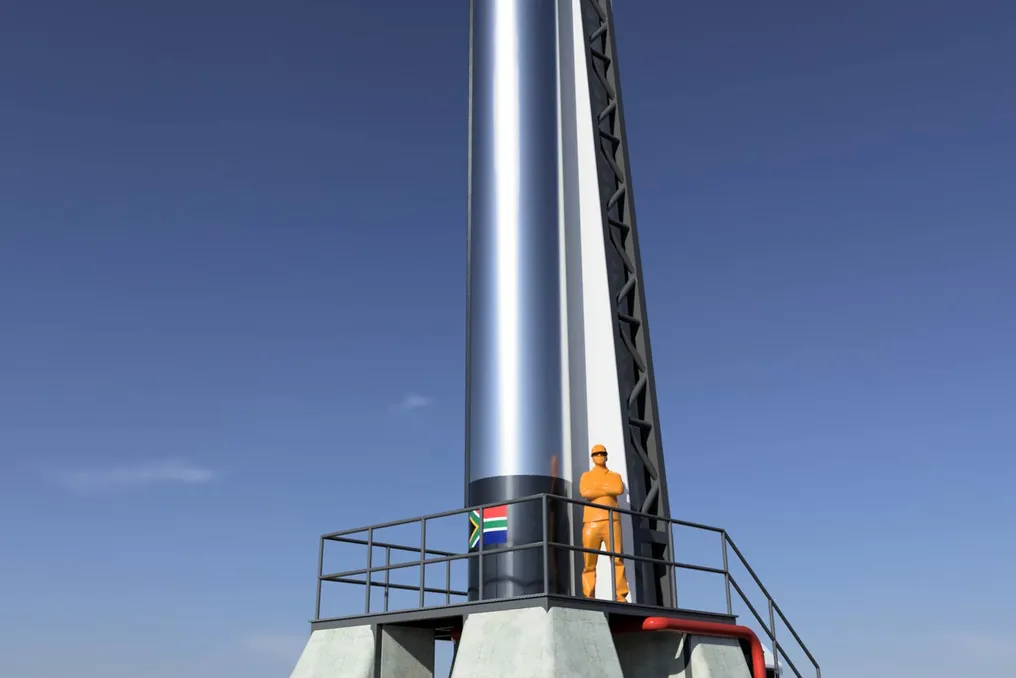
The Aerospace Systems Research Institute of the University of KwaZulu-Natal (ASRI) aims to conduct the first satellite launch from South African soil by 2030. This plan is contingent upon securing funding of 3 billion rand and increasing the team's staff by sixfold. ASRI is developing the Saffire liquid-propellant engine and a two-stage commercial launcher (CLV) that will be powered by it. Prior to this, the institute intends to launch a suborbital sounding rocket vehicle capable of reaching space in 2028.
Professor Glenn Sneden from ASRI noted that timelines and funding are closely linked. He stated that they hope to launch the suborbital rocket in 2028 if they overcome regulatory and financial hurdles, with the target date for the orbital launch being 2030.
The main barriers between ASRI's current status and its set goals are a lack of funds and personnel. According to Sneden, the total cost of the CLV program will be around 3 billion rand, which, at the 2023 exchange rate, is equivalent to approximately 186 million US dollars—a sum he deemed low in dollar terms. Currently, ASRI utilizes only a small fraction of these funds, having received significant funding from DSTI amounting to 100 million rand for the 2026 and 2027 fiscal years.
Commercialization
A more serious problem, in Sneden's view, is the staff shortage. He believes the staff needs to increase from the current twenty employees to at least 120 people, not including jobs that will emerge in related industries and supply chains. As of the end of 2024, ASRI employed 16 engineers. A sixfold increase in personnel, and a program costing 30 times the current two-year allocation, is difficult for a university research institute to absorb. This is why ASRI is striving to move out of the university structure.
While working within the university, ASRI faces both advantages and limitations. The institute is currently working with the council, UKZN structures, and DSTI to commercialize at least part of its activities. Sneden emphasized that achieving the goal of launching satellites from South African soil requires a substantial growth in personnel and facility scale, which cannot be realized solely within the university framework.
This transition has already begun: in October 2025, ASRI signed an exclusive agreement with local company Mura Space to commercialize the launch facility for sounding rockets at the Denel Overberg test range near Arniston. Mura announced a series of suborbital campaigns for 2026, some targeting the 100 km Karman line, but these flights will be conducted by international teams using ASRI's integration facility, not the institute's own vehicles. ASRI's own space-capable rocket remains a goal for 2028. Neither party has yet announced a flight under this agreement.
Furthermore, ASRI is in preliminary discussions with the developers of Cape Winelands Airport, which confirmed the institute's involvement in July. These discussions concern the possibility of creating an assembly complex from which rockets would be transported to the launch site for final integration and launch, although Sneden clarified that these are only initial stages of negotiation. Professor Corne Schutte, Deputy Dean for Research and Industry Liaison at the Faculty of Engineering, Stellenbosch University, warned in July that the airport's aerospace plans represent an 'intention, not a project.'
From Phoenix to Saffire
ASRI originated from the Aerospace Systems Research Group, which conducted propulsion system research at UKZN since 2009. Sneden dates the establishment of the institute as a research center to 2023, and UKZN officially launched it in April 2024. The institute's first vehicle, the hybrid Phoenix rocket, completed eight launches across five campaigns from Overberg. The height record belongs to the Phoenix-1B Mk IIr flight on March 8, 2021, which reached 17.9 km and broke the African record for hybrid rockets of 10.3 km. At that time, the group leader, Jean Pittot, expressed joy to the team for the successful completion of the work.
Two subsequent flights from the new integration facility in December 2024 reached lower altitudes—16.6 km and 11.9 km. Sneden attributed this to a deliberate shift in focus: instead of setting a record, as in 2021, attention was concentrated on payload launches and attempts to recover data with a smaller fuel load, leading to reduced altitudes.
The true value of the rocket lies in the people. Sneden noted that there is currently a lack of rocket launch specialists in the South African market, necessitating the development of these skills. The Phoenix rocket is safe for students because its fuel is inert.
The December flights also allowed for the commissioning of a permanent integration facility at Overberg. This facility, commissioned in October 2024 with funding from the science department and built by local firm TF Design, is comparable in height to a six-story building. During the opening of this facility, Deputy Minister of Science Nomalungelo Gina called it a 'national asset that will be used for launching suborbital rockets created by ASRI.' The facility was designed with capacity to meet future tasks.
The 200 kg Question
ASRI was established around the conceptual CLV project, capable of placing 200 kg into a sun-synchronous orbit at an altitude of 500 km from Overberg. The design features a two-stage system with nine plus one engine, operating on liquid oxygen and kerosene via electrically driven pumps. Sneden compared it to Rocket Lab's Electron rocket, which uses a similar architecture and also places 200 kg into a sun-synchronous orbit.
The engine required to realize this task is named Saffire, which stands for South African First Integrated Rocket Engine. It is designed for a thrust of 27.6 kN. The ablatively cooled, pressure-fed demonstrator, known as Able, produces 18 kN on liquid oxygen and Jet A-1 fuel. It was tested at the Overberg facility during three campaigns, and UKZN called it one of the most powerful student liquid rocket engines.
Sneden reported that preliminary tests of the first full-scale electric pump are currently underway, and the regeneratively cooled chamber is being 3D printed by various suppliers for assembly and testing later this year. He added that obtaining this component will open the path to the entire system.
The Phoenix rocket will not be decommissioned. Sneden mentioned that ASRI assisted international organizations in testing their hybrid systems, and international Phoenix launches may soon commence. The 2028 suborbital vehicle is part of a strategy to prove fail-safe, recovery, and telemetry functions on low-cost rockets before transitioning to the much more expensive CLV system.
ASRI is also researching green monopropellant fuels and chemical propulsion in space. In November 2025, the institute opened a modern production complex that, according to Sneden, already allows for the in-house manufacturing of high-precision parts.
ASRI collaborates with Stellenbosch University on the development of turbopumps and with its Laboratory of Electronic Systems for telemetry, downlinks, and control. Sneden noted that they are updating the memorandum of understanding to an agreement and sees greater potential in the Stellenbosch-Somerset-West corridor, where companies such as CubeSpace, Dragonfly Aerospace, and Simera Sense are located, and which was previously featured in TechCentral as a South African satellite project cluster. He believes there is a great opportunity to create a broader aerospace institute that could serve more than just the sum of its parts.
In June 2025, Daily Maverick reported that Elon Musk wanted to launch SpaceX rockets from Overberg in the context of White House discussions with President Cyril Ramaphosa. This claim was not substantiated by reference to a specific party, and neither Musk nor SpaceX publicly confirmed it. Sneden is fundamentally not opposed. He noted that the integration facility was designed to accommodate European systems, such as the Red Kite engine from the German aerospace center, and preliminary talks were held regarding the delivery of international vehicles for scientific missions, although they 'did not lead to anything significant.' 'We clearly support this idea as a learning opportunity.'
A more complex issue is that launch technologies are strictly controlled and have dual-use capabilities. Sneden stated that the transfer of launch systems from one country to another and the potential 'sharing' of this knowledge must be accompanied by credible guarantees between governments, which is currently a difficult requirement due to a lack of trust among all parties. He added that anything less than equal joint development will be more expensive in terms of technology transfer than creating opportunities locally, and will 'tie South Africa to outdated philosophical concepts of design.'
He also noted that Denel 'is ready to support the creation of sovereign launch capability, but does not view it as an international marketing opportunity, which is regrettable given existing market opportunities.' ASRI sees 'encouraging signs' in the revival of the South African Space Agency, which licenses launch activities in accordance with the Outer Space Act of 1993. The location question is also complex. Overberg's southern latitude is suitable for polar and sun-synchronous launches—which is precisely what the 200 kg CLV was designed for—but excludes clients seeking equatorial orbits.
Sneden concludes that progress is measured by tests, not triumphs. 'We are in a process of spiral development... so success and failure often coexist in a bittersweet combination. We are doing everything possible to mitigate risks and ensure we 'fall forward.' That is what Elon Musk taught us.'