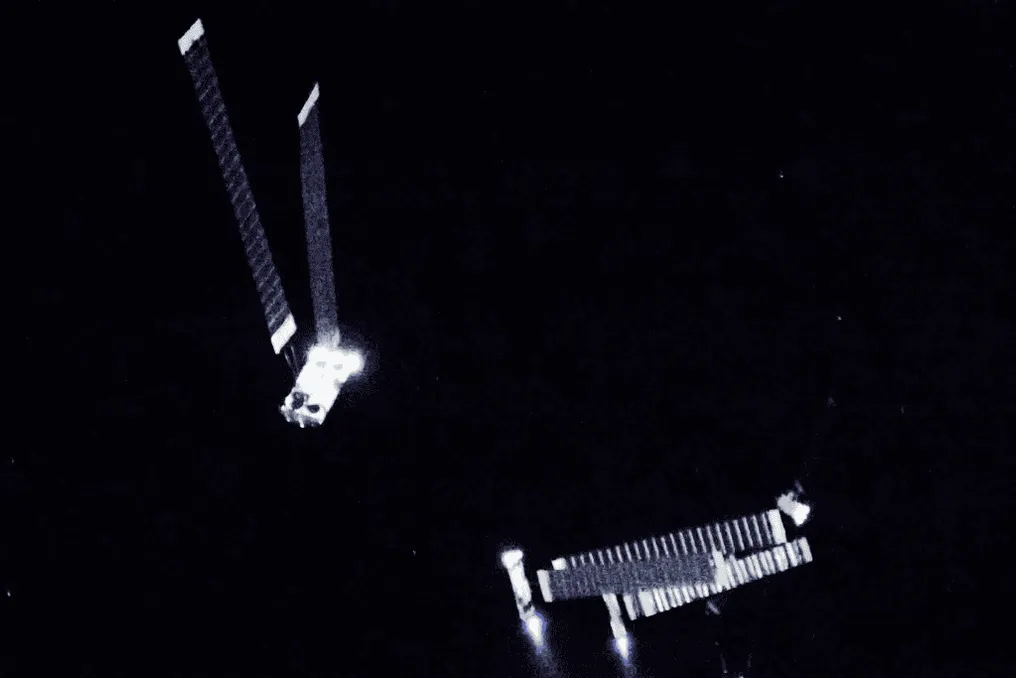
During the thirteenth successful test flight of the Starship, the new generation of Starlink V3 satellites, a satellite internet constellation from SpaceX, was experimentally implemented. A notable aspect of these new satellites is their considerable size, exceeding the wingspan of a Boeing 737, placing them among the largest communication satellites in low Earth orbit.
This increase in dimension raises doubts about whether such objects will pose an even greater problem for observing the Universe. Although the concern may not only be about what is seen in the sky, there are also fears related to what is being listened to.
Since the launch of the Starlink constellation in 2019, it has rapidly expanded, transforming internet access in remote global areas. However, this growth has generated significant discussions in the scientific community, with light trails crossing observatory images and potential interference with radio telescopes worrying astronomers.
SpaceX itself has acknowledged these challenges and has been working on solutions to mitigate the impact of its satellites on astronomy. Measures such as less reflective surfaces and greater attention to radio signal leakage have made the satellites more discreet, although not invisible, keeping the astronomical community cautious about the new generation.
The Starlink V3 marks a substantial technological advance compared to the V2. According to SpaceX, each unit offers a transmission capacity of 1 terabit per second in downlink and 160 gigabits per second in uplink, representing tenfold improvements in download and twenty-twofold improvements in upload compared to the V2. The antennas of the new models support 4,096 communication beams, an increase from the 336 of the V2, allowing for more simultaneous users with higher speeds.
This gain in capacity comes from new processors, more advanced antennas, faster inter-satellite communication, and more efficient electronic systems. However, all this computational and transmission power implies a high energy cost, requiring an increase in solar panels to generate the necessary energy in orbit.
Although SpaceX has not disclosed all official specifications of the Starlink V3, estimates based on images suggest that the satellite has two large solar panels of 19 meters each. Together with the satellite body, which is larger than a dining room, the total structure reaches about 45 meters end-to-end.
Initially, such a large satellite might seem brighter, but modern solar panels are designed to maximize light absorption. Furthermore, in response to astronomical criticism, SpaceX introduced modifications such as VisorSat, a type of visor to reduce solar incidence on the brightest parts of the structure.
Based on the estimated dimensions, it is predicted that a Starlink V3 will be only about half a magnitude brighter than a Starlink V2, if no other measures are implemented. This increase would be noticeable, but much smaller than the size suggests, although this needs to be confirmed in practice.
However, while the visual impact may be minimized for observers with optical telescopes, the situation is different for those who 'listen' to the universe through radio waves. Radio telescopes study extremely weak signals from distant galaxies, interstellar gas clouds, pulsars, and the primordial Universe, seeking to unravel mysteries such as the origin of dark energy.
The core of the problem lies in spurious emissions, or unwanted 'leakages' of signal in bands distinct from those used by the radio transmitter, and not in the authorized operating frequencies. Researchers have already identified unintentional emissions from Starlink satellites in bands used in radio astronomy—weak signals, but capable of affecting highly sensitive instruments.
The prospect of satellites operating with higher power, transmitting more data to a vast audience, and functioning continuously raises serious questions. Despite SpaceX's investments in efficient electronics and filtering, conclusive public data on the real impact of this new generation on radio astronomy is still lacking, which will likely only be known after its full operation.
This concern adds to other debates about mega-constellations, such as the growing risk of collisions in orbit, which could trigger the Kessler Syndrome. Theoretically, the increased transmission capacity of the V3 could reduce the number of satellites needed, but this does not appear to be SpaceX's adopted strategy.
The technological advance represented by the Starlink V3 is undeniable; no global company has managed to develop, manufacture, and operate satellites with such capacity in such a short period, consolidating SpaceX at the forefront of the global communications revolution.
The future challenge, as the saying goes, is to balance the expansion of these technologies with the preservation of the conditions necessary for the scientific exploration of the Universe, connecting billions without neglecting the ancestral connection to the stars.